2019 · LeBaron et al. — A New Approach for the Prevention and Treatment of Cardiovascular Disorders. Molecular Hydrogen Significantly Reduces the Effects of Oxidative Stress.
Super-Abstract
Molecular hydrogen (H₂) has been studied in preclinical and clinical settings for a wide range of cardiovascular conditions linked to oxidative stress and inflammation. It can be administered via inhalation, hydrogen-rich water, or hydrogen-rich saline and favorably modulates inflammatory signalling. This 2019 review by LeBaron and colleagues surveys the available evidence and discusses the unique biological profile of H₂ — including a hormetic-like effect that may partly explain its benefits.
Commentary
This comprehensive review covers radiation-induced heart disease, ischemia-reperfusion injury, myocardial and brain infarction, and organ preservation for transplantation. The authors highlight H₂'s ability to suppress pro-inflammatory cytokines and excess reactive oxygen species (ROS) while activating the Nrf2 antioxidant pathway. Importantly, they acknowledge that the exact mechanisms remain elusive and note a mild hormetic pattern in some data. No clinical toxicity has been reported. The paper is a useful map of the evidence landscape but does not provide new experimental data of its own.
Key quotes
- „Hydrogen is primarily administered via inhalation, drinking hydrogen-rich water, or injection of hydrogen-rich saline.“ — the three main H₂ delivery routes covered in clinical literature
- „It favorably modulates signal transduction and gene expression resulting in suppression of proinflammatory cytokines, excess ROS production, and in the activation of the Nrf2 antioxidant transcription factor.“ — proposed molecular mechanisms
- „There is no reported clinical toxicity; however, some data suggests that H2 has a mild hormetic-like effect, which likely mediate some of its benefits.“ — honest safety summary and the hormesis hypothesis
Our assessment
This is a review article (no new experimental data), synthesising preclinical and clinical studies on H₂ for cardiovascular and related conditions. Its strength lies in breadth of coverage and the honest acknowledgement that mechanisms are not yet fully understood. Limitations: narrative reviews can be selectively cited; effect sizes are not pooled; several cited studies are animal experiments not directly applicable to humans. The hormesis remark is scientifically interesting but remains speculative. LeBaron's affiliation with the Molecular Hydrogen Institute is a declared interest context readers should weigh.
Study design
- Type: narrative review · n: n/a (literature synthesis) · H₂ delivery: inhalation, hydrogen-rich water, hydrogen-rich saline (as reported in cited studies)
- Scope: cardiovascular diseases, ischemia-reperfusion, radiation-induced cardiotoxicity · Conclusion: H₂ shows promise as an adjunct for ROS/inflammation-driven cardiac conditions; exact mechanisms remain to be clarified
Abstract
Cardiovascular diseases are the most common causes of morbidity and mortality worldwide. Redox dysregulation and a dyshomeostasis of inflammation arise from, and result in, cellular aberrations and pathological conditions, which lead to cardiovascular diseases. Despite years of intensive research, there is still no safe and effective method for their prevention and treatment. Recently, molecular hydrogen has been investigated in preclinical and clinical studies on various diseases associated with oxidative and inflammatory stress such as radiation-induced heart disease, ischemia-reperfusion injury, myocardial and brain infarction, storage of the heart, heart transplantation, etc. Hydrogen is primarily administered via inhalation, drinking hydrogen-rich water, or injection of hydrogen-rich saline. It favorably modulates signal transduction and gene expression resulting in suppression of proinflammatory cytokines, excess ROS production, and in the activation of the Nrf2 antioxidant transcription factor. Although H2 appears to be an important biological molecule with anti-oxidant, anti-inflammatory, and anti-apoptotic effects, the exact mechanisms of action remain elusive. There is no reported clinical toxicity; however, some data suggests that H2 has a mild hormetic-like effect, which likely mediate some of its benefits. The mechanistic data, coupled with the pre-clinical and clinical studies, suggest that H2 may be useful for ROS/inflammation-induced cardiotoxicity and other conditions.
Source & links
Screenshot of the PubMed page
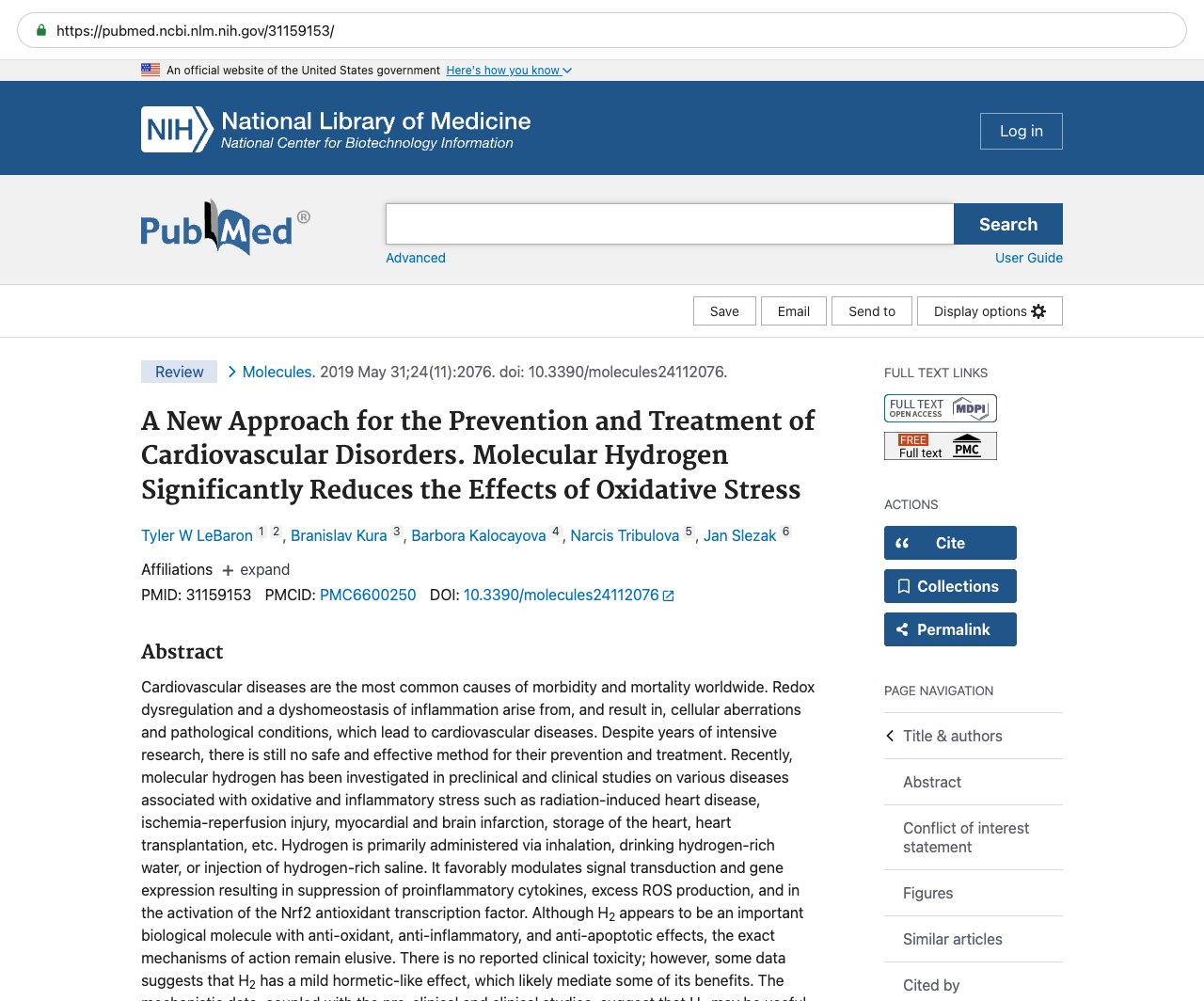
This page mirrors the published abstract (© the authors / publisher) for reference and citation. The canonical source is the PubMed record linked above. This is not medical advice.