2023 · Aokage — Attenuation of pulmonary damage in aged lipopolysaccharide-induced inflammation mice through continuous 2 % hydrogen gas inhalation: A potential therapeutic strategy for geriatric inflammation and survival
Super-Abstract
In aged mice (21–23 months) with LPS-induced systemic inflammation, continuous inhalation of 2 % hydrogen gas for 24 hours reduced lung inflammation, lowered senescence-related markers, and improved survival — while having no measurable effect on LPS-induced liver injury. This is an animal study addressing a geriatric inflammation scenario; results cannot be directly applied to elderly humans.
Commentary
Sepsis disproportionately affects older adults and carries a high mortality rate in this population. Aged mice at 21–23 months represent a reasonable model for the elderly immune system, as they exhibit baseline inflammaging and higher vulnerability to LPS. The study's strength lies in systematically comparing different durations (1 h, 6 h, 24 h) and concentrations (1 %, 2 %) of H₂ inhalation, isolating the 2 % / 24 h regimen as the effective one. Beneficial effects were seen specifically in lung tissue — reduced inflammatory mRNA, suppressed senescence-associated markers (p21, CXCL2, MMP-3, arginase-1) — but not in the liver, which is an important honest negative finding. The differential organ response suggests tissue-specific H₂ sensitivity. The relevance for human geriatric medicine is speculative at this stage and requires clinical investigation.
Key quotes
- „Extended administration of hydrogen gas specifically at a 2 % concentration for 24 h led to a favorable prognosis in the aged mice by reducing mRNA expression of inflammatory biomarkers in lung and liver tissue, mitigating lung injury, and diminishing the expression of the senescence-associated protein p21.“ — specific dose and duration that proved effective
- „Hydrogen gas did not alleviate LPS-induced liver injury under the conditions tested.“ — honest negative finding — liver was not protected
- „Continuous inhalation of hydrogen gas at a 2 % concentration for 24 h can be a potent intervention in the geriatric population for improving survival and physical activity by mitigating pulmonary inflammation.“ — authors' conclusion — extrapolated from aged mice
Our assessment
This aged-mouse study adds nuance to the H₂ inhalation literature by focusing on a geriatric model and by honestly reporting that H₂ did not protect the liver. The pulmonary findings are encouraging, but the translation to elderly human sepsis patients is uncertain. Dose, timing, and physiological differences between aged rodents and elderly humans are substantial. The study is a useful mechanistic stepping-stone, not clinical evidence.
Study design
- Type: controlled animal experiment · Model: aged male mice (21–23 months), LPS-induced inflammation (n = 8 groups of varying size) · H₂ delivery: gas inhalation (1 % or 2 %), durations 1 h / 6 h / 24 h
- Result: 2 % H₂ for 24 h: improved survival; reduced lung inflammatory mRNA; suppressed p21, CXCL2, MMP-3, arginase-1 in lung; no liver protection observed
Abstract
INTRODUCTION: With the global population aging, there is an increased prevalence of sepsis among the elderly, a demographic particularly susceptible to inflammation. This study aimed to evaluate the therapeutic potential of hydrogen gas, known for its anti-inflammatory and antioxidant properties, in attenuating inflammation specifically in the lungs and liver, and age-associated molecular markers in aged mice. METHODS: Male mice aged 21 to 23 months, representative of the human elderly population, were subjected to inflammation via intraperitoneal injection of lipopolysaccharide (LPS). The mice were allocated into eight groups to examine the effects of varying durations and concentrations of hydrogen gas inhalation: control, saline without hydrogen, saline with 24-hour 2 % hydrogen, LPS without hydrogen, LPS with 24-hour 2 % hydrogen, LPS with 6-hour 2 % hydrogen, LPS with 1-hour 2 % hydrogen, and LPS with 24-hour 1 % hydrogen. Parameters assessed included survival rate, activity level, inflammatory biomarkers, and organ injury. RESULTS: Extended administration of hydrogen gas specifically at a 2 % concentration for 24 h led to a favorable prognosis in the aged mice by reducing mRNA expression of inflammatory biomarkers in lung and liver tissue, mitigating lung injury, and diminishing the expression of the senescence-associated protein p21. Moreover, hydrogen gas inhalation selectively ameliorated senescence-related markers in lung tissue, including C-X-C motif chemokine 2, metalloproteinase-3, and arginase-1. Notably, hydrogen gas did not alleviate LPS-induced liver injury under the conditions tested. CONCLUSION: The study highlights that continuous inhalation of hydrogen gas at a 2 % concentration for 24 h can be a potent intervention in the geriatric population for improving survival and physical activity by mitigating pulmonary inflammation and modulating senescence-related markers in aged mice with LPS-induced inflammation. This finding paves the way for future research into hydrogen gas as a therapeutic strategy to alleviate severe inflammation that can lead to organ damage in the elderly.
Source & links
Screenshot of the PubMed page
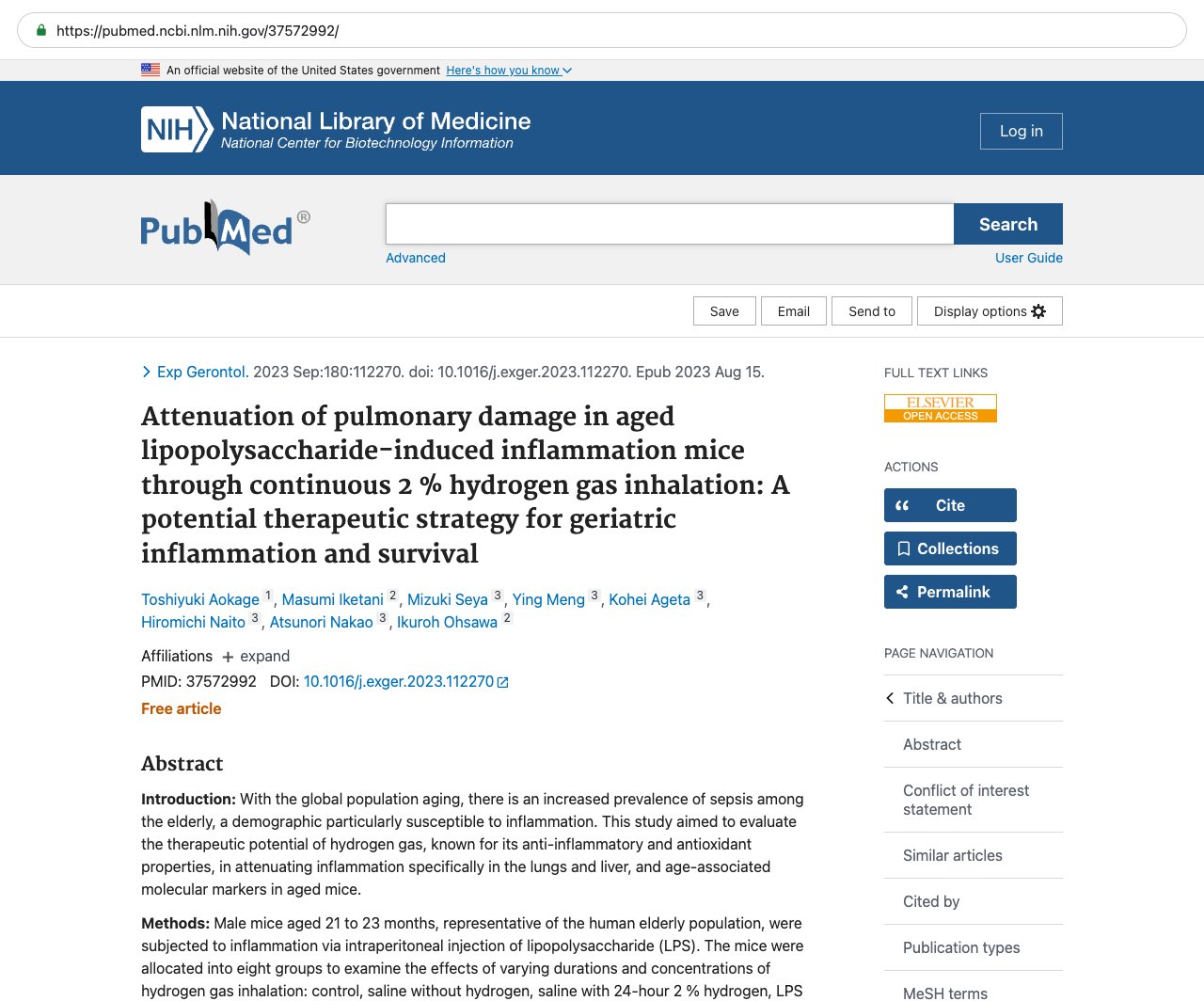
This page mirrors the published abstract (© the authors / publisher) for reference and citation. The canonical source is the PubMed record linked above. This is not medical advice.