2015 · Vogt et al. — Chemical communication in the gut: Effects of microbiota-generated metabolites on gastrointestinal bacterial pathogens.
Super-Abstract
The gut microbiota does not merely occupy space — it actively shapes the chemical environment of the intestine through metabolites that can inhibit or promote bacterial pathogens. This review covers key molecules involved, including short-chain fatty acids, bile acids, and molecular hydrogen (H₂), and how they collectively determine the outcome of gut infections. (Anaerobe, 2015.)
Commentary
Vogt and colleagues synthesize a body of literature on how the resident microbiota acts as a chemical gatekeeper against pathogens such as Salmonella, Clostridium difficile, diarrheagenic Escherichia coli, and Vibrio cholerae. Molecular hydrogen is mentioned as one of several well-studied metabolites that can influence pathogen growth and virulence. The review highlights that most microbiota-produced metabolites are still uncharacterized, meaning this is an emerging field with significant knowledge gaps. It is not a study testing hydrogen therapeutically in animals or humans — rather it is a literature analysis of microbial ecology in the gut.
Key quotes
- „Although most gut microbiota-produced metabolites are currently uncharacterized, several well-studied molecules made or modified by the microbiota are known to affect the growth and virulence of pathogens, including short-chain fatty acids, succinate, mucin O-glycans, molecular hydrogen, secondary bile acids, and the AI-2 quorum sensing autoinducer.“ — H₂ is listed among metabolites with documented influence on pathogen behavior
- „It is well established that a healthy gut microbiota provides its host with protection from numerous pathogens, including Salmonella species, Clostridium difficile, diarrheagenic Escherichia coli, and Vibrio cholerae.“ — the protective role of a healthy microbiome — context for H₂ as part of this system
- „We also discuss challenges and possible approaches to further study of the chemical interplay between microbiota and gastrointestinal pathogens.“ — the authors acknowledge how much remains unknown — an honest research horizon
Our assessment
This is a narrative review of the scientific literature — not a clinical or experimental study on hydrogen therapy. Molecular hydrogen appears as one metabolite among several, discussed in the context of gut microbial ecology. The review is informative for understanding H₂'s natural role in the intestinal environment, but it provides no direct evidence for therapeutic hydrogen use in humans. The breadth of the review is its strength; the absence of new experimental data is its limitation. Most relevant for researchers interested in the intersection of microbiome science and H₂ biology.
Study design
- Type: narrative review · n: n/a (literature analysis) · H₂ delivery: endogenous H₂ produced by intestinal microbiota (no exogenous H₂ intervention studied)
- Result: molecular hydrogen identified as one of several microbiota-derived metabolites with documented effects on pathogen growth and virulence; most microbiota metabolites remain uncharacterized
Abstract
Gastrointestinal pathogens must overcome many obstacles in order to successfully colonize a host, not the least of which is the presence of the gut microbiota, the trillions of commensal microorganisms inhabiting mammals' digestive tracts, and their products. It is well established that a healthy gut microbiota provides its host with protection from numerous pathogens, including Salmonella species, Clostridium difficile, diarrheagenic Escherichia coli, and Vibrio cholerae. Conversely, pathogenic bacteria have evolved mechanisms to establish an infection and thrive in the face of fierce competition from the microbiota for space and nutrients. Here, we review the evidence that gut microbiota-generated metabolites play a key role in determining the outcome of infection by bacterial pathogens. By consuming and transforming dietary and host-produced metabolites, as well as secreting primary and secondary metabolites of their own, the microbiota define the chemical environment of the gut and often determine specific host responses. Although most gut microbiota-produced metabolites are currently uncharacterized, several well-studied molecules made or modified by the microbiota are known to affect the growth and virulence of pathogens, including short-chain fatty acids, succinate, mucin O-glycans, molecular hydrogen, secondary bile acids, and the AI-2 quorum sensing autoinducer. We also discuss challenges and possible approaches to further study of the chemical interplay between microbiota and gastrointestinal pathogens.
Source & links
Screenshot of the PubMed page
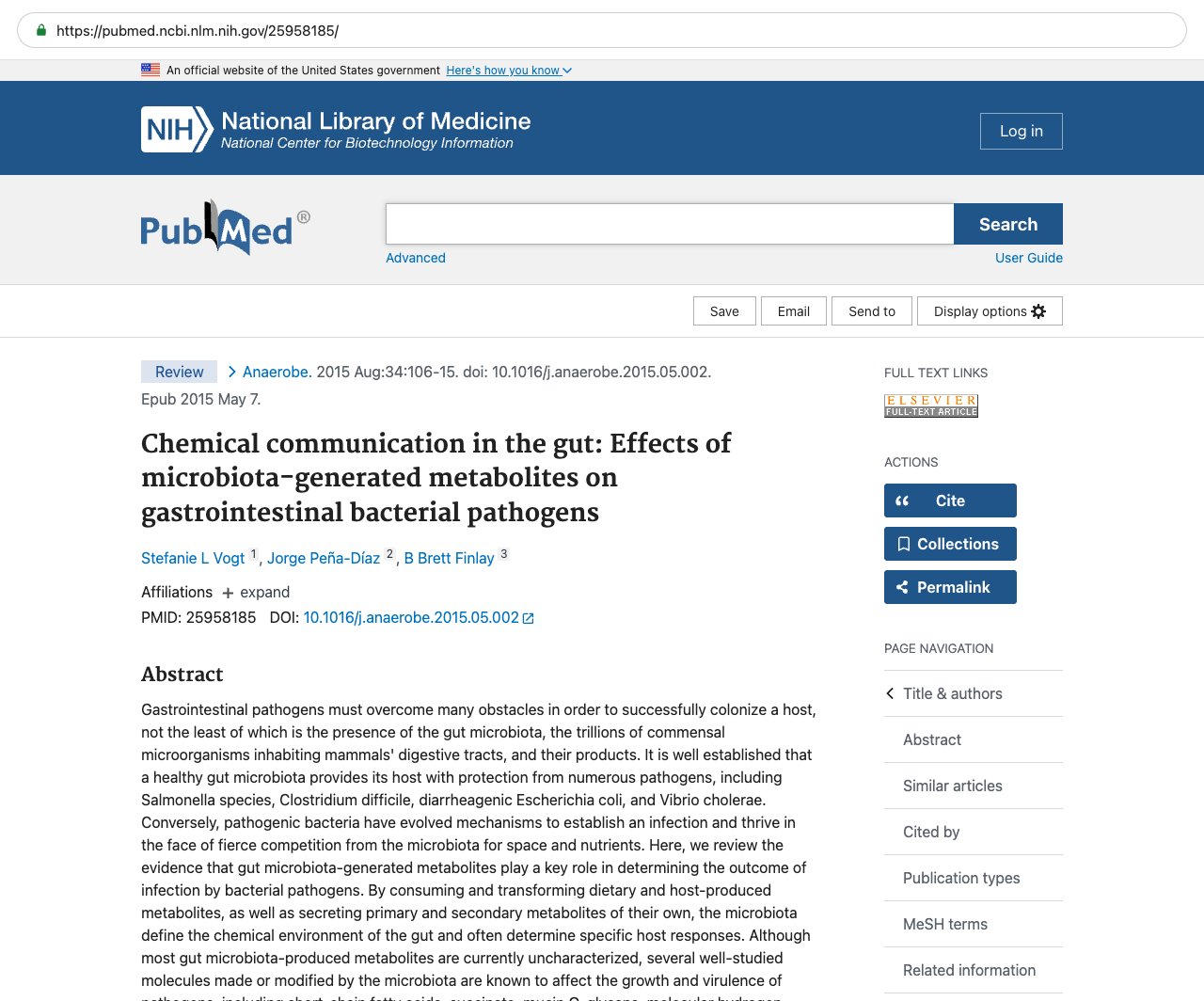
This page mirrors the published abstract (© the authors / publisher) for reference and citation. The canonical source is the PubMed record linked above. This is not medical advice.