2012 · Wang et al. — Binding hot-spots in an antibody-ssDNA interface: a molecular dynamics study.
Super-Abstract
This computational biology study used molecular dynamics simulations to identify key amino acid residues that stabilise the interaction between a lupus-associated antibody and single-stranded DNA (ssDNA). „Hydrogen“ in this study refers exclusively to hydrogen bonds between protein residues and DNA — the fundamental structural force in molecular biology. This is not a molecular hydrogen (H₂) therapy study.
Commentary
The antibody studied here is associated with systemic lupus erythematosus (SLE), where autoantibodies bind to nucleic acids. Understanding the binding interface is relevant to immunology and potential antibody engineering. The study used 605-nanosecond molecular dynamics simulations and free-energy calculation methods (PMF, MM-PBSA) to identify eight key residues and five inter-protein molecular hydrogen bonds critical for antibody-ssDNA affinity. Throughout, „hydrogen bonds“ refers to the weak electrostatic bonds between electronegative atoms (N, O) and hydrogen atoms within proteins and DNA — a ubiquitous concept in structural biology, not related to molecular H₂ gas or H₂ therapy in any way. This paper appears in the H₂ database due to keyword indexing of „molecular hydrogen bonds“ — it has no relevance to therapeutic H₂.
Key quotes
- „the 8 residues (i.e. Gly44 (HCDR2), Asn54 (HCDR2), Arg98 (HCDR3), Tyr100 (HCDR3), Asp101 (HCDR3), Tyr32 (LCDR1), Tyr49 (LCDR2) and Nef50 (LCDR2)), and the five inter-protein molecular hydrogen bonds may profoundly impact the antibody-ssDNA interaction.“ — key finding: specific residues and H-bonds stabilise the lupus antibody-DNA complex
- „Our dissociation binding affinity is 7.96 ± 0.33 kcal mol(-1) and MM-PBSA binding affinity is 9.12 ± 1.65 kcal mol(-1), which is close to the experimental value.“ — computational validation: simulated binding affinity matches experimental measurement
- „the 8 residues may play a more significant role in developing bioactive antibody analogues.“ — applied implication: potential use in antibody engineering for lupus
Our assessment
This is a computational structural biology study with no connection to molecular hydrogen therapy. The term „molecular hydrogen bonds“ refers to classical H-bond interactions in protein-DNA interfaces — unrelated to H₂ gas or its biological or medical effects. Honest note: this paper is indexed here due to keyword overlap. Its findings are relevant to lupus autoantibody biology and protein engineering, not to H₂ medicine.
Study design
- Type: computational in-vitro study · Method: molecular dynamics simulation (605 ns), potential of mean force (PMF), MM-PBSA free energy calculations · Subject: SLE antibody–ssDNA complex interaction
- H₂ relevance: none — „molecular hydrogen bonds“ refers to structural protein-DNA H-bonds, not to molecular H₂ gas or therapy
- Result: 8 key residues and 5 intermolecular H-bonds identified as critical for antibody-ssDNA affinity; computational binding affinity matches experimental values
Abstract
Simulating antigen-antibody interactions is essential for elucidating antigen-antibody mechanics. Proteins interactions are vital for elucidating antibody-ssDNA associations in immunology. Therefore, this study investigated the dissociation of the human systemic lupus erythematosus antibody-ssDNA complex structure. Dissociation (i.e. the distance between the center of mass of the ssDNA and the antibody) is also studied using the potential of mean force calculations based on molecular dynamics and the explicit water model. The MM-PBSA method is also used to prove our dissociation simulations. With 605 nanosecond molecular dynamics simulations, the results indicate that the 8 residues (i.e. Gly44 (HCDR2), Asn54 (HCDR2), Arg98 (HCDR3), Tyr100 (HCDR3), Asp101 (HCDR3), Tyr32 (LCDR1), Tyr49 (LCDR2) and Asn50 (LCDR2)), and the five inter-protein molecular hydrogen bonds may profoundly impact the antibody-ssDNA interaction, a finding which may be useful for protein engineering of this antibody-ssDNA structure. Experimental binding affinity of this antibody-ssDNA complex equals 7.00 kcal mol(-1). Our dissociation binding affinity is 7.96 ± 0.33 kcal mol(-1) and MM-PBSA binding affinity is 9.12 ± 1.65 kcal mol(-1), which is close to the experimental value. Additionally, the 8 residues Gly44 (HCDR2), Asn54 (HCDR2), Arg98 (HCDR3), Tyr100 (HCDR3), Asp101 (HCDR3), Tyr32 (LCDR1), Tyr49 (LCDR2) and Asn50 (LCDR2) may play a more significant role in developing bioactive antibody analogues.
Source & links
Screenshot of the PubMed page
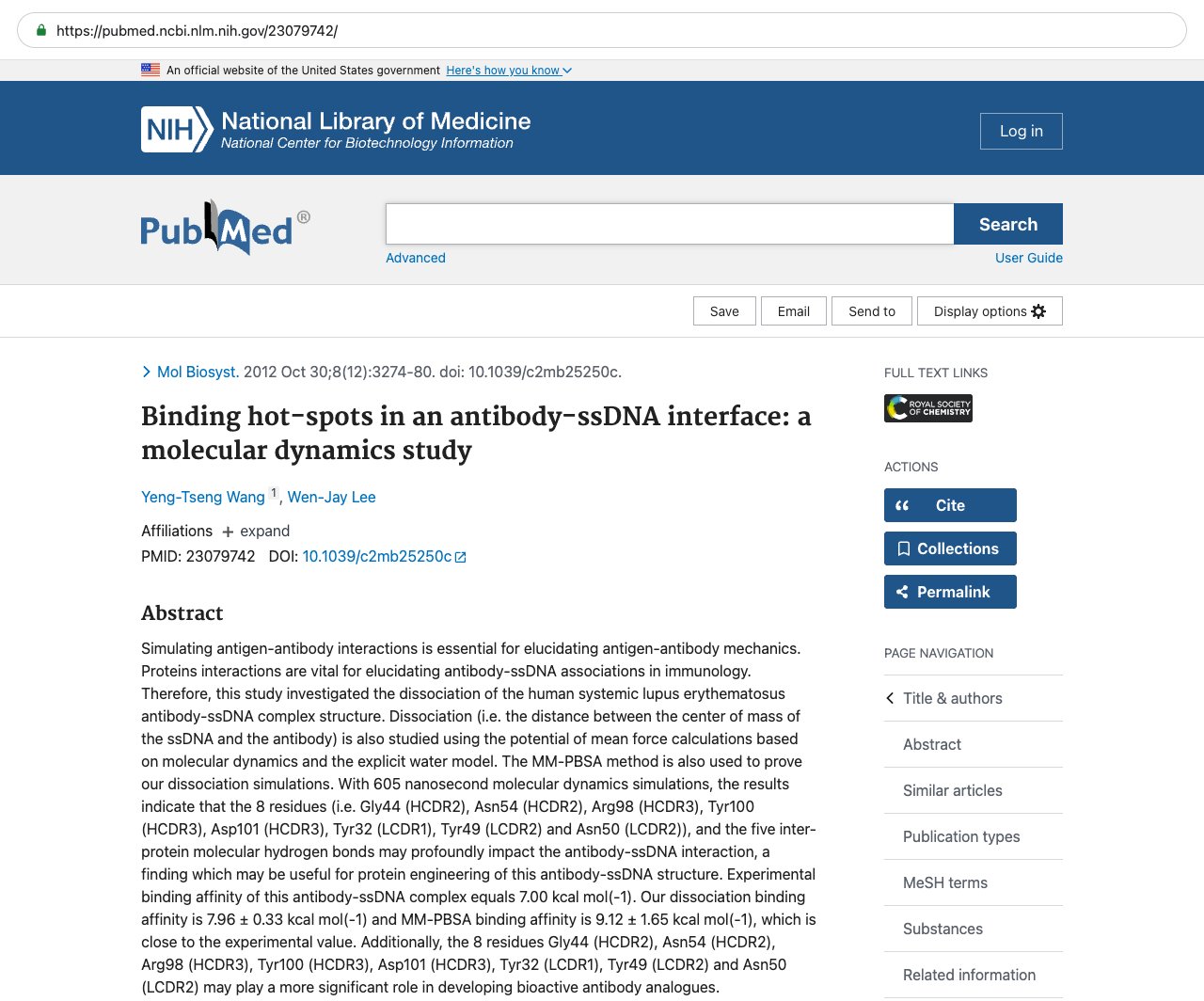
This page mirrors the published abstract (© the authors / publisher) for reference and citation. The canonical source is the PubMed record linked above. This is not medical advice.