2020 FASEB journal : official publication of the Federation of American Societies for Experimental Biology Mechanism / Preclinical Saline / IV
2020 · Lu — Molecular hydrogen regulates PTEN-AKT-mTOR signaling via ROS to alleviate peritoneal dialysis-related peritoneal fibrosis.
Super-Abstract
In mice treated with high-glucose dialysate to induce peritoneal fibrosis, and in MeT-5A mesothelial cells in culture, hydrogen-rich peritoneal dialysate inhibited fibrosis by eliminating intracellular reactive oxygen species (ROS) and suppressing the PTEN/AKT/mTOR signalling pathway. These results are encouraging for dialysis patients at risk of peritoneal fibrosis, but remain animal and cell-culture findings — no human data are provided.
Commentary
Peritoneal dialysis is a lifesaving therapy for about 11% of end-stage renal disease patients worldwide, but long-term use damages the peritoneal membrane through fibrosis — a major clinical problem. This study tests whether hydrogen-enriched dialysate can prevent this damage. Using a well-characterised mouse model (intraperitoneal high-glucose dialysate) and parallel MeT-5A cell experiments, the authors show that molecular hydrogen scavenges ROS and, by doing so, deactivates the PTEN/AKT/mTOR fibrotic cascade. The dual in-vivo/in-vitro design strengthens the mechanistic argument. The practical angle is particularly interesting: hydrogen can be dissolved in the dialysate itself, making delivery technically feasible in clinical dialysis. Limitations: the mouse model uses exogenous high-glucose dialysate — a reasonable but simplified proxy for chronic peritoneal dialysis; and MeT-5A is a transformed human cell line, not primary mesothelial cells.
Key quotes
- „molecular hydrogen could inhibit peritoneal fibrosis progress induced by high glucose effectively.“ — core finding in both mouse model and cell culture
- „molecular hydrogen alleviate fibrosis by eliminating intracellular ROS and inhibiting the activation of the PTEN/AKT/mTOR pathway.“ — mechanism: ROS scavenging → pathway suppression → reduced fibrosis
- „molecule hydrogen is a potential, safe, and effective treatment agent, with peritoneal protective property and great clinical significance.“ — authors' conclusion — promising but requires clinical validation
Our assessment
This is an animal + cell-culture (in-vitro) study — not a clinical trial. The mechanism is plausible and the delivery route (H₂ dissolved in dialysate) is clinically relevant. Limitations: the mouse model and MeT-5A cells are simplified; chronic human peritoneal dialysis involves complex biological changes not captured here. The authors' claim of „great clinical significance“ is premature without human data. This is hypothesis-generating and mechanistically credible, but no clinical conclusions for dialysis patients can be drawn.
Study design
- Type: animal study (in-vivo) + cell study (in-vitro) · Model: mice with high-glucose peritoneal dialysate (ESRD fibrosis model); MeT-5A human mesothelial cells · H₂ delivery: hydrogen-rich peritoneal dialysate (mice); hydrogen-rich saline IV context (cells)
- Outcome: H₂-rich dialysate inhibited peritoneal fibrosis markers in-vivo; in MeT-5A cells: reduced intracellular ROS, suppressed PTEN/AKT/mTOR activation, decreased fibrotic protein expression
Abstract
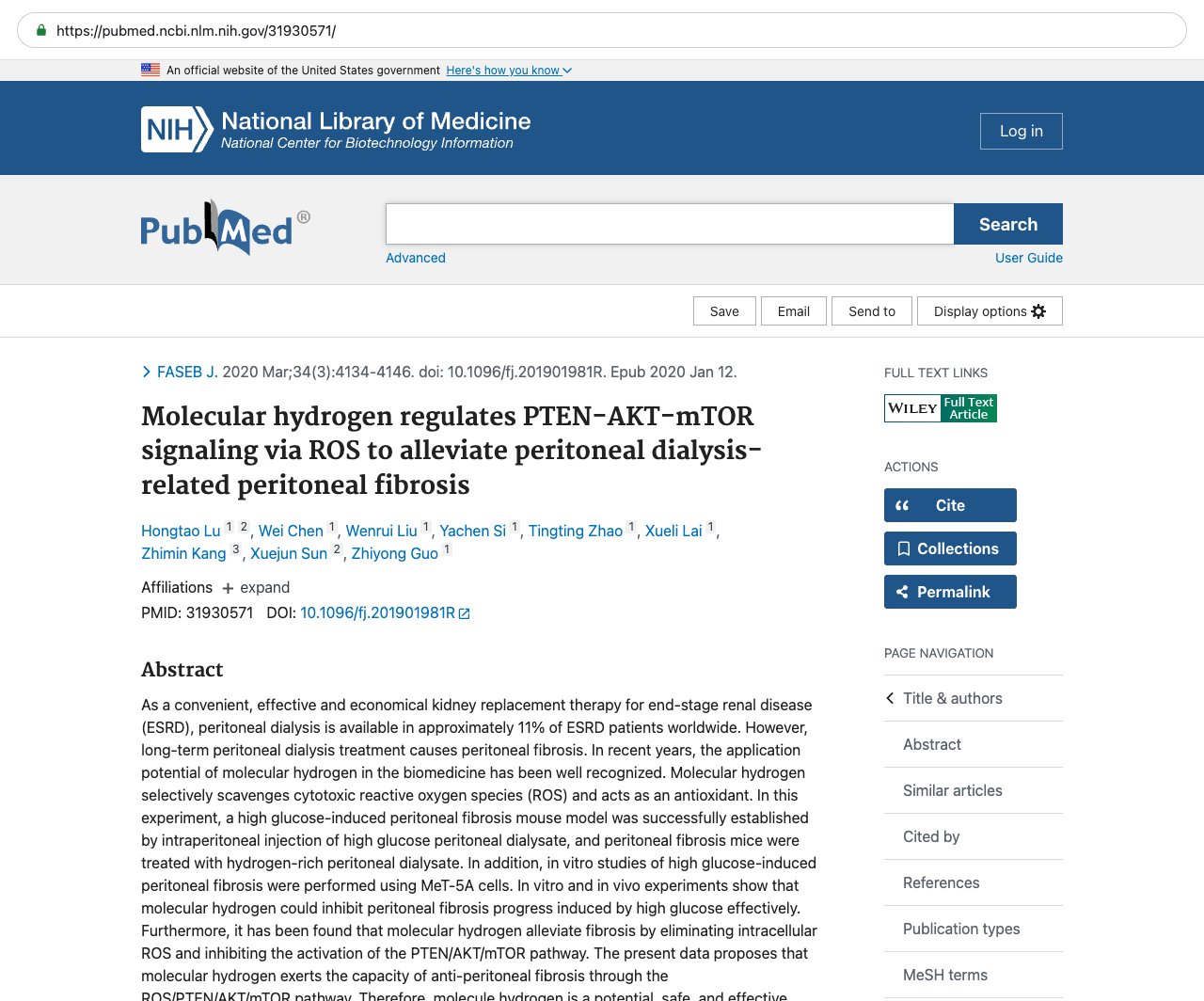
As a convenient, effective and economical kidney replacement therapy for end-stage renal disease (ESRD), peritoneal dialysis is available in approximately 11% of ESRD patients worldwide. However, long-term peritoneal dialysis treatment causes peritoneal fibrosis. In recent years, the application potential of molecular hydrogen in the biomedicine has been well recognized. Molecular hydrogen selectively scavenges cytotoxic reactive oxygen species (ROS) and acts as an antioxidant. In this experiment, a high glucose-induced peritoneal fibrosis mouse model was successfully established by intraperitoneal injection of high glucose peritoneal dialysate, and peritoneal fibrosis mice were treated with hydrogen-rich peritoneal dialysate. In addition, in vitro studies of high glucose-induced peritoneal fibrosis were performed using MeT-5A cells. In vitro and in vivo experiments show that molecular hydrogen could inhibit peritoneal fibrosis progress induced by high glucose effectively. Furthermore, it has been found that molecular hydrogen alleviate fibrosis by eliminating intracellular ROS and inhibiting the activation of the PTEN/AKT/mTOR pathway. The present data proposes that molecular hydrogen exerts the capacity of anti-peritoneal fibrosis through the ROS/PTEN/AKT/mTOR pathway. Therefore, molecule hydrogen is a potential, safe, and effective treatment agent, with peritoneal protective property and great clinical significance.
Source & links
Screenshot of the PubMed page
This page mirrors the published abstract (© the authors / publisher) for reference and citation. The canonical source is the PubMed record linked above. This is not medical advice.