2018 [Zhonghua yan ke za zhi] Chinese journal of ophthalmology Review / Meta-analysis Saline / IVDrinking (HRW)
2018 · Chen — Research progress of hydrogen-rich saline for eye diseases.
Super-Abstract
This Chinese-language review summarizes the published research on hydrogen-rich saline (and hydrogen-rich water) for the treatment of eye diseases, including glaucoma, retinal ischemia, and other ocular conditions. The authors note that while H₂ has shown positive results in nervous, digestive, respiratory, cardiac, and renal disease research, ophthalmology-specific studies remain sparse. (Chinese Journal of Ophthalmology, 2018.)
Commentary
This is a brief narrative review published in a Chinese ophthalmology journal. It synthesizes the available preclinical and limited clinical evidence for H₂-based interventions in ocular disease. The rationale is sound: the eye is highly susceptible to oxidative stress (retinal cells have extremely high metabolic rates and oxygen consumption), and conditions like glaucomatous optic neuropathy, diabetic retinopathy, and ischemia-reperfusion retinal injury all have oxidative stress as a central mechanism. H₂'s selective antioxidant properties could therefore theoretically be relevant. However, the review itself acknowledges the paucity of ophthalmological research. The abstract is brief and does not list the specific studies evaluated, making quality assessment of the underlying evidence difficult. This is best understood as a field orientation paper for Chinese ophthalmologists, not a systematic review with pooled effect sizes.
Key quotes
- „Hydrogen-rich water has achieved good results in nervous system, digestive system, respiratory system, heart and kidney diseases.“ — scope of existing H₂ evidence: multiple non-ocular disease areas
- „At present, there are few studies on the treatment of eye diseases with hydrogen-rich water.“ — honest statement of the evidence gap in ophthalmology
- „This review summarizes the research progress of hydrogen-rich water for eye diseases in the domestic and foreign literatures.“ — scope and purpose of the review
Our assessment
This is a narrative review — it synthesizes preclinical and limited clinical evidence for H₂ in ocular disease, but does not provide new experimental data. The review explicitly acknowledges that ophthalmological H₂ research is sparse compared to other disease areas. No systematic search strategy or inclusion criteria are described in the available abstract. The level of evidence is low (narrative review of heterogeneous preclinical and early clinical literature), and the paper should be read as a field-orientation summary rather than strong clinical evidence. No treatment conclusions can be drawn for human eye diseases.
Study design
- Type: narrative review · Topic: hydrogen-rich saline/water interventions in ocular diseases (glaucoma, retinal ischemia, and other conditions) · H₂ delivery routes covered: hydrogen-rich saline injection, hydrogen-rich water
- Result: no new experimental data; qualitative summary of existing preclinical and limited clinical H₂ studies in ophthalmology; conclusion: evidence base is thin compared to other organ systems; field is in early stage
Abstract
As an antioxidant, hydrogen-rich water has been widely studied in recent years. It is mild enough neither to disturb metabolic redox reactions nor to affect signaling reactive oxygen species. Therefore, there should be no or few adverse effects of H(2). Numerous studies in biology and medicine show that hydrogen-rich water has achieved good results in nervous system, digestive system, respiratory system, heart and kidney diseases. At present, there are few studies on the treatment of eye diseases with hydrogen-rich water. This review summarizes the research progress of hydrogen-rich water for eye diseases in the domestic and foreign literatures. (Chin J Ophthalmol, 2018, 54: 631-635).
Source & links
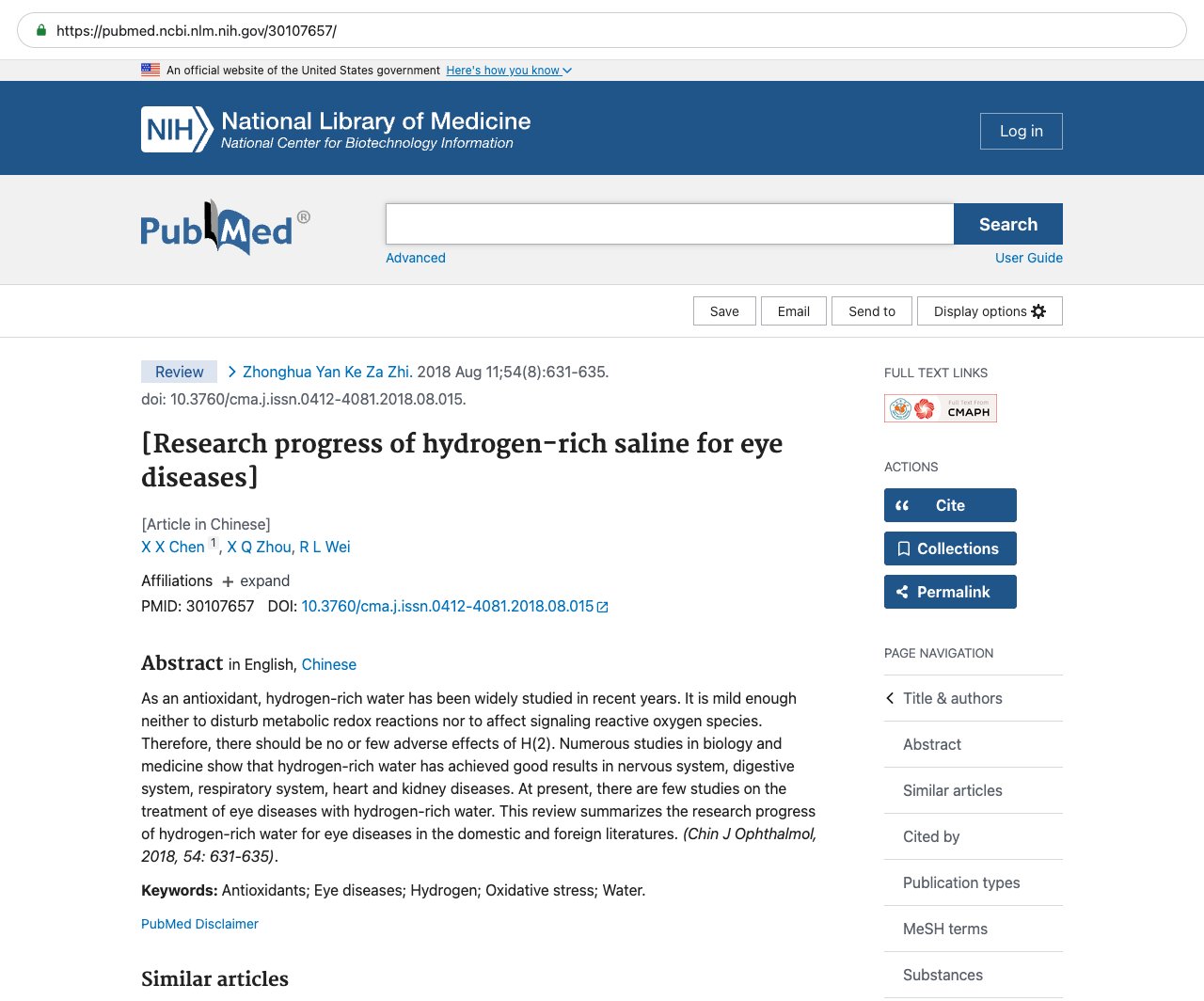
Screenshot of the PubMed page
This page mirrors the published abstract (© the authors / publisher) for reference and citation. The canonical source is the PubMed record linked above. This is not medical advice.