2016 · Du — Hydrogen-Rich Saline Attenuates Acute Kidney Injury After Liver Transplantation via Activating p53-Mediated Autophagy
Super-Abstract
In rats undergoing liver transplantation, hydrogen-rich saline (HRS) protected the kidneys from acute injury by reducing oxidative damage and cell death, with p53-mediated autophagy as a key mechanism. Blocking autophagy reversed H₂'s kidney-protective effect, confirming the pathway's importance. This is a preclinical animal study; no human transplant data exist. (Transplantation, 2016.)
Commentary
Acute kidney injury (AKI) is a serious and relatively common complication after orthotopic liver transplantation (OLT), yet its mechanisms and effective treatments remain incompletely understood. Du et al. used a rat OLT model with four groups: sham operation, OLT alone, OLT plus HRS pretreatment (6 ml/kg), and OLT plus HRS and the autophagy inhibitor chloroquine. Samples were taken 6 hours after reperfusion. HRS dramatically reduced histopathological kidney damage, restored renal function biomarkers, and decreased oxidative stress indices. It also reduced apoptosis (caspase-3, cytochrome c). Crucially, HRS upregulated the autophagy machinery (Beclin-1, LC3-II) while reducing p62 and LAMP-2 — a pattern indicating enhanced autophagic flux. The phosphorylation of p53 appeared central to this autophagy induction. When chloroquine blocked autophagy, HRS's kidney-protective benefits were lost — causally linking the pathway to the effect. The study design is rigorous for an animal model, but the leap to human OLT settings is large.
Key quotes
- „HRS dramatically attenuated the histopathologic damage, restored the renal function, and decreased the oxidative stress level.“ — primary functional and morphological outcomes in the rat model
- „The inhibition of autophagy by chloroquine counteracted the renoprotective effects of HRS.“ — causal evidence linking p53-mediated autophagy to H₂'s kidney protection
- „HRS is able to protect against AKI after liver transplantation partly by reducing apoptosis, which is possibly involved in the modulation of p53-mediated autophagy.“ — authors' mechanistic conclusion
Our assessment
This is a preclinical rat study — no human data. It is mechanistically detailed and well-controlled, identifying a specific signaling route (p53 → autophagy induction → anti-apoptosis → kidney protection) that H₂-rich saline appears to engage after liver transplantation. The chloroquine rescue experiment strengthens the causal claim. Limitations include: single species, single time point (6 hours), intraperitoneal saline administration (not how H₂ would be given clinically), and no dose-response data. AKI after liver transplantation in humans is multifactorial and the pathophysiology differs substantially from rat models. Clinical translation requires dedicated human safety and efficacy trials.
Study design
- Type: animal study (in vivo, rat orthotopic liver transplantation model) · Model: adult male Sprague-Dawley rats, 4 groups (sham, OLT, OLT+HRS, OLT+HRS+chloroquine) · H₂ delivery: hydrogen-rich saline 6 ml/kg i.p. pretreatment before reperfusion
- Result: HRS restored renal histology and function, reduced oxidative stress, reduced apoptosis (↓caspase-3/cytochrome c), enhanced autophagic flux (↑Beclin-1, ↑LC3-II, ↓p62, ↓LAMP-2) via p53 phosphorylation; chloroquine abolished HRS kidney protection — all in a rat model 6 h post-reperfusion
Abstract
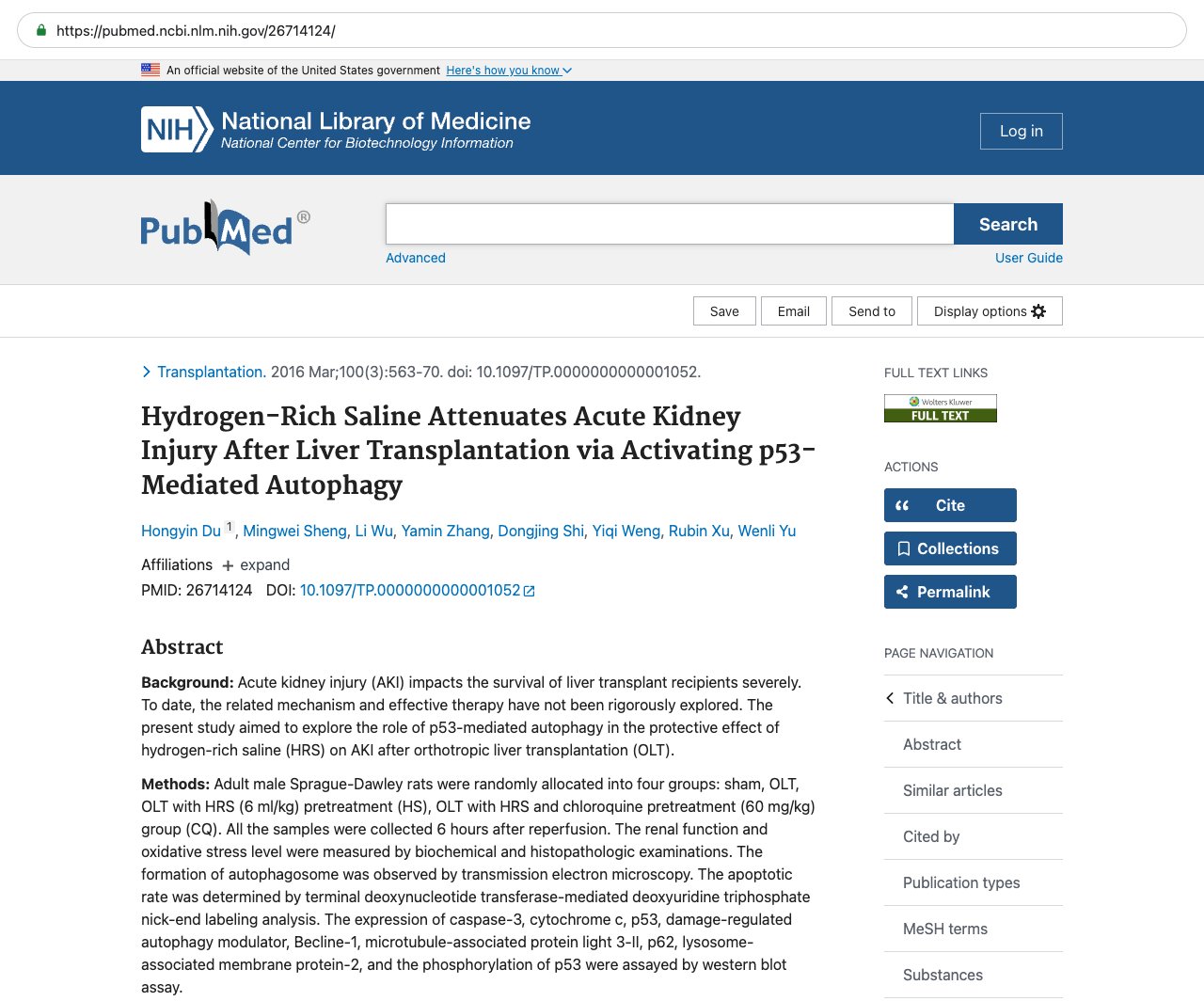
BACKGROUND: Acute kidney injury (AKI) impacts the survival of liver transplant recipients severely. To date, the related mechanism and effective therapy have not been rigorously explored. The present study aimed to explore the role of p53-mediated autophagy in the protective effect of hydrogen-rich saline (HRS) on AKI after orthotropic liver transplantation (OLT). METHODS: Adult male Sprague-Dawley rats were randomly allocated into four groups: sham, OLT, OLT with HRS (6 ml/kg) pretreatment (HS), OLT with HRS and chloroquine pretreatment (60 mg/kg) group (CQ). All the samples were collected 6 hours after reperfusion. The renal function and oxidative stress level were measured by biochemical and histopathologic examinations. The formation of autophagosome was observed by transmission electron microscopy. The apoptotic rate was determined by terminal deoxynucleotide transferase-mediated deoxyuridine triphosphate nick-end labeling analysis. The expression of caspase-3, cytochrome c, p53, damage-regulated autophagy modulator, Becline-1, microtubule-associated protein light 3-II, p62, lysosome-associated membrane protein-2, and the phosphorylation of p53 were assayed by western blot assay. RESULTS: Compared with the OLT group, HRS dramatically attenuated the histopathologic damage, restored the renal function, and decreased the oxidative stress level. Simultaneously, HRS significantly ameliorated apoptosis by decreasing the apoptotic rate and inhibiting the expression of caspase-3 and cytochrome c in rats subjected to OLT. The expression of Becline-1 and microtubule-associated protein light 3-II were upregulated with the inhibition of p62 and lysosome-associated membrane protein-2. The inhibition of autophagy by chloroquine counteracted the renoprotective effects of HRS. CONCLUSIONS: HRS is able to protect against AKI after liver transplantation partly by reducing apoptosis, which is possibly involved in the modulation of p53-mediated autophagy.
Source & links
Screenshot of the PubMed page
This page mirrors the published abstract (© the authors / publisher) for reference and citation. The canonical source is the PubMed record linked above. This is not medical advice.