2025 · Wang — Effect of hydrogen-rich saline on melanopsin after acute blue light-induced retinal damage in rats
Super-Abstract
Hydrogen protects the retina from blue light: In rats with blue-light-induced retinal damage, hydrogen-rich saline (HRS) accelerated recovery — with markedly more melanopsin and more functional light-sensitive ganglion cells within two weeks. (Photochemistry and Photobiology, 2025.)
Commentary
Excessive blue light — for example from screens — can damage the retina. This study investigated a special cell type: the intrinsically photosensitive retinal ganglion cells (ipRGCs), which carry the light pigment melanopsin and, among other things, control the day-night rhythm. Rats were exposed to blue light for 48 hours and then treated with hydrogen-rich saline (HRS) for 0, 3, 7 and 14 days. Measurement used qRT-PCR and Western blot (genes/proteins), pattern ERG (function of the ipRGCs) and immunofluorescence (number and shape of the melanopsin cells). The blue light initially lowered function, melanopsin protein and cell count. Remarkably: even without treatment, melanopsin recovered on its own over time — but incompletely within two weeks. HRS accelerated this recovery markedly: more melanopsin, more melanopsin-positive ganglion cells and a better pERG curve. Staying honest: this is a <strong>preclinical rat study</strong> with qualitative to semi-quantitative endpoints; the abstract gives no exact percentages or p-values.
Key quotes
- „Acute blue light exposure caused a decrease in ipRGC function, decreased expression of melanopsin protein and the melanopsin-positive RGCs, and diminished immunoreactivity in dendrites.“ — the damage picture from blue light
- „over time, melanopsin showed a tendency to self-recovery … with incomplete recovery of function within two weeks.“ — the important control: partly spontaneous recovery
- „HRS treatment accelerated the recovery process, with a significant increase in melanopsin expression and the number of melanopsin-positive RGCs, and an improvement in the pERG waveform within two weeks.“ — the actual H₂ effect: accelerated recovery
Our assessment
A clean mechanistic study on an everyday stimulus (blue light) on a defined cell type of the retina. The strength is that the authors carry along the spontaneous self-recovery as a comparison — so the HRS benefit is the acceleration versus the natural course, not a restoration from nothing. Notable for translation to humans: the delivery form here is H₂-rich saline (intraperitoneal/injectable in the animal model), not orally administered H₂ water. Limitation, stated honestly: purely preclinical (rat), abstract without hard numbers/p-values, narrow indication window; no statement about vision improvement in humans.
Study design
- Type: preclinical (rats, blue-light-induced retinal damage) · n: animal model (number in the full text) · Duration: 48 h blue light + treatment over 0/3/7/14 days · H₂ delivery: hydrogen-rich saline (HRS)
- Result figures: significantly increased melanopsin expression, more melanopsin-positive RGCs, improved pERG waveform under HRS vs. natural course (abstract without exact figures)
Abstract
Excessive exposure to blue light can cause retinal damage. Hydrogen-rich saline (HRS), one of the hydrogen therapies, has been demonstrated to be effective in eye photodamage, but the effect on the expression of melanopsin in intrinsically photosensitive retinal ganglion cells (ipRGCs) is unknown. In this study, we used a rat model of light-induced retinal injury to observe the expression of melanopsin after HRS treatment and to determine the effect of HRS on retinal ganglion cell protection. Adult SD rats were exposed to blue light (48 h) and treated with HRS for 0, 3, 7, and 14 days. Real-time polymerase chain reaction (qRT-PCR) and Western blotting (WB) were performed to find the expression of genes and proteins, respectively. The function of retinal ipRGCs was measured by pattern-evoked electroretinography (pERG). The number and morphological changes of melanopsin-positive ganglion cells in the retina were observed by immunofluorescence (IF). Acute blue light exposure caused a decrease in ipRGC function, decreased expression of melanopsin protein and the melanopsin-positive RGCs, and diminished immunoreactivity in dendrites. However, over time, melanopsin showed a tendency to self-recovery, with an increase in melanopsin protein expression and the number of melanopsin-positive RGCs, with incomplete recovery of function within two weeks. HRS treatment accelerated the recovery process, with a significant increase in melanopsin expression and the number of melanopsin-positive RGCs, and an improvement in the pERG waveform within two weeks.
Source & links
Screenshot of the PubMed page
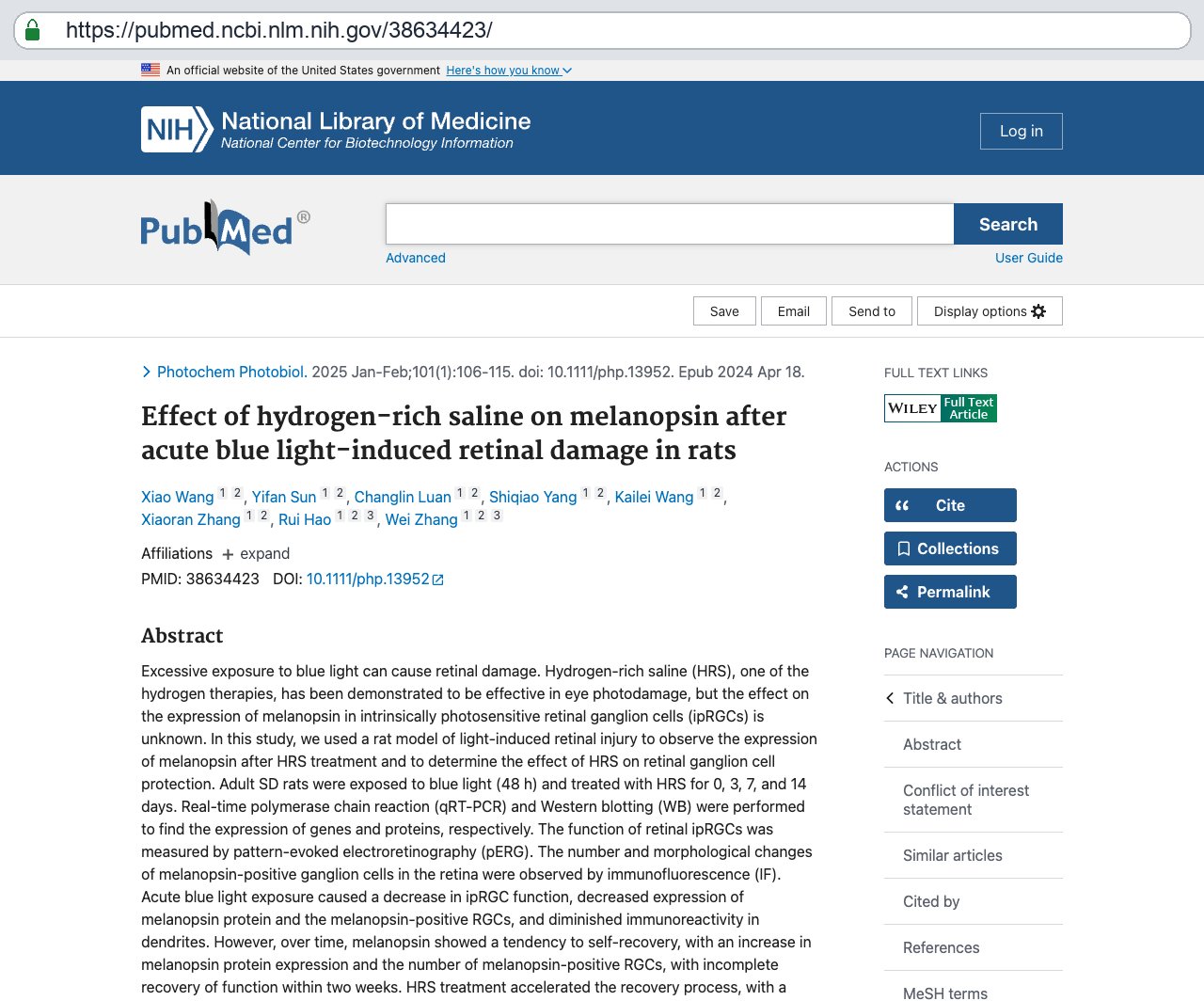
This page mirrors the published abstract (© the authors / publisher) for reference and citation. The canonical source is the PubMed record linked above. This is not medical advice.