2018 · Nakayama — Translational Research of Peritoneal Dialysis Solution with Dissolved Molecular Hydrogen
Super-Abstract
Adding molecular hydrogen to peritoneal dialysis solution (PDS) protected the peritoneal membrane in a chronic kidney disease rat model, and a small 2-week human pilot (n=6 dialysis patients) found it safe and feasible. Markers of mesothelial regeneration (CA125, mesothelin) increased in some patients, suggesting a biological effect. This is early translational research; definitive clinical evidence of benefit does not yet exist. (Contributions to Nephrology, 2018.)
Commentary
Nakayama and colleagues bridge animal and human data in a single paper, which is relatively uncommon at this stage of H₂ research. The rat CKD experiment shows improved peritoneal membrane histology: more mesothelial cells, less peritoneal thickening, reduced vimentin/apoptosis markers in H₂-PDS vs. standard PDS groups. The 6-patient clinical pilot is small and lacks a control arm, but it demonstrates safety and shows increases in CA125 and mesothelin in the dialysis effluent — proteins produced by healthy mesothelial cells — in selected cases. The paper is candid that this is a feasibility study for future trials, not a demonstration of efficacy. The clinical significance of surrogate marker changes without hard clinical endpoints (peritoneal function, EPS prevention) remains unclear.
Key quotes
- „Histological study revealed a significant increase in the number of mesothelial cells and a significant decrease in peritoneal thickness in the H2-PD group as compared to the control and PD groups.“ — animal result: H₂-enriched dialysate protects the peritoneal membrane structurally
- „In the clinical trial with 6 prevalent PD patients, all subjects completed the study with no adverse effects.“ — human safety signal — small but important for the translational pathway
- „H2-enriched PDS is a candidate novel PDS with improved biocompatibility. Further, our results support the significance of H2-PD clinical trials in the future.“ — cautious, forward-looking conclusion
Our assessment
A promising translational study that combines preclinical mechanistic data with a first-in-human feasibility signal. The peritoneal membrane is indeed at risk from long-term PDS exposure, and improved biocompatibility would be a clinically meaningful goal. Limitations: the clinical arm is n=6, uncontrolled, and very short (2 weeks); hard endpoints (technique survival, ultrafiltration capacity, EPS incidence) were not assessed; surrogate marker changes are interesting but not yet clinically validated. This work supports the rationale for larger randomised trials, but does not yet establish clinical efficacy in human dialysis patients.
Study design
- Type: combined animal + human feasibility study · Animal model: CKD rats, subcutaneous PDS infusion 3 weeks · Human arm: 6 prevalent PD patients, 2 weeks H₂-PDS replacing standard PDS (uncontrolled pilot)
- H₂ delivery: H₂-dissolved in commercially available neutral-pH peritoneal dialysis solution · Animal endpoints: histology, immunostaining (vimentin, apoptosis)
- Human endpoints: safety, CA125 and mesothelin in dialysis effluent · Result: improved peritoneal membrane histology in rats; no adverse events in humans; CA125/mesothelin increases in selected patients
Abstract
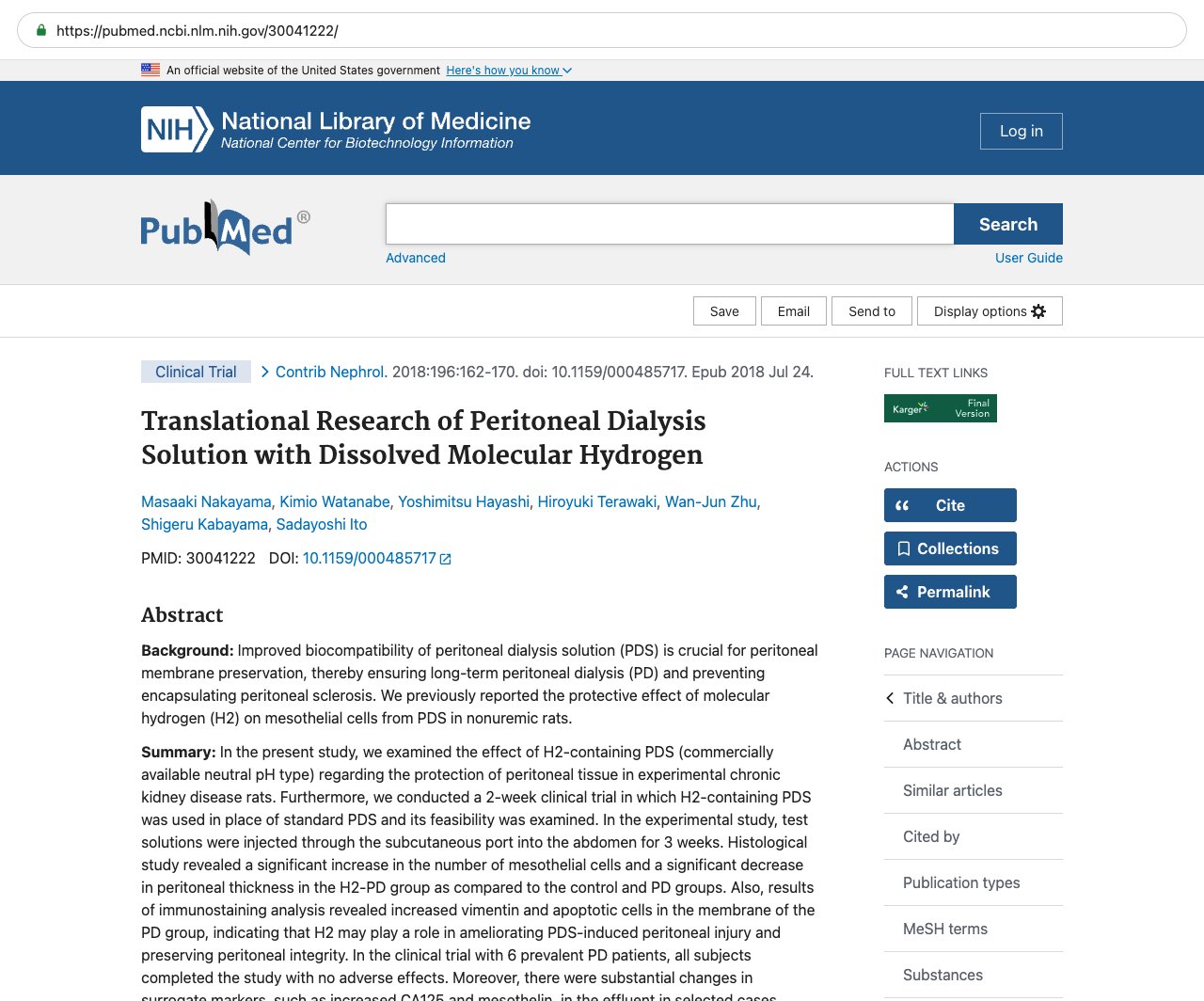
BACKGROUND: Improved biocompatibility of peritoneal dialysis solution (PDS) is crucial for peritoneal membrane preservation, thereby ensuring long-term peritoneal dialysis (PD) and preventing encapsulating peritoneal sclerosis. We previously reported the protective effect of molecular hydrogen (H2) on mesothelial cells from PDS in nonuremic rats. SUMMARY: In the present study, we examined the effect of H2-containing PDS (commercially available neutral pH type) regarding the protection of peritoneal tissue in experimental chronic kidney disease rats. Furthermore, we conducted a 2-week clinical trial in which H2-containing PDS was used in place of standard PDS and its feasibility was examined. In the experimental study, test solutions were injected through the subcutaneous port into the abdomen for 3 weeks. Histological study revealed a significant increase in the number of mesothelial cells and a significant decrease in peritoneal thickness in the H2-PD group as compared to the control and PD groups. Also, results of immunostaining analysis revealed increased vimentin and apoptotic cells in the membrane of the PD group, indicating that H2 may play a role in ameliorating PDS-induced peritoneal injury and preserving peritoneal integrity. In the clinical trial with 6 prevalent PD patients, all subjects completed the study with no adverse effects. Moreover, there were substantial changes in surrogate markers, such as increased CA125 and mesothelin, in the effluent in selected cases, suggesting enhanced mesothelial regeneration by H2. Key Message: H2-enriched PDS is a candidate novel PDS with improved biocompatibility. Further, our results support the significance of H2-PD clinical trials in the future.
Source & links
Screenshot of the PubMed page
This page mirrors the published abstract (© the authors / publisher) for reference and citation. The canonical source is the PubMed record linked above. This is not medical advice.