2026 Wiadomosci lekarskie (Warsaw, Poland : 1960) Pilot / Observational Human H₂ therapy Drinking (HRW)
2026 · Pesotskaya — Hydration Bioanalyses of the Effects of Hydrogen-Rich Water (HRW)
Super-Abstract
Twenty-one days of daily hydrogen-rich water intake in healthy volunteers produced statistically significant decreases in hematocrit and blood viscosity, and reduced urine osmolality — all consistent with improved systemic hydration. No signs of red blood cell abnormalities were observed. The study is small (n=10) and uses a device-specific hydrogen preparation, but represents one of the few human studies directly measuring hydration biomarkers with HRW. (Wiadomosci lekarskie, 2026.)
Commentary
This small pilot study addresses a frequently discussed but rarely tested question: does hydrogen-rich water improve hydration beyond regular water? The investigators measured three hydration proxies — hematocrit, blood viscosity, and urine osmolality — in 10 healthy volunteers over 21 days of HRW consumption. All three markers shifted in the direction consistent with better hydration. The device used (Hydrogen Evodrop Water, 900–1200 ppb H₂, ORP −450 to −580 mV, pH 7.1–7.3) is a commercial preparation, which is worth noting since results may not generalize to other H₂ delivery methods. The study has no control arm and no blinding — volunteers knew they were drinking HRW. The gender difference in baseline urine osmolality (higher in men) is an interesting observation but was not a primary endpoint. The journal (Wiadomosci lekarskie) is a Polish medical journal with limited impact factor.
Key quotes
- „Both men and women exhibited statistically significant changes in hematocrit and blood viscosity parameters after consuming HEW, which decreased.“ — the primary finding: both sexes showed lower hematocrit and blood viscosity, suggesting improved plasma volume and hydration
- „Urine osmolality in both men and women decreased after HEW consumption, likely due to improved hydration.“ — the renal hydration marker also shifted in the expected direction
- „No evidence of erythrocyte agglutination or morphological abnormalities was observed.“ — the safety observation: HRW did not damage or agglutinate red blood cells
Our assessment
A small, unblinded, single-arm pilot study — no control group, no placebo, no blinding. The results are directionally interesting but cannot exclude confounding factors (e.g., increased total water intake, dietary changes, seasonal variation). The absence of a control group is the primary limitation: the observed hematocrit and osmolality changes could be explained by simply drinking more water, regardless of hydrogen content. The safety signal (no erythrocyte damage) is reassuring. The hydrogen concentration (900–1200 ppb) is within the range used in other published studies. This study should be considered hypothesis-generating, not confirmatory evidence that HRW improves hydration beyond equivalent plain water intake.
Study design
- Type: uncontrolled single-arm observational study · n: 10 healthy volunteers (5 women, 5 men) · H₂ delivery: hydrogen-rich water (Hydrogen Evodrop Water; 900–1200 ppb H₂, ORP −450 to −580 mV, pH 7.1–7.3) for 21 days
- Endpoints: hematocrit, blood viscosity, urine osmolality measured before and after 21-day HRW intake; erythrocyte morphology assessed
- Result: statistically significant decreases in hematocrit and blood viscosity in both sexes; urine osmolality decreased (improved hydration marker); no erythrocyte abnormalities; no control/placebo arm
Abstract
OBJECTIVE: Aim: To demonstrate the effects of hydrogen-rich water (HRW) on hydration by examining hematocrit, blood viscosity, and urine osmolality. PATIENTS AND METHODS: Materials and Methods: Hydrogen Evodrop rich water (HEW), produced from a patented device with hydrogen concentration therein 900-1200 ppb or 0.9-1.2 ppm, ORP ranging from -450 to -580 mV, and pH=7.1-7.3. Blood viscosity, hematocrit and urine osmolality had been determined in 10 volunteers (five women and five men) during the 21-day period of HEW intake, under standard dietary conditions. RESULTS: Results: No evidence of erythrocyte agglutination or morphological abnormalities was observed. Urine osmolality in both men and women decreased after HEW consumption, likely due to improved hydration. However, osmolality before the consumption was higher in men compared to women. Both men and women exhibited statistically significant changes in hematocrit and blood viscosity parameters after consuming HEW, which decreased. This suggests improved hydration and reduced blood viscosity. CONCLUSION: Conclusions: These results suggest that measurable hydration effects in the human body may be achieved through regular intake of HEW. The findings of the research support the benefit of the use of HEW in promoting body hydration. The analysis suggests that hematocrit is more closely associated with other factors, such as hydration status and plasma volume following HEW consumption. HEW consumption consistently affected urine osmolality, which may reflect in overall hydration status. Overall, HEW intake produced consistent changes in key hematological and renal hydration markers, indicating favorable effects on blood fluidity and water balance.
Source & links
Screenshot of the PubMed page
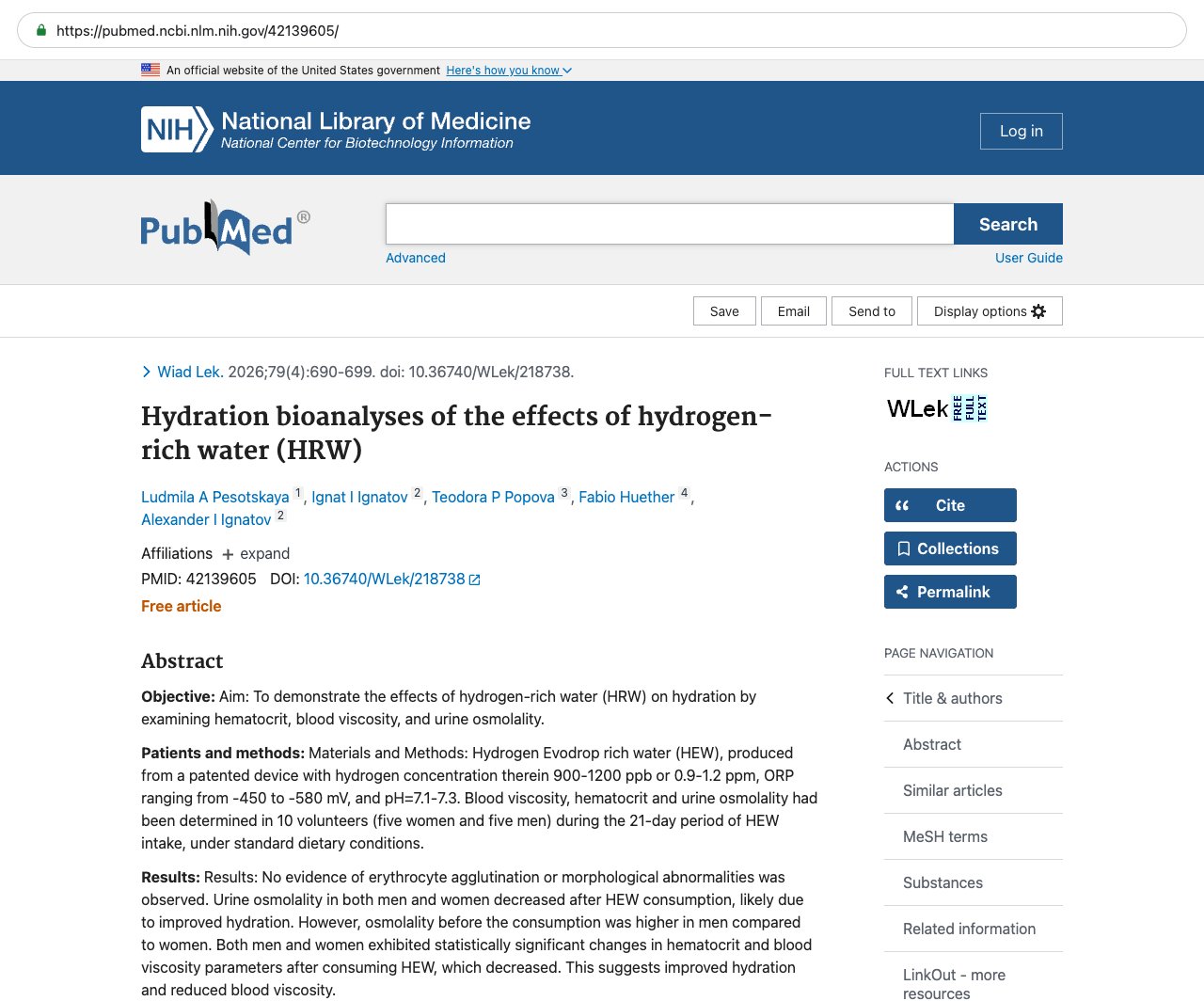
This page mirrors the published abstract (© the authors / publisher) for reference and citation. The canonical source is the PubMed record linked above. This is not medical advice.