2022 · Mizutani — Hydrogen-rich water reduced oxidative stress and renal fibrosis in rats with unilateral ureteral obstruction.
Super-Abstract
In a rat model of obstructive kidney injury, drinking hydrogen-rich water (HRW) for two weeks after surgery significantly reduced interstitial fibrosis and oxidative stress markers in the affected kidney. The mechanism may involve the anti-aging protein klotho. This is an animal study; findings cannot be directly applied to humans. (Pediatric Research, 2022.)
Commentary
Congenital obstructive nephropathy is a leading cause of pediatric chronic kidney disease. Reactive oxygen species play a central role in driving the fibrotic remodeling that follows ureteral obstruction. Mizutani et al. used the well-established unilateral ureteral obstruction (UUO) rat model and compared outcomes in animals drinking ordinary distilled water versus hydrogen-rich water. HRW animals showed reduced interstitial fibrosis (measured by collagen-area fraction), fewer α-SMA-, ED-1- and TGF-β1-positive cells (markers of fibroblast activation, macrophage infiltration, and pro-fibrotic signaling, respectively), and a less pronounced drop in klotho mRNA. Klotho is a protein known for anti-aging and anti-fibrotic properties. The study is well-controlled within the animal model but UUO is an acute surgical model, which may not fully replicate the chronic progression of human congenital obstructive nephropathy. Translation to pediatric patients requires dedicated clinical trials.
Key quotes
- „Oral HW intake reduced oxidative stress and prevented interstitial fibrosis in UUO kidneys, potentially involving klotho in the underlying mechanism.“ — main conclusion of the study — animal data only
- „HW administration attenuated tubulointerstitial injury and reduced interstitial fibrotic area“ — histological finding: structural kidney protection observed in treated rats
- „Drinking HW is a safe and convenient treatment for oxidative stress-induced pathologies, without side effects.“ — authors' assessment of HRW tolerability — based on animal data
Our assessment
This is an animal study (rats) and its results cannot be directly transferred to humans. The UUO model is a recognised experimental tool, but it represents an acute surgical obstruction, not the gradual development typical of congenital obstructive nephropathy in children. The involvement of klotho is an interesting mechanistic lead that merits further investigation. The finding that simple oral HRW intake was sufficient — without injections or invasive delivery — is notable for its translational relevance, but clinical proof is still lacking.
Study design
- Type: controlled animal experiment · Model: male Sprague-Dawley rats, unilateral ureteral obstruction · H₂ delivery: hydrogen-rich water (oral, ad libitum, 2 weeks post-surgery)
- Outcome: reduced tubulointerstitial injury, decreased interstitial fibrosis, fewer α-SMA/ED-1/TGF-β1-positive cells, preserved klotho mRNA expression in HRW group vs. distilled water control
Abstract
BACKGROUND: Congenital obstructive nephropathy (CKD) is commonly implicated in the pathophysiology of chronic kidney disease occurring in the pediatric and adolescent age groups and the release of reactive oxygen species contribute to the worsening of renal fibrosis. Molecular hydrogen (H2) protects against tissue injury by reducing oxidative stress. We evaluated the efficacy of oral H2-rich water (HW) intake in preventing unilateral ureteral obstruction (UUO)-induced renal injury in rats. METHODS: Male Sprague-Dawley UUO or control rats were administered with distilled water (DW) or HW for 2 weeks post-surgery. Histopathological and immunohistochemical analyses of kidney samples were performed. RESULTS: Histological changes were not apparent in the sham-operated kidneys. However, UUO kidneys were found to have widened interstitial spaces and tubular dilatation. Compared with the UUO + DW group, HW administration attenuated tubulointerstitial injury and reduced interstitial fibrotic area, causing a substantial decline in the frequency of α-SMA-, ED-1-, and TGF-β1-positive cells in the UUO + HW group. The decrease in the klotho mRNA expression in the UUO + HW group was less pronounced than that in the UUO + DW group. CONCLUSION: Oral HW intake reduced oxidative stress and prevented interstitial fibrosis in UUO kidneys, potentially involving klotho in the underlying mechanism. IMPACT: Oral intake of hydrogen-rich water (HW) can reduce oxidative stress and suppress interstitial fibrosis in unilateral ureteral obstruction-induced renal injury in rats. This mechanism possibly involves klotho, which is known for its antiaging roles. The association between molecular hydrogen and klotho in renal fibrosis is well known; this is the first report on the association in a unilateral ureteral obstruction model. Drinking HW is a safe and convenient treatment for oxidative stress-induced pathologies, without side effects. As a prospect for future research, oral HW intake to treat oxidative stress may improve renal fibrosis in congenital obstructive nephropathy.
Source & links
Screenshot of the PubMed page
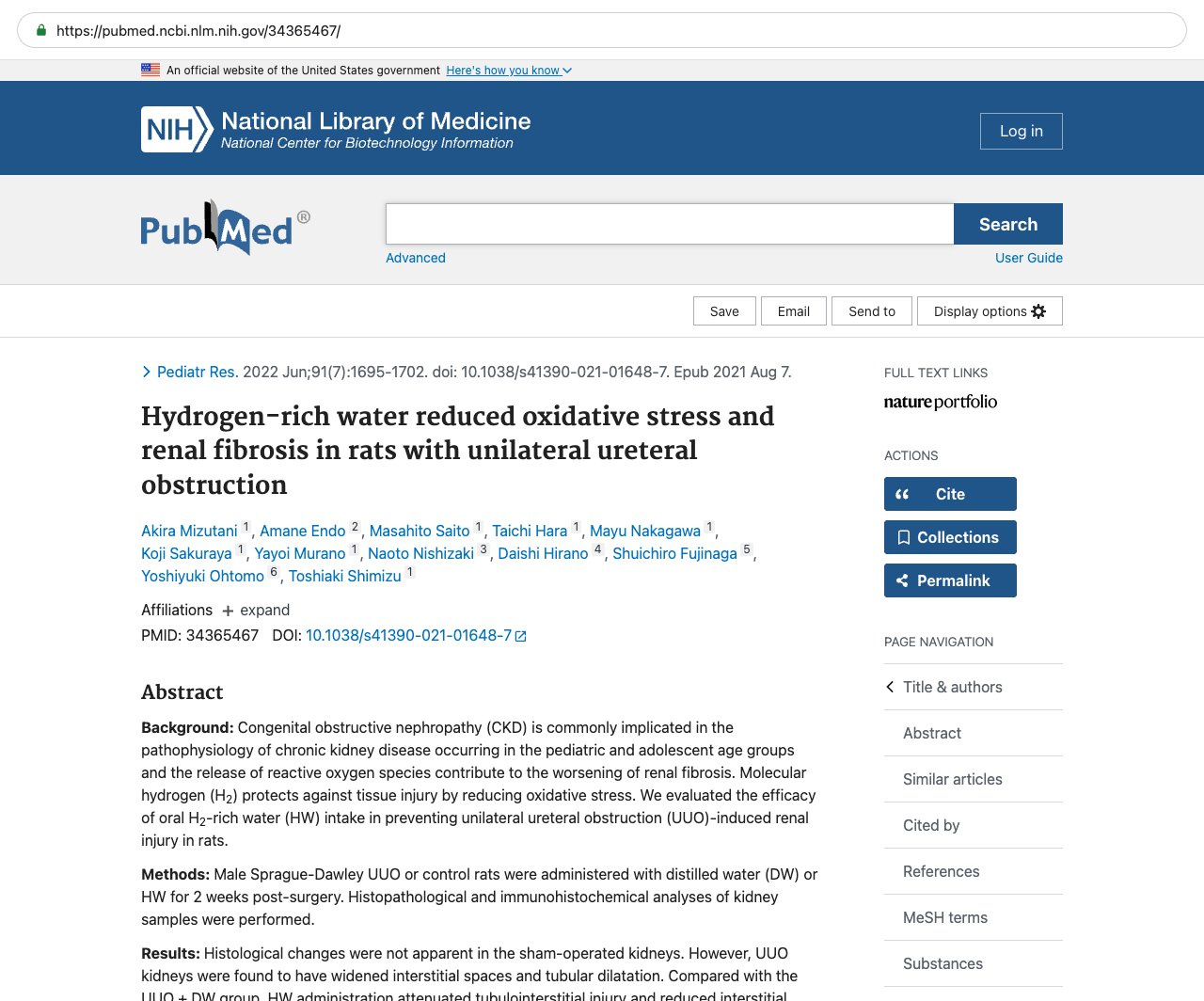
This page mirrors the published abstract (© the authors / publisher) for reference and citation. The canonical source is the PubMed record linked above. This is not medical advice.