2019 · Yamasaki — Effects of hydrogen-rich water in a rat model of polycystic kidney disease.
Super-Abstract
In PCK rats — a rodent model of polycystic kidney disease — drinking hydrogen-rich water did not significantly reduce cyst growth compared to plain water when consumed in equivalent volumes. High-volume fluid intake (regardless of H₂ content) slightly reduced kidney-to-body-weight ratio, but H₂ showed no additional benefit over water alone in this experimental design. The authors suggest that altered delivery method or duration might yield different results. (PLOS ONE, 2019.)
Commentary
This is a notable study precisely because its primary outcome was negative or null for the H₂ hypothesis. The rationale behind it was sound: vasopressin suppression through high fluid intake is known to slow cyst progression, and H₂ has documented anti-oxidative properties relevant to kidney injury. The team therefore tested whether H₂-rich high-volume water would outperform plain high-volume water. It did not — the cross-sectional cyst area ratio was statistically indistinguishable across all four groups. Interestingly, H₂ water without added sugar actually increased kidney weight relative to the high-volume plain-water groups, a counterintuitive signal the paper does not fully explain. The honest acknowledgment that the study did not show a significant H₂-specific effect is scientifically valuable. Confounding factors include the relatively short 10-week observation window and the use of a genetic rat model that may not mirror the heterogeneity of human PKD.
Key quotes
- „This experiment showed that the effect of drinking large volumes of hydrogen-rich water was not significantly different from that of normal water, in terms of preventing an increase in the size of cysts in PCK rats.“ — primary null finding: H₂ water offered no benefit beyond water alone
- „The kidney weights in H and WH were significantly increased in comparison to W.“ — unexpected result: H₂ groups had higher kidney weights than the plain high-volume water group
- „Significant differences might become obvious if we change aspects such as the administration method or administration period.“ — authors' cautious hypothesis for follow-up research
Our assessment
This animal study should be read as a caution against over-generalizing positive H₂ findings to polycystic kidney disease. The result is a null finding for H₂-specific cyst suppression in this specific rodent model. No human data exist for this application. The study is small (n = 40 rats, 10 per group) and short (10 weeks). The null result does not conclusively disprove an effect — design limitations (dose, timing, route) leave room for future study — but it does demonstrate that H₂ is not universally effective in every oxidative-stress-related disease model.
Study design
- Type: preclinical randomized animal study · Model: PCK rats (polycystic kidney disease model), n = 40 (4 groups of 10), ages 5–15 weeks · H₂ delivery: ad-libitum hydrogen-rich water (with or without sugar additive to increase volume)
- Result: no significant difference in cross-sectional cyst-to-total-kidney-area ratio across all four groups; kidney weight per body weight modestly lower in high-volume water group (W) vs. control; H₂ groups showed unexpectedly higher kidney weights vs. W; serum creatinine unchanged across groups
Abstract
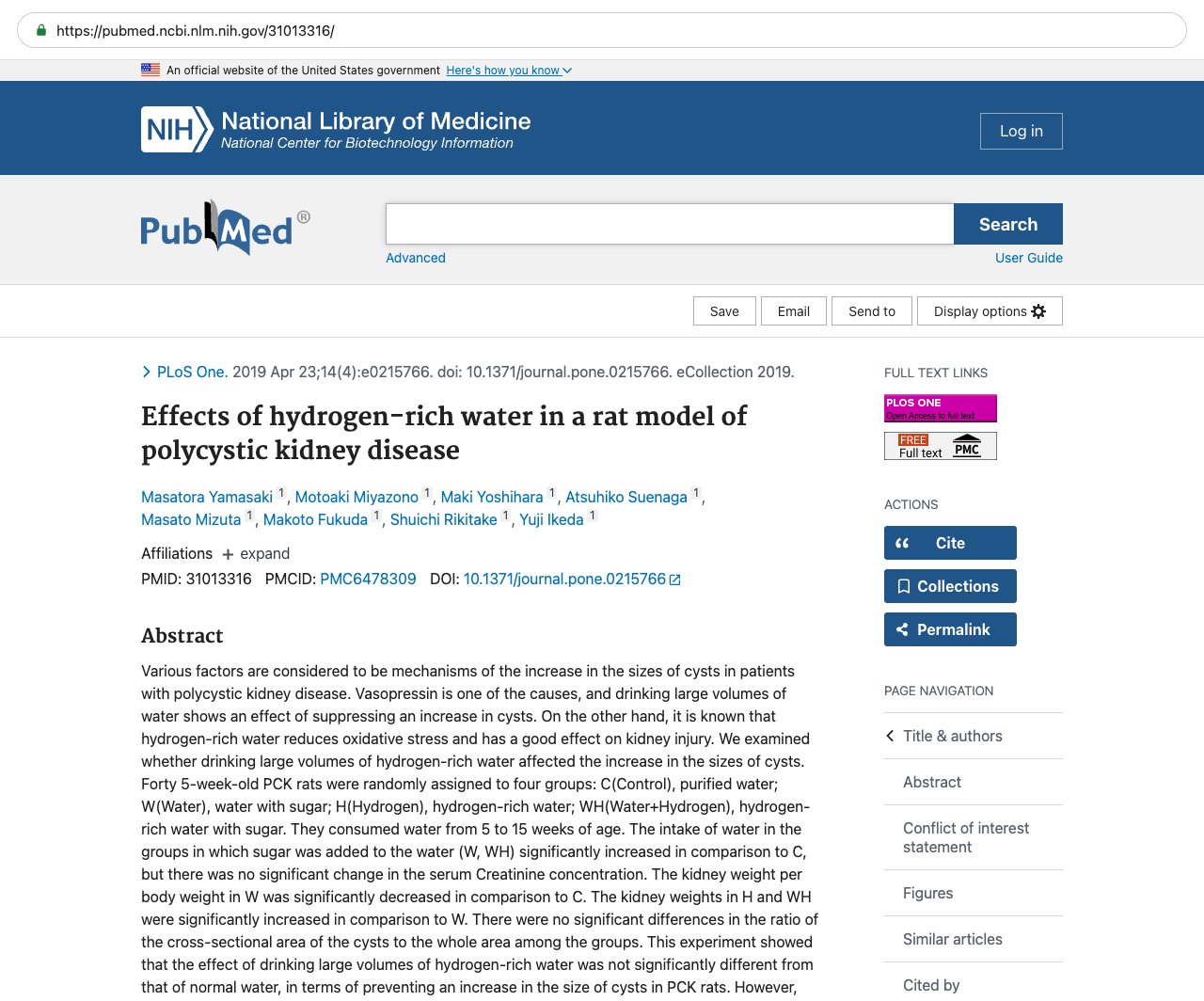
Various factors are considered to be mechanisms of the increase in the sizes of cysts in patients with polycystic kidney disease. Vasopressin is one of the causes, and drinking large volumes of water shows an effect of suppressing an increase in cysts. On the other hand, it is known that hydrogen-rich water reduces oxidative stress and has a good effect on kidney injury. We examined whether drinking large volumes of hydrogen-rich water affected the increase in the sizes of cysts. Forty 5-week-old PCK rats were randomly assigned to four groups: C(Control), purified water; W(Water), water with sugar; H(Hydrogen), hydrogen-rich water; WH(Water+Hydrogen), hydrogen-rich water with sugar. They consumed water from 5 to 15 weeks of age. The intake of water in the groups in which sugar was added to the water (W, WH) significantly increased in comparison to C, but there was no significant change in the serum Creatinine concentration. The kidney weight per body weight in W was significantly decreased in comparison to C. The kidney weights in H and WH were significantly increased in comparison to W. There were no significant differences in the ratio of the cross-sectional area of the cysts to the whole area among the groups. This experiment showed that the effect of drinking large volumes of hydrogen-rich water was not significantly different from that of normal water, in terms of preventing an increase in the size of cysts in PCK rats. However, some papers acknowledge the influence of hydrogen water. Significant differences might become obvious if we change aspects such as the administration method or administration period.
Source & links
Screenshot of the PubMed page
This page mirrors the published abstract (© the authors / publisher) for reference and citation. The canonical source is the PubMed record linked above. This is not medical advice.