2025 · Tu et al. — Molecular Hydrogen Therapy in Rheumatoid Arthritis: A Case Report on the Amelioration of Methotrexate-induced Myelosuppression and Immune Modulation
Super-Abstract
Methotrexate (MTX) is essential for rheumatoid arthritis but can cause dangerous bone marrow suppression. This case report documents a 66-year-old woman with severe MTX-induced pancytopenia, liver failure, and acute kidney injury who showed marked clinical improvement after molecular hydrogen therapy was introduced. Flow cytometry revealed progressive increases in regulatory T cell populations with no adverse events. (In Vivo, 2025.)
Commentary
This case is notable for the severity of the clinical picture: pancytopenia, hepatic insufficiency, acute kidney injury, and hemodynamic instability — all triggered by MTX toxicity — presented to the emergency department. Standard medications were stopped, and hydrogen therapy was introduced as the only active intervention. The subsequent normalization of laboratory parameters and the favorable immunological shifts (increased PD-1+ T helper and cytotoxic T cells, increased memory and activated Treg cells, while B regulatory cells remained unchanged) are clinically interesting. The authors describe this as the first case report specifically highlighting severe MTX-induced myelosuppression in the context of H₂ therapy. This is exactly the kind of clinical scenario — where conventional treatment has failed and needs augmentation — in which case-level evidence serves as a hypothesis generator. It does not prove causality, but it raises testable questions about H₂ as a cytoprotective co-therapy with immunosuppressants.
Key quotes
- „The patient exhibited marked clinical improvement, with normalization of laboratory parameters.“ — clinical turnaround after initiation of hydrogen therapy
- „Flow cytometry analysis demonstrated a progressive increase in the percentages of PD-1+ subsets of Th and Tc cells, as well as memory and activated regulatory T (Treg) cells. In contrast, B regulatory (Breg) cell levels remained unchanged.“ — specific immune shifts observed — T cell-selective modulation
- „This is the first case report to highlight severe MTX-induced myelosuppression in an RA patient and to demonstrate the potential of molecular hydrogen therapy in modulating immune markers.“ — novelty claim by the authors: a first in this clinical context
Our assessment
This is a single case report — the weakest level of clinical evidence. No control, no way to attribute recovery exclusively to H₂ (MTX was also discontinued, which alone would trigger recovery). The patient's spontaneous improvement from MTX removal cannot be separated from any H₂ effect. The immune phenotyping adds mechanistic texture but cannot establish causality at n=1. Honestly: H₂ may have contributed, but we cannot know. The value lies in the detailed immune profiling accompanying a dramatic clinical scenario. This warrants prospective study of H₂ as an adjunct in MTX-treated RA patients to assess cytoprotective or immunomodulatory synergy.
Study design
- Type: single case report · n: 1 (66-year-old female with RA and acute MTX toxicity) · H₂ delivery: hydrogen-rich water (drinking), dose unspecified
- Endpoints: laboratory normalization (AST, ALT, CBC, renal function); flow cytometry of T and B cell subsets
- Result: clinical improvement and lab normalization observed; progressive increases in PD-1+ T cells and activated Tregs; Breg cells unchanged; no adverse effects
Abstract
BACKGROUND/AIM: Rheumatoid arthritis (RA) is a chronic autoimmune disease with systemic manifestations. Methotrexate (MTX) remains a cornerstone of RA treatment, offering significant therapeutic benefits; however, it is also associated with adverse effects, particularly myelosuppression. Molecular hydrogen, recognized for its anti-inflammatory and antioxidant properties, has demonstrated potential in mitigating oxidative stress and modulating immune responses in RA. This study aimed to evaluate the efficacy of molecular hydrogen therapy in alleviating MTX-induced myelosuppression while preserving its immunoregulatory effects in a patient with RA. CASE REPORT: We present the case of a 66-year-old Taiwanese female diagnosed with RA according to the 2010 American College of Rheumatology/European League Against Rheumatism (ACR/EULAR) criteria. The patient presented to the emergency department on August 30, 2024, with oral ulcers, sore throat, weakness, and diarrhea. Clinical assessment revealed hypotension, tachycardia, pancytopenia, hepatic insufficiency, and acute kidney injury. Outpatient medications were discontinued, and molecular hydrogen therapy was initiated. The patient exhibited marked clinical improvement, with normalization of laboratory parameters. Flow cytometry analysis demonstrated a progressive increase in the percentages of PD-1+ subsets of Th and Tc cells, as well as memory and activated regulatory T (Treg) cells. In contrast, B regulatory (Breg) cell levels remained unchanged. No adverse events were observed during the course of hydrogen therapy. CONCLUSION: This is the first case report to highlight severe MTX-induced myelosuppression in an RA patient and to demonstrate the potential of molecular hydrogen therapy in modulating immune markers.
Source & links
Screenshot of the PubMed page
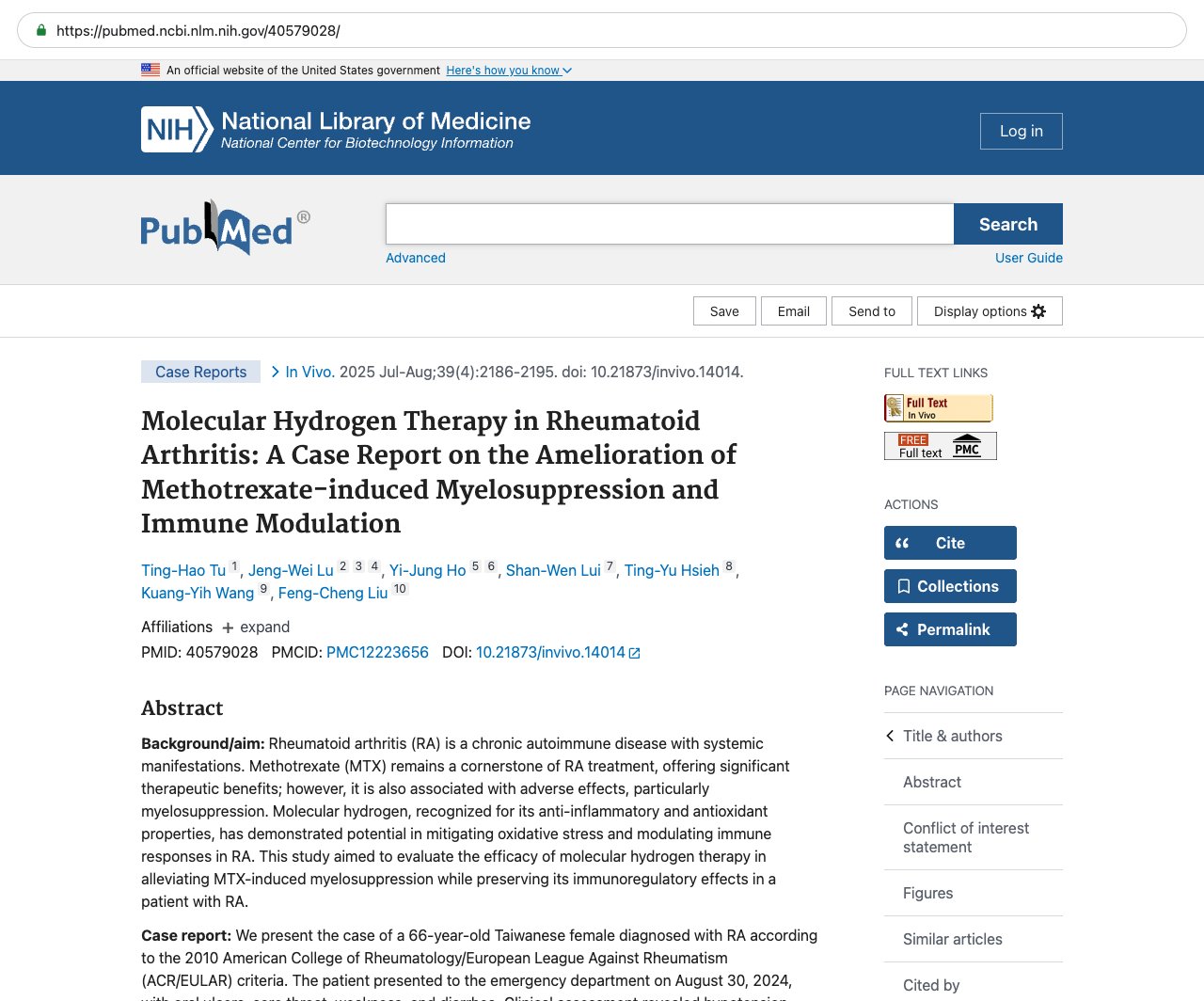
This page mirrors the published abstract (© the authors / publisher) for reference and citation. The canonical source is the PubMed record linked above. This is not medical advice.