2019 · Asada et al. — Effects of hydrogen-rich water bath on visceral fat and skin blotch, with boiling-resistant hydrogen bubbles.
Super-Abstract
Four subjects (2 men, 2 women) bathed daily in H₂-rich warm water (41 °C, ~300 μg/L dissolved H₂) for 1–6 months; the two female subjects showed reduced visceral fat area (47 → 36 cm²) and waist circumference (91 → 82 cm), and all subjects showed reduction of skin blotches — described by the authors as „markedly smaller and thinner“. The study also documents that the H₂ nanobubbles in this water resist boiling. This is an uncontrolled 4-person observational study. (Medical Gas Research, 2019.)
Commentary
This is a second publication from the same Japanese group as PMID 33004708, again centred on boiling-resistant H₂ nanobubbles — this time in a bath apparatus. The cosmetic angle (skin blotches, visceral fat) is notable because it aligns with consumer interest but is measured in only 4 subjects, 2 of whom provide the body composition data, and the rest of whom provide the skin data. The proposed mechanisms — reductive bleaching of melanin and lipofuscin, promotion of dermal cell renewal for skin; fat metabolism for visceral fat — are speculative given the study scale. The fasting blood glucose result (increased by 13.6 % in one female subject) is an unexplained and potentially concerning finding that is not discussed. The technical nanobubble data (boiling stability) is the more robust part of this study, as it is a physical measurement.
Key quotes
- „The wide-ranging, dense, and irregularly shaped skin blotches became markedly smaller and thinner, assumedly through reductive bleaching of melanin and lipofuscin and promotion of dermal cell renewal by the hydrogen-rich warm water.“ — skin improvement — observed in all 4 subjects; mechanism is speculative
- „the visceral fat area decreased from 47 to 36 cm[2], and the abdominal circumference decreased from 91 to 82 cm, in the two female subjects bathing in hydrogen-water.“ — visceral fat reduction — only 2 subjects, no control; natural variation cannot be excluded
- „Dissolved hydrogen was retained at 300-175 μg/L and 200 μg/L, even 1-6 hours and 24 hours, respectively, after boiling.“ — nanobubble boiling stability — the technically most reliable finding
Our assessment
A very small, uncontrolled pilot with an interesting technical finding (H₂ nanobubble stability) and cosmetically relevant but entirely uncontrolled clinical observations. The skin and body composition data in 2–4 people cannot support any claims about efficacy. The unexplained fasting blood glucose increase in one subject is a notable adverse signal that should have been discussed. Limitations: n = 4 total (2 for body composition); no control group; effects of diet, season, and behaviour over 1–6 months cannot be separated; blood glucose anomaly unremarked; the boiling-resistance claim conflicts with established thermodynamics and requires independent replication.
Study design
- Type: uncontrolled observational pilot · n: 4 (2 men, 2 women; ages 41–48) · H₂ delivery: daily 10-min warm bath (41 °C) in H₂-rich water (~300 μg/L); 1–6 months
- Outcomes: skin blotch appearance (all 4); visceral fat area and waist circumference (2 female subjects); cholesterol and glucose (1 female, 6 months)
- Key finding: skin blotches reduced; visceral fat −9 cm² in 2 women; LDL −16.2 %; fasting glucose +13.6 % (unexplained adverse signal); nanobubbles stable after boiling
Abstract
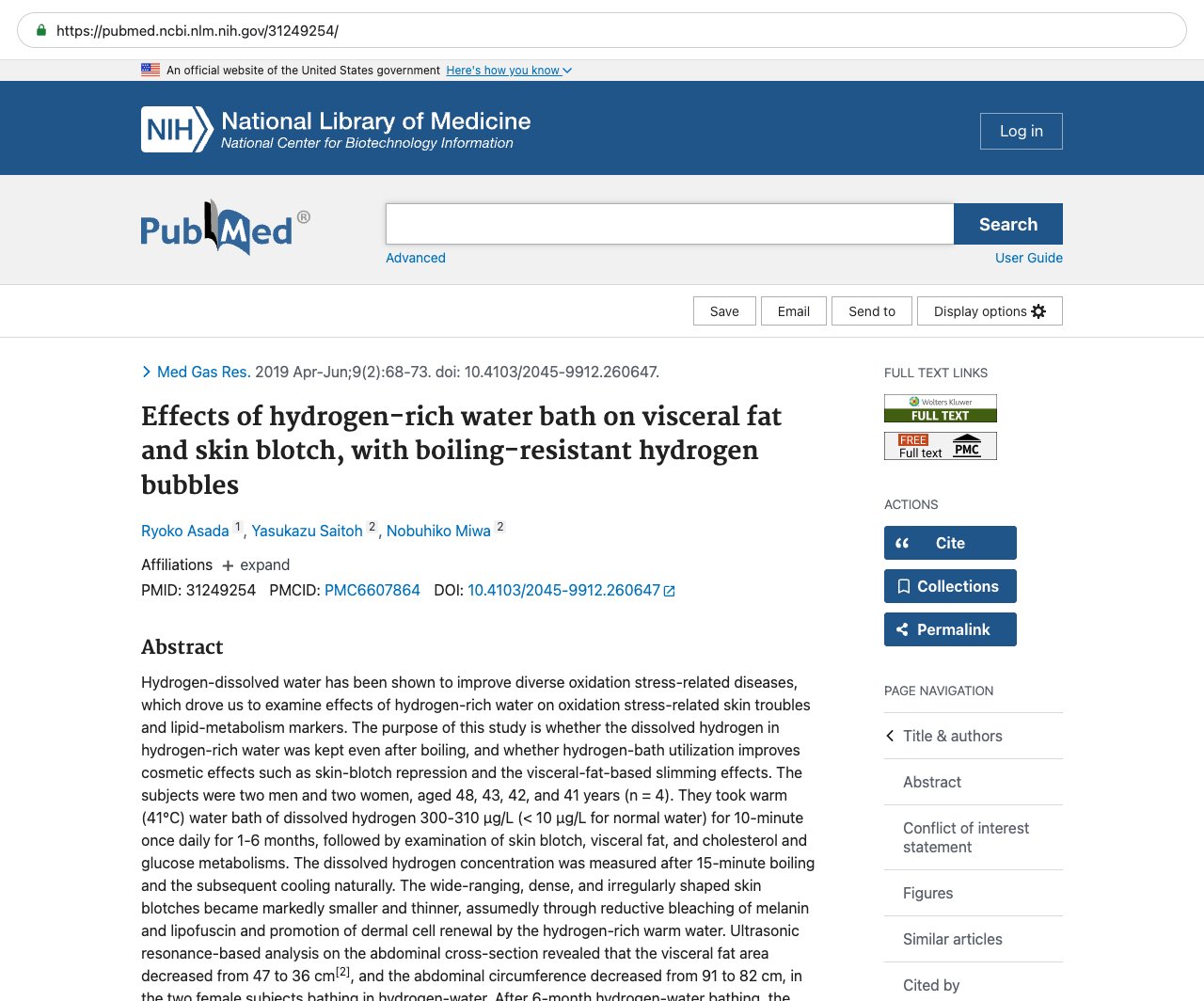
Hydrogen-dissolved water has been shown to improve diverse oxidation stress-related diseases, which drove us to examine effects of hydrogen-rich water on oxidation stress-related skin troubles and lipid-metabolism markers. The purpose of this study is whether the dissolved hydrogen in hydrogen-rich water was kept even after boiling, and whether hydrogen-bath utilization improves cosmetic effects such as skin-blotch repression and the visceral-fat-based slimming effects. The subjects were two men and two women, aged 48, 43, 42, and 41 years (n = 4). They took warm (41°C) water bath of dissolved hydrogen 300-310 μg/L (< 10 μg/L for normal water) for 10-minute once daily for 1-6 months, followed by examination of skin blotch, visceral fat, and cholesterol and glucose metabolisms. The dissolved hydrogen concentration was measured after 15-minute boiling and the subsequent cooling naturally. The wide-ranging, dense, and irregularly shaped skin blotches became markedly smaller and thinner, assumedly through reductive bleaching of melanin and lipofuscin and promotion of dermal cell renewal by the hydrogen-rich warm water. Ultrasonic resonance-based analysis on the abdominal cross-section revealed that the visceral fat area decreased from 47 to 36 cm[2], and the abdominal circumference decreased from 91 to 82 cm, in the two female subjects bathing in hydrogen-water. After 6-month hydrogen-water bathing, the low-density lipoprotein cholesterol level was decreased by 16.2% and the fasting blood glucose level increased by 13.6% in the blood of a female subject. Before boiling, the dissolved hydrogen and an oxidation-reduced potential were 300 μg/L and -115 mV, respectively. Dissolved hydrogen was retained at 300-175 μg/L and 200 μg/L, even 1-6 hours and 24 hours, respectively, after boiling. Therefore, a hydrogen-rich water-bath apparatus can electrolytically generate abundant boiling-resistant hydrogen bubbles, improving visceral fat and blotches on the skin. The study was approved by the Medical Ethics Committee of the Japanese Center for Anti-Aging Medical Sciences and that was officially authenticated by the Hiroshima Prefecture Government of Japan (approval number 15C1) in 2016.
Source & links
Screenshot of the PubMed page
This page mirrors the published abstract (© the authors / publisher) for reference and citation. The canonical source is the PubMed record linked above. This is not medical advice.