2012 Biochimica et biophysica acta Review / Meta-analysis InhalationSaline / IVBath / TopicalDrinking (HRW)
2012 · Ohta — Molecular hydrogen is a novel antioxidant to efficiently reduce oxidative stress with potential for the improvement of mitochondrial diseases.
Super-Abstract
This review by Shigeo Ohta — one of the founders of modern H₂ medicine — surveys the biological effects of molecular hydrogen across more than 38 diseases, physiological states, and clinical tests documented in the years following the 2007 Nature Medicine paper. It covers multiple administration routes (inhalation, H₂-rich water, H₂ bath, H₂ saline, eye drops), reports anti-oxidative, anti-inflammatory, and anti-allergic effects, and highlights preliminary clinical evidence that H₂-dissolved water may benefit mitochondrial disorders.
Commentary
Ohta is one of the key figures in establishing H₂ medicine as a research field — his group published the landmark 2007 Ohsawa et al. Nature Medicine paper. This 2012 review in Biochimica et Biophysica Acta (a special issue on mitochondrial biochemistry) is a comprehensive synthesis of the first five years of therapeutic H₂ research. A notable strength is the honest framing: the authors acknowledge that „the molecular mechanisms underlying the marked effects of small amounts of hydrogen remain elusive“ — a candid admission central to the field's credibility challenge. The coverage of multiple administration routes is useful: inhalation gas, drinking H₂-dissolved water, H₂ bath, intravenous H₂ saline, H₂ eye drops, and increased intestinal H₂ via bacterial production. The preliminary clinical trials in mitochondrial disorders are particularly notable because mitochondria are both the primary source of ROS and the proposed primary target of H₂'s antioxidant effect — making this mechanistic linkage compelling, even if the clinical evidence is still early-stage.
Key quotes
- „Hydrogen has many advantages for therapeutic and preventive applications, and shows not only anti-oxidative stress effects, but also various anti-inflammatory and anti-allergic effects.“ — scope of H₂ biological effects beyond simple antioxidant action
- „Preliminary clinical trials show that drinking hydrogen-dissolved water seems to improve the pathology of mitochondrial disorders.“ — notable human signal: early clinical evidence in mitochondrial disease
- „the molecular mechanisms underlying the marked effects of small amounts of hydrogen remain elusive.“ — honest acknowledgment of the field's core open question
Our assessment
A foundational review from one of the field's leading researchers, providing a comprehensive picture of where H₂ medicine stood around 2011–2012. Its value is in the breadth of evidence surveyed and its honest acknowledgment of mechanistic gaps. Limitations: as a review (not original data), it does not provide new effect estimates; the majority of evidence it surveys is preclinical (animal/in-vitro); the six human disease areas covered had very small, often non-randomised preliminary trials at that stage. The review's conclusion that H₂ has „great potential for actual medical applications“ is warranted as a hypothesis, but should not be read as established clinical evidence. Since 2012, the evidence base has grown — this review should be treated as a historical anchor point, not the current state of the field.
Study design
- Type: narrative review · Scope: 38+ diseases, physiological states, and clinical tests; evidence from in-vitro, animal, and human studies · H₂ routes covered: inhalation gas, H₂-rich water, H₂ bath, i.v. H₂ saline, H₂ eye drops, intestinal bacterial H₂ production
- Key focus: mitochondria as primary ROS source and primary target of H₂'s antioxidant effect; mitochondrial disease as leading clinical interest
- Human evidence noted: preliminary clinical trials in mitochondrial disorders (H₂-dissolved water); also diabetes, skin, eye conditions; mechanisms remain elusive
Abstract
BACKGROUND: Mitochondria are the major source of oxidative stress. Acute oxidative stress causes serious damage to tissues, and persistent oxidative stress is one of the causes of many common diseases, cancer and the aging process; however, there has been little success in developing an effective antioxidant with no side effect. We have reported that molecular hydrogen has potential as an effective antioxidant for medical applications [Ohsawa et al., Nat. Med. 13 (2007) 688-694]. SCOPE OF REVIEW: We review the recent progress toward therapeutic and preventive applications of hydrogen. Since we published the first paper in Nature Medicine, effects of hydrogen have been reported in more than 38 diseases, physiological states and clinical tests in leading biological/medical journals. Based on this cumulative knowledge, the beneficial biological effects of hydrogen have been confirmed. There are several ways to intake or consume hydrogen, including inhaling hydrogen gas, drinking hydrogen-dissolved water, taking a hydrogen bath, injecting hydrogen-dissolved saline, dropping hydrogen-dissolved saline into the eyes, and increasing the production of intestinal hydrogen by bacteria. Hydrogen has many advantages for therapeutic and preventive applications, and shows not only anti-oxidative stress effects, but also has various anti-inflammatory and anti-allergic effects. Preliminary clinical trials show that drinking hydrogen-dissolved water seems to improve the pathology of mitochondrial disorders. MAJOR CONCLUSIONS: Hydrogen has biological benefits toward preventive and therapeutic applications; however, the molecular mechanisms underlying the marked effects of small amounts of hydrogen remain elusive. GENERAL SIGNIFICANCE: Hydrogen is a novel antioxidant with great potential for actual medical applications. This article is part of a Special Issue entitled Biochemistry of Mitochondria.
Source & links
Screenshot of the PubMed page
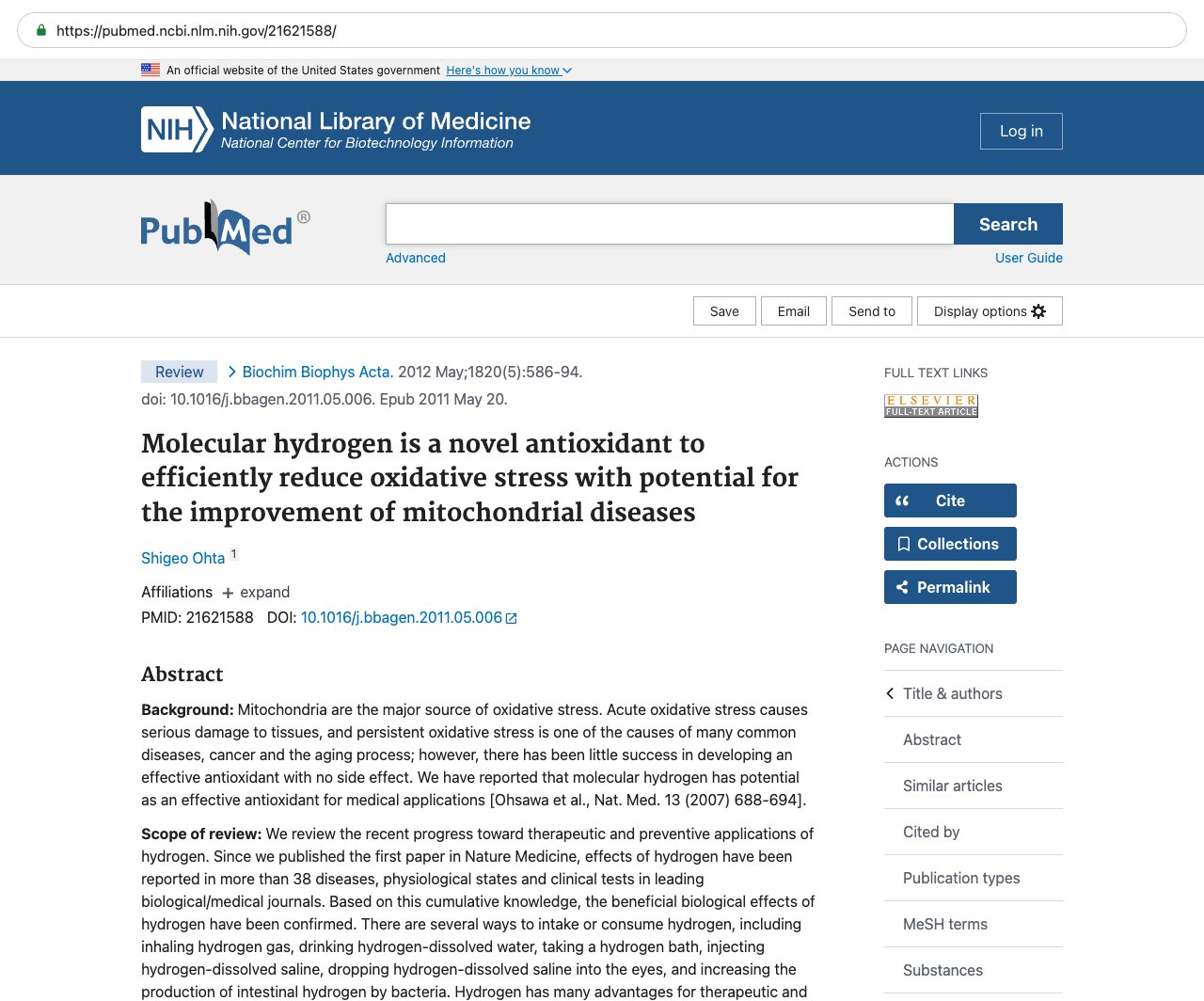
This page mirrors the published abstract (© the authors / publisher) for reference and citation. The canonical source is the PubMed record linked above. This is not medical advice.