2023 Cellular and molecular life sciences : CMLS Review / Meta-analysis InhalationSaline / IVBath / TopicalDrinking (HRW)
2023 · Saengsin et al. — Hydrogen Therapy as a Potential Therapeutic Intervention in Heart Disease: From the Past Evidence to Future Application
Super-Abstract
This comprehensive review in Cellular and Molecular Life Sciences synthesises in-vitro, animal, and clinical evidence for molecular hydrogen's protective effects in cardiovascular disease, covering its antioxidant, anti-inflammatory, and anti-apoptotic mechanisms. The authors specifically address ischemia-reperfusion injury, radiation-induced cardiac injury, atherosclerosis, chemotherapy-induced cardiotoxicity, and cardiac hypertrophy. Multiple delivery routes (inhalation, hydrogen-rich water drinking, intravenous hydrogen-rich saline, and organ bathing) are discussed. This is a review, not a new experiment.
Commentary
Cardiovascular disease remains the world's leading killer, and both oxidative stress and inflammation are central drivers of its key pathological events — ischemia-reperfusion injury above all. This review's strength is its attempt to systematically cover the full spectrum of H₂ cardiovascular research from cell to clinic. The authors highlight H₂'s unusual biological profile: it is small enough to penetrate membranes and enter mitochondria, it selectively neutralises the most toxic ROS (hydroxyl radical, peroxynitrite) while leaving beneficial H₂O₂ signalling intact, and it leaves no residue after metabolism. The multi-route delivery section is practically informative. However, the review is candid that the exact intracellular mechanisms remain unclear, and that human clinical data — while encouraging in some areas such as myocardial ischemia — are still limited in scale and quality. The leap from preclinical elegance to robust clinical proof requires considerably more rigorous human trial data than currently exists.
Key quotes
- „Molecular hydrogen can be administered through inhalation, the drinking of hydrogen-rich water, injection with hydrogen-rich-saline, and bathing of an organ in a preservative solution.“ — the four main delivery routes — reflecting H₂'s versatility as a potential therapeutic agent
- „It has been demonstrated that molecular hydrogen exerts antioxidant, anti-inflammatory, and antiapoptotic effects, leading to cardioprotective benefits.“ — the three core mechanisms underpinning cardioprotection in the reviewed evidence
- „The exact intracellular mechanisms of its action are still unclear.“ — the authors' own honest caveat — mechanistic understanding is still incomplete
Our assessment
A thorough and well-referenced review covering the breadth of H₂ cardiovascular research across in-vitro, animal, and clinical settings. The mechanistic discussion is nuanced and the delivery-route overview is practically useful. Honest limitation: this is a review article, not new experimental evidence. Clinical evidence for most of the specific cardiovascular applications discussed is still early-stage and requires larger controlled trials. The authors themselves note that intracellular mechanisms remain incompletely understood. No therapeutic conclusions for individual patients can be drawn from this review alone.
Study design
- Type: comprehensive narrative review · n: n/a (literature synthesis across in-vitro, in-vivo, clinical) · H₂ delivery: all routes reviewed (inhalation, HRW drinking, IV saline, organ bathing)
- Cardiovascular focus areas: ischemia-reperfusion injury, radiation cardiac injury, atherosclerosis, chemotherapy cardiotoxicity, cardiac hypertrophy
- Result: convergent preclinical evidence for cardioprotection via antioxidant/anti-inflammatory/anti-apoptotic mechanisms; human clinical evidence encouraging but limited; mechanisms not fully resolved
Abstract
Cardiovascular disease is the leading cause of mortality worldwide. Excessive oxidative stress and inflammation play an important role in the development and progression of cardiovascular disease. Molecular hydrogen, a small colorless and odorless molecule, is considered harmless in daily life when its concentration is below 4% at room temperature. Owing to the small size of the hydrogen molecule, it can easily penetrate the cell membrane and can be metabolized without residue. Molecular hydrogen can be administered through inhalation, the drinking of hydrogen-rich water, injection with hydrogen-rich-saline, and bathing of an organ in a preservative solution. The utilization of molecular hydrogen has shown many benefits and can be effective for a wide range of purposes, from prevention to the treatment of diseases. It has been demonstrated that molecular hydrogen exerts antioxidant, anti-inflammatory, and antiapoptotic effects, leading to cardioprotective benefits. Nevertheless, the exact intracellular mechanisms of its action are still unclear. In this review, evidence of the potential benefits of hydrogen molecules obtained from in vitro, in vivo, and clinical investigations are comprehensively summarized and discussed with a focus on the cardiovascular aspects. The potential mechanisms involved in the protective effects of molecular hydrogen are also presented. These findings suggest that molecular hydrogen could be used as a novel treatment in various cardiovascular pathologies, including ischemic-reperfusion injury, cardiac injury from radiation, atherosclerosis, chemotherapy-induced cardiotoxicity, and cardiac hypertrophy.
Source & links
Screenshot of the PubMed page
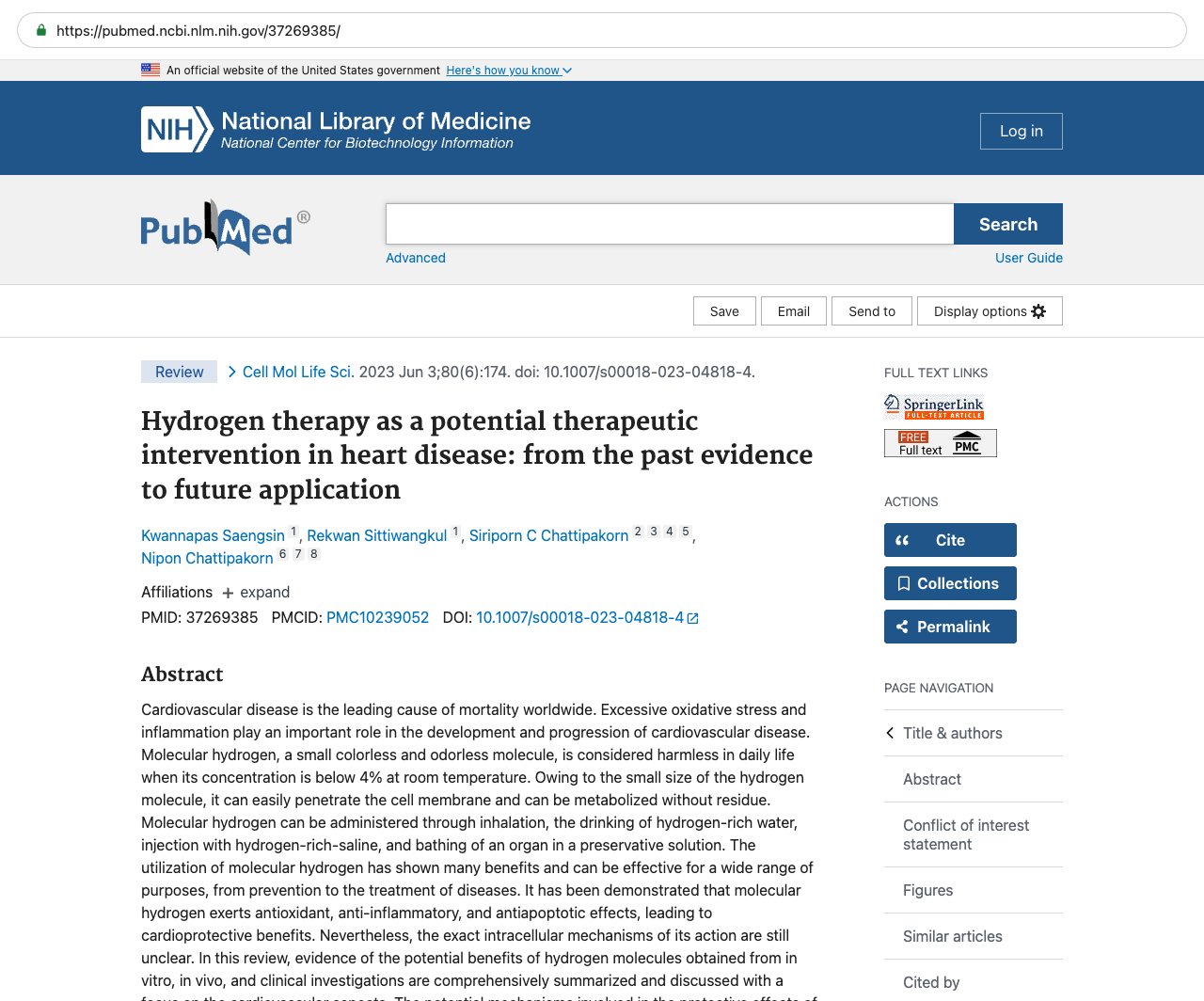
This page mirrors the published abstract (© the authors / publisher) for reference and citation. The canonical source is the PubMed record linked above. This is not medical advice.