2011 Current pharmaceutical design Review / Meta-analysis InhalationSaline / IVBath / TopicalDrinking (HRW)
2011 · Ohta — Recent progress toward hydrogen medicine: potential of molecular hydrogen for preventive and therapeutic applications.
Super-Abstract
Since the landmark 2007 Nature Medicine paper demonstrating that molecular hydrogen (H₂) selectively neutralizes toxic hydroxyl radicals, the field of hydrogen medicine has grown rapidly. This comprehensive review by Shigeo Ohta — one of the founding figures of H₂ research — summarizes evidence across more than 38 diseases and physiological states, covering multiple delivery methods (inhalation, drinking, bathing, injection, eye drops) and both oxidative stress and anti-inflammatory / anti-allergic mechanisms. It is a review, not a new clinical trial.
Commentary
This 2011 review by Ohta is a key historical document in the development of hydrogen medicine as a research field. Published just four years after the founding Nature Medicine paper (2007, also by Ohta's group), it marks the transition from a single striking observation to an emerging research program. The breadth of effects summarized — across cancers, metabolic diseases, neurological conditions, allergies, eye disease, and aging — is remarkable, though it must be noted that much of the underlying evidence at that time came from preclinical models. Ohta is transparent about the central puzzle: H₂ exerts marked biological effects at very small amounts, yet the molecular mechanisms beyond •OH scavenging remain elusive in 2011. He also notes that H₂ appears to affect gene expression and protein phosphorylation — pointing toward signaling roles beyond simple radical scavenging. As a review, this paper does not generate new experimental evidence but provides an authoritative synthesis of the state of the field circa 2011.
Key quotes
- „H(2) rapidly diffuses into tissues and cells, and it is mild enough neither to disturb metabolic redox reactions nor to affect reactive oxygen species (ROS) that function in cell signaling, thereby, there should be little adverse effects of consuming H(2).“ — the safety argument and selectivity rationale for H₂ as a therapeutic agent
- „the biological effects of H(2) have been confirmed by the publication of more than 38 diseases, physiological states and clinical tests in leading biological/medical journals.“ — the scope of H₂ research by 2011 — 38 conditions studied within 4 years
- „the molecular mechanisms underlying the marked effects of very small amounts of H(2) remain elusive.“ — honest admission of the key open scientific question — mechanism not fully explained
Our assessment
This is a narrative review by a leading figure in H₂ research, summarizing the state of the field in 2011. It provides a useful map of the breadth of H₂ biology at that time and articulates the safety and selectivity rationale clearly. As a review, it synthesizes existing evidence rather than producing new experimental proof. A key honest caveat: much of the evidence cited comes from preclinical (animal/cell) studies, and the clinical evidence base was still early. The mechanisms underlying H₂'s effects beyond •OH scavenging remained unexplained. The paper is historically important but should be read as a 2011 state-of-knowledge summary, not as a current systematic evidence review.
Study design
- Type: narrative review · n: n/a (literature synthesis) · H₂ delivery methods covered: inhalation, hydrogen water, bathing, intravenous hydrogen saline, eye drops, intestinal bacterial production
- Result: no pooled effect sizes; summarizes evidence across 38+ diseases/conditions; highlights anti-oxidative, anti-inflammatory, and anti-allergic effects; identifies open mechanistic questions; notes emerging clinical examinations underway
Abstract
Persistent oxidative stress is one of the major causes of most lifestyle-related diseases, cancer and the aging process. Acute oxidative stress directly causes serious damage to tissues. Despite the clinical importance of oxidative damage, antioxidants have been of limited therapeutic success. We have proposed that molecular hydrogen (H(2)) has potential as a "novel" antioxidant in preventive and therapeutic applications [Ohsawa et al., Nat Med. 2007: 13; 688-94]. H(2) has a number of advantages as a potential antioxidant: H(2) rapidly diffuses into tissues and cells, and it is mild enough neither to disturb metabolic redox reactions nor to affect reactive oxygen species (ROS) that function in cell signaling, thereby, there should be little adverse effects of consuming H(2). There are several methods to ingest or consume H(2), including inhaling hydrogen gas, drinking H(2)-dissolved water (hydrogen water), taking a hydrogen bath, injecting H(2)- dissolved saline (hydrogen saline), dropping hydrogen saline onto the eye, and increasing the production of intestinal H(2) by bacteria. Since the publication of the first H(2) paper in Nature Medicine in 2007, the biological effects of H(2) have been confirmed by the publication of more than 38 diseases, physiological states and clinical tests in leading biological/medical journals, and several groups have started clinical examinations. Moreover, H(2) shows not only effects against oxidative stress, but also various anti-inflammatory and antiallergic effects. H(2) regulates various gene expressions and protein-phosphorylations, though the molecular mechanisms underlying the marked effects of very small amounts of H(2) remain elusive.
Source & links
Screenshot of the PubMed page
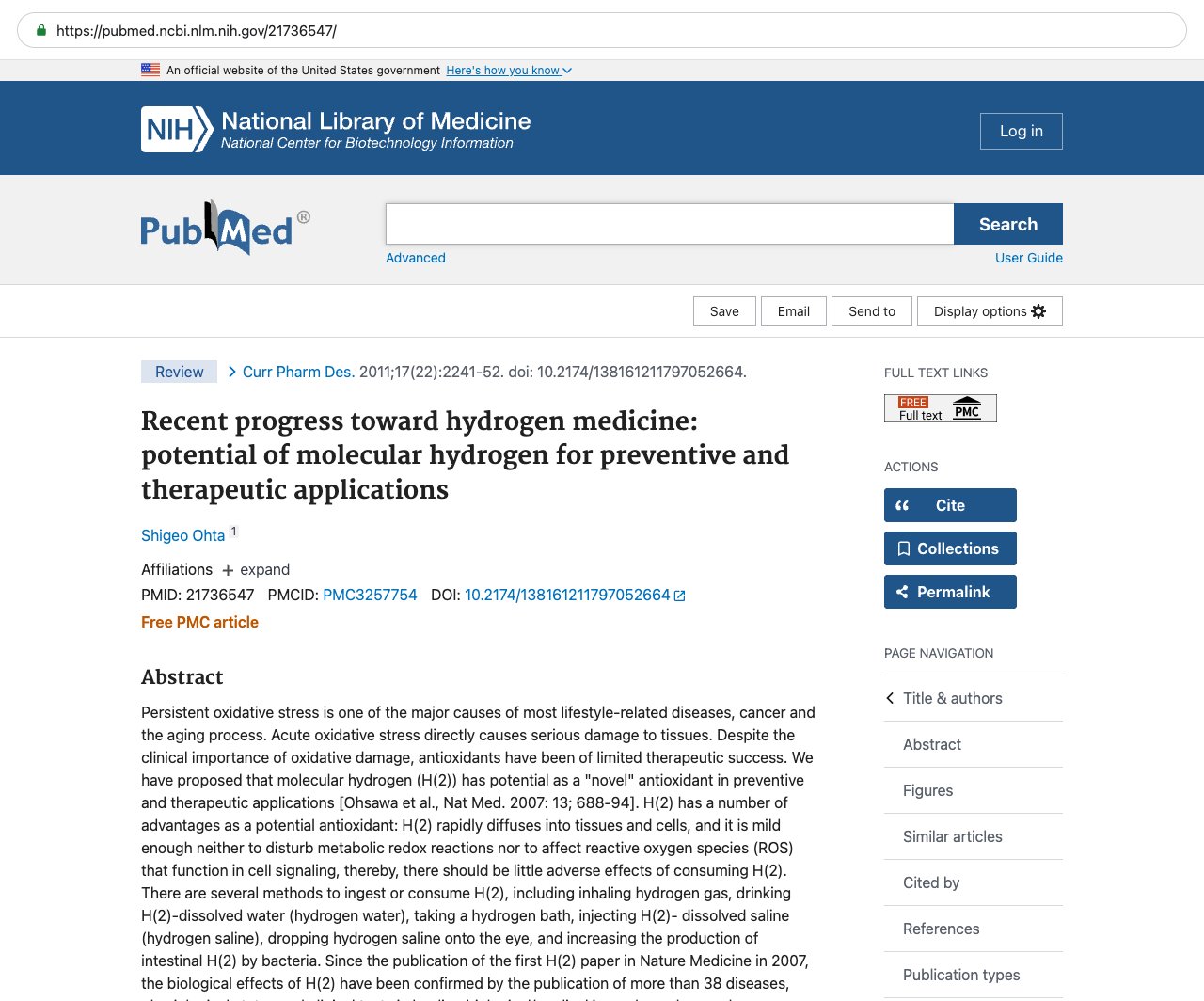
This page mirrors the published abstract (© the authors / publisher) for reference and citation. The canonical source is the PubMed record linked above. This is not medical advice.