2022 · Chen et al. — Photocatalytic Glucose Depletion and Hydrogen Generation for Diabetic Wound Healing
Super-Abstract
Researchers engineered hydrogen-incorporated titanium oxide nanorods that, under visible light, simultaneously deplete glucose and generate molecular hydrogen (H₂) at diabetic wound sites — addressing both the hyperglycaemic microenvironment and chronic inflammation. In preclinical models, the photocatalytic nanoparticles significantly promoted diabetic wound closure by reducing glycation end products and inhibiting apoptosis of skin cells. This is an in-vitro and animal study — results have not yet been validated in humans. (Nature Communications, 2022.)
Commentary
Diabetic foot ulcers (DFU) are driven by a vicious cycle: high local glucose causes glycation and chronic inflammation, which impairs healing. Hydrogen-rich water baths have shown some clinical promise for DFU, but daily soaking prevents scab formation and does not address the glucose excess. This study proposes an elegant photocatalytic solution: nanoparticles that use the problematic glucose itself as a sacrificial agent to drive H₂ production under visible light, simultaneously reducing glucose levels and releasing anti-inflammatory H₂. The dual mechanism — local glucose depletion + H₂ generation — is mechanistically sophisticated and the preclinical results are striking. However, this is still very far from clinical translation: the nanoparticle formulation has not been tested for safety or efficacy in human patients.
Key quotes
- „Local glucose depletion and hydrogen generation jointly attenuate the apoptosis of skin cells and promote their proliferation and migration by inhibiting the synthesis of advanced glycation end products and the expression of their receptors, respectively.“ — the dual mechanism of action: targeting both glycation and inflammation simultaneously
- „Hydrogen-rich water bath can promote the healing of DFU in clinic by virtue of the anti-inflammatory effect of hydrogen molecules, but the long-term daily soaking counts against the formation of a scab.“ — why existing H₂ approaches for diabetic wounds have practical limitations
- „The proposed VIS-photocatalytic strategy provides a solution for facile, safe and efficient treatment of DFU.“ — the authors' conclusion — stated as promise, not clinical proof
Our assessment
This is a preclinical in-vitro and animal study. The concept of photocatalytic H₂ generation at wound sites is scientifically innovative and mechanistically well-supported by the data presented. However, no human clinical evidence is provided. The nanoparticle approach raises unresolved questions about biocompatibility, long-term safety, light penetration in real wound tissue, and scalability. The paper should be read as proof-of-concept for a novel therapeutic approach, not as evidence of clinical efficacy in diabetic patients.
Study design
- Type: in-vitro + animal preclinical study · Model: diabetic wound model (mice) + cell culture · H₂ delivery: photocatalytic generation via hydrogen-incorporated TiO₂ nanorods under visible light; comparison with H₂-rich water bath
- Result: photocatalytic nanorods achieved efficient glucose depletion and H₂ generation; significantly promoted wound healing in diabetic mouse model; mechanism: reduced AGE synthesis + inhibited RAGE expression → reduced apoptosis, promoted cell proliferation and migration
Abstract
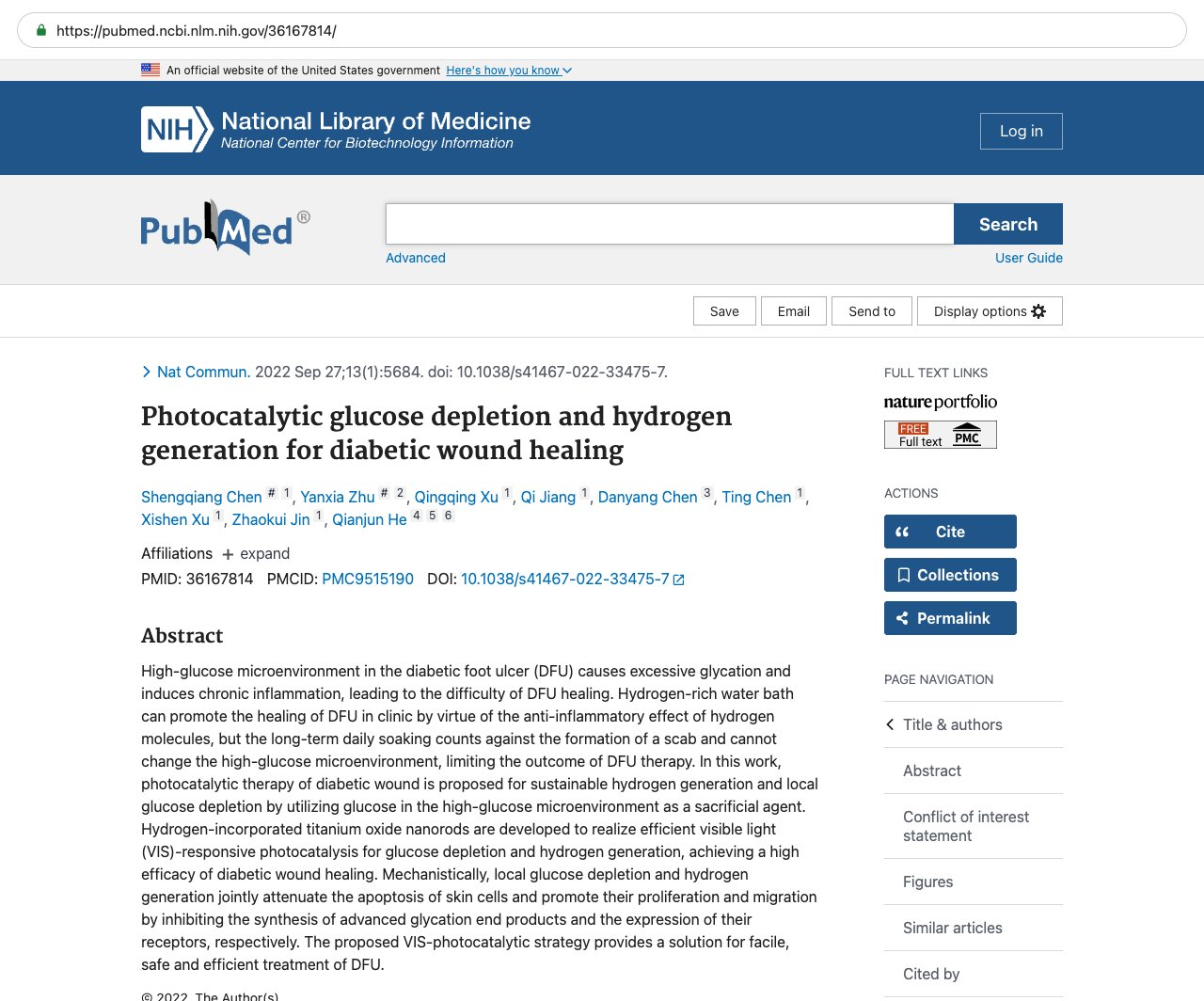
High-glucose microenvironment in the diabetic foot ulcer (DFU) causes excessive glycation and induces chronic inflammation, leading to the difficulty of DFU healing. Hydrogen-rich water bath can promote the healing of DFU in clinic by virtue of the anti-inflammatory effect of hydrogen molecules, but the long-term daily soaking counts against the formation of a scab and cannot change the high-glucose microenvironment, limiting the outcome of DFU therapy. In this work, photocatalytic therapy of diabetic wound is proposed for sustainable hydrogen generation and local glucose depletion by utilizing glucose in the high-glucose microenvironment as a sacrificial agent. Hydrogen-incorporated titanium oxide nanorods are developed to realize efficient visible light (VIS)-responsive photocatalysis for glucose depletion and hydrogen generation, achieving a high efficacy of diabetic wound healing. Mechanistically, local glucose depletion and hydrogen generation jointly attenuate the apoptosis of skin cells and promote their proliferation and migration by inhibiting the synthesis of advanced glycation end products and the expression of their receptors, respectively. The proposed VIS-photocatalytic strategy provides a solution for facile, safe and efficient treatment of DFU.
Source & links
Screenshot of the PubMed page
This page mirrors the published abstract (© the authors / publisher) for reference and citation. The canonical source is the PubMed record linked above. This is not medical advice.