2022 · Asiain-Mira et al. — Hydrogen Production from Urea in Human Urine Using Segregated Systems
Super-Abstract
This study demonstrates a novel process for recovering energy from human urine by extracting urea, decomposing it thermally into ammonia, and then converting ammonia to hydrogen gas (H₂) — a potential energy fuel. Energy balance modelling suggests a city of 160,000 inhabitants could produce 430 kg of H₂ daily through this approach. This is an environmental engineering and circular economy study; it has no connection to therapeutic hydrogen applications. (Water Research, 2022.)
Commentary
This paper addresses the challenge of nitrogen removal from wastewater — one of the most energy-intensive processes in conventional sewage treatment — by reframing urine as a resource rather than waste. The process involves urea adsorption onto activated carbon, thermal desorption at 250°C to regenerate ammonia and CO₂, and subsequent catalytic ammonia decomposition to yield H₂ as an energy carrier. The system demonstrated stable adsorption capacity across five consecutive cycles. This is chemical engineering / sustainable energy research; the H₂ produced is a fuel, not a therapeutic agent.
Key quotes
- „This paper demonstrates the feasibility of a novel process to recover energy from human urine based on the pre-isolation of urea to decrease the energy requirements for its thermal decomposition.“ — the central claim: urea pre-isolation makes thermochemical H₂ production energetically viable
- „Preliminary energy balances show that the adoption of this energy recovery system in a city of 160,000 inhabitants would lead to a daily hydrogen production of 430 kg, with a net energy production of 2,500 kWh/day.“ — the scale estimate — H₂ here is a municipal-scale energy fuel, not a health supplement
- „Such waste-to-energy process would lead to energy savings of 4,600 kWh/day in a conventional wastewater treatment plant reducing its energy consumption by around 35%.“ — the circular economy benefit: turning wastewater treatment from an energy consumer to a partial energy producer
Our assessment
This is an in-vitro / engineering study (wastewater treatment, sustainable energy). It has no relevance to therapeutic molecular hydrogen. H₂ produced here is a combustible fuel for energy generation — not hydrogen-rich water or inhaled H₂ for health purposes. The study is technically sound within its domain of circular economy and sustainable energy. Honest note: This study appears in an H₂-medicine context solely due to keyword overlap; its subject matter is environmental engineering.
Study design
- Type: in-vitro / process engineering study · Model: laboratory-scale urea adsorption/desorption cycles + energy balance modelling · H₂ relevance: none (therapeutic) — H₂ is produced as a combustible energy fuel from urine-derived urea
- Result: stable urea adsorption capacity over ≥5 cycles on activated carbon; thermal decomposition at 250°C achieves full carbon regeneration; projected yield of 430 kg H₂/day for a 160,000-person city; net energy production 2,500 kWh/day; estimated 35% reduction in wastewater treatment energy consumption
Abstract
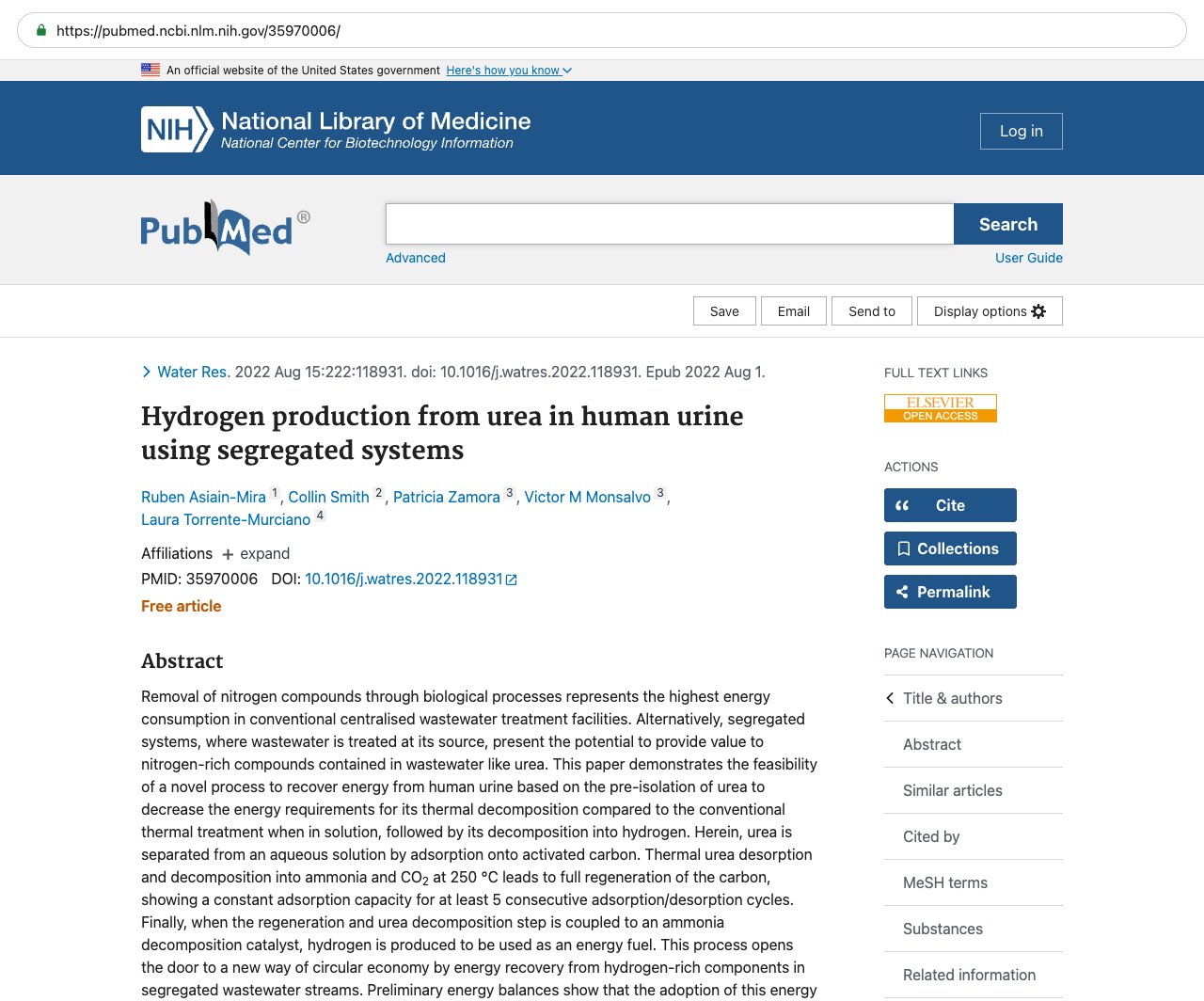
Removal of nitrogen compounds through biological processes represents the highest energy consumption in conventional centralised wastewater treatment facilities. Alternatively, segregated systems, where wastewater is treated at its source, present the potential to provide value to nitrogen-rich compounds contained in wastewater like urea. This paper demonstrates the feasibility of a novel process to recover energy from human urine based on the pre-isolation of urea to decrease the energy requirements for its thermal decomposition compared to the conventional thermal treatment when in solution, followed by its decomposition into hydrogen. Herein, urea is separated from an aqueous solution by adsorption onto activated carbon. Thermal urea desorption and decomposition into ammonia and CO2 at 250 °C leads to full regeneration of the carbon, showing a constant adsorption capacity for at least 5 consecutive adsorption/desorption cycles. Finally, when the regeneration and urea decomposition step is coupled to an ammonia decomposition catalyst, hydrogen is produced to be used as an energy fuel. This process opens the door to a new way of circular economy by energy recovery from hydrogen-rich components in segregated wastewater streams. Preliminary energy balances show that the adoption of this energy recovery system in a city of 160,000 inhabitants would lead to a daily hydrogen production of 430 kg, with a net energy production of 2,500 kWh/day. In addition, such waste-to-energy process would lead to energy savings of 4,600 kWh/day in a conventional wastewater treatment plant reducing its energy consumption by around 35%.
Source & links
Screenshot of the PubMed page
This page mirrors the published abstract (© the authors / publisher) for reference and citation. The canonical source is the PubMed record linked above. This is not medical advice.