2024 Biomedicine & pharmacotherapy = Biomedecine & pharmacotherapie Mechanism / Preclinical Drinking (HRW)
2024 · Lu et al. — Decoupling the Mutual Promotion of Inflammation and Oxidative Stress Mitigates Cognitive Decline and Depression-Like Behavior in rmTBI Mice by Promoting Myelin Renewal and Neuronal Survival
Super-Abstract
In mice subjected to repetitive mild traumatic brain injury (rmTBI), early treatment with hydrogen-rich water (HRW) significantly reduced oxidative stress and inflammasome activation, preserved myelin integrity, and improved both cognitive performance and depression-like behaviour. The study maps the exact time windows of molecular pathology after rmTBI and shows that HRW interrupts the self-reinforcing cycle of inflammation and oxidative damage. This is an animal study; results cannot yet be directly extrapolated to humans.
Commentary
Repetitive mild TBI — as seen in contact sports or military exposure — can produce lasting neurological and psychiatric sequelae through a protracted cascade of oxidative stress and neuroinflammation. This study elegantly addresses both the timing and mechanism: NLRP3 inflammasome activation peaks at 7–14 days post-injury (DPI), while oxidative stress persists for the full first month. HRW administration reduces Nrf2-driven oxidative signalling in the prefrontal cortex and hippocampus, and MR spectroscopy shows partial restoration of neurometabolite ratios. Behavioural endpoints — elevated plus maze, sucrose preference, Morris water maze — all improved with HRW versus untreated rmTBI mice. The strength of this paper is its longitudinal multimodal design: molecular, imaging, and behavioural data across the same time course. Its limitation is fundamental: mouse models of rmTBI differ substantially from human concussion biology, and HRW delivery in drinking water creates uncertain and variable H₂ dosing. Nonetheless, the mechanistic evidence is coherent and suggests a genuinely protective window for early HRW intervention.
Key quotes
- „Early intervention with HRW can attenuate inflammasome assembly and reduce oxidative stress after rmTBI.“ — primary conclusion: HRW interrupts the neuroinflammatory cascade if given early
- „These changes may restore local oligodendrocyte function, promote myelin repair, prevent axonal damage and neuronal apoptosis, and alleviate depression-like behavior and cognitive impairment.“ — proposed downstream mechanism: myelin repair and neuroprotection
- „NLRP-3 expression in the rmTBI group was elevated at 7 and 14 DPI, and inflammasome marker levels returned to normal at 30 DPI. Oxidative stress persisted throughout the first month postinjury.“ — key temporal finding: inflammasome and oxidative stress have different trajectories — both are targets for HRW
Our assessment
A well-designed animal study using multiple complementary methods (immunoblotting, MR spectroscopy, immunofluorescence, behavioural testing) to investigate HRW in repetitive mild TBI. The mechanistic story — HRW decouples the mutual reinforcement of inflammation and oxidative stress — is internally consistent and supported by converging data. Honest limitation: this is an animal study (mice) with no human data. Mouse TBI models are imperfect proxies for human concussion syndromes. H₂ dosing via drinking water is inherently imprecise. Translating these findings to humans requires dedicated clinical studies.
Study design
- Type: preclinical animal study · Model: C57BL/6 mice, repetitive mild traumatic brain injury (rmTBI) · H₂ delivery: hydrogen-rich water (HRW) ad libitum drinking
- Groups: sham / rmTBI / sham+HRW / rmTBI+HRW · Endpoints: NLRP3/Nrf2 expression (immunoblot), MRS neurometabolites, MR-ADC imaging, elevated plus maze, sucrose preference test, Morris water maze
- Result: HRW significantly reduced NLRP3 and Nrf2 signalling, partially normalised neurometabolite ratios, improved anxiety/anhedonia and spatial memory in rmTBI mice — all preclinical
Abstract
BACKGROUND: Repetitive mild traumatic brain injury (rmTBI) can lead to somatic, emotional, and cognitive symptoms that persist for years after the initial injury. Although the ability of various treatments to promote recovery after rmTBI has been explored, the optimal time window for early intervention after rmTBI is unclear. Previous research has shown that hydrogen-rich water (HRW) can diffuse through the blood-brain - barrier, attenuate local oxidative stress, and reduce neuronal apoptosis in patients with severe traumatic brain injury. However, research on the effect of HRW on rmTBI is scarce. AIMS: The objectives of this study were to explore the following changes after rmTBI and HRW treatment: (i) temporal changes in inflammasome activation and oxidative stress-related protein expression through immunoblotting, (ii) temporal changes in neuron/myelin-related metabolite concentrations in vivo through magnetic resonance spectroscopy, (iii) myelin structural changes in late-stage rmTBI via immunofluorescence, and (iv) postinjury anxiety/depression-like behaviors and spatial learning and memory impairment. RESULTS: NLRP-3 expression in the rmTBI group was elevated at 7 and 14 DPI, and inflammasome marker levels returned to normal at 30 DPI. Oxidative stress persisted throughout the first month postinjury. HRW replacement significantly decreased Nrf2 expression in the prefrontal cortex and hippocampal CA2 region at 14 and 30 DPI, respectively. Edema and local gliosis in the hippocampus and restricted diffusion in the thalamus were observed on MR-ADC images. The tCho/tCr ratio in the rmTBI group was elevated, and the tNAA/tCr ratio was decreased at 30 DPI. Compared with the mice in the other groups, the mice in the rmTBI group spent more time exploring the open arms in the elevated plus maze (P < 0.05) and were more active in the maze (longer total distance traveled). In the sucrose preference test, the rmTBI group exhibited anhedonia. In the Morris water maze test, the latency to find the hidden platform in the rmTBI group was longer than that in the sham and HRW groups (P < 0.05). CONCLUSION: Early intervention with HRW can attenuate inflammasome assembly and reduce oxidative stress after rmTBI. These changes may restore local oligodendrocyte function, promote myelin repair, prevent axonal damage and neuronal apoptosis, and alleviate depression-like behavior and cognitive impairment.
Source & links
Screenshot of the PubMed page
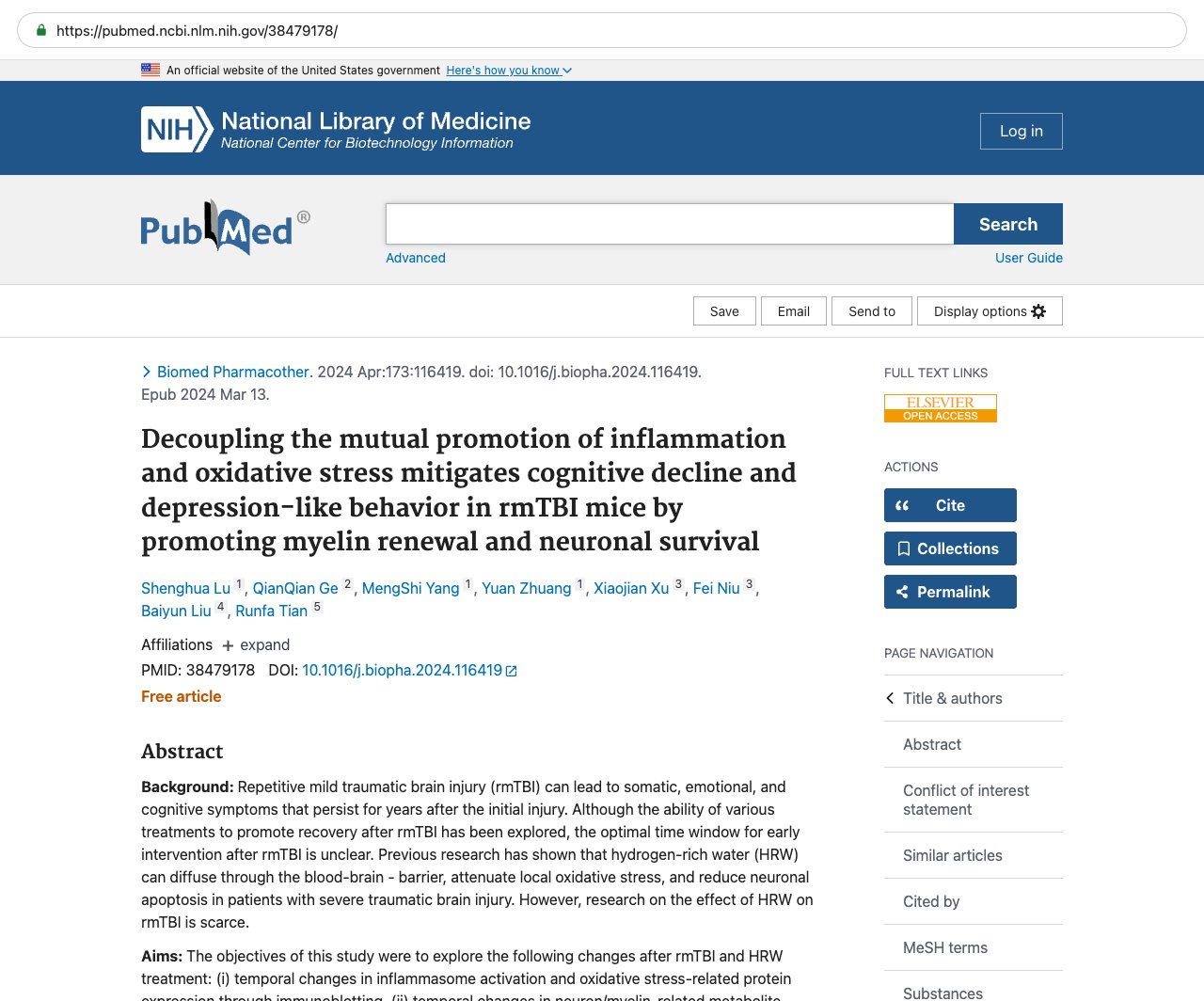
This page mirrors the published abstract (© the authors / publisher) for reference and citation. The canonical source is the PubMed record linked above. This is not medical advice.