2022 · An — Gender-based differences in neuroprotective effects of hydrogen gas against intracerebral hemorrhage-induced depression
Super-Abstract
In a mouse model of intracerebral hemorrhage (ICH), hydrogen gas inhalation provided stronger neuroprotective effects against post-stroke depression in female mice than in males — and adding estrogen to male mice restored comparable H₂ efficacy. The study identifies estrogen-mediated suppression of NF-κB signaling in astrocytes as the likely explanation. This is an animal study; results cannot be directly transferred to humans. (Neurochemistry International, 2022.)
Commentary
Post-stroke depression (PSD) affects a significant proportion of patients after intracerebral hemorrhage and worsens functional recovery. Previous hydrogen research has largely ignored potential sex-based differences in response — a gap this study directly addresses. Using an autologous blood injection model in the basal ganglia of rodents, the researchers treated animals with 2.9 % H₂ for 2 hours daily for three days after the ICH event, then evaluated depression-like behaviors at 30 days via sucrose preference, forced swimming, and social interaction tests. Female mice showed significantly better outcomes than males under the same H₂ protocol. When male mice received estrogen alongside H₂, their behavioral and biochemical outcomes converged with females. The mechanism centers on NF-κB signaling in amygdala astrocytes: estrogen appears to enhance H₂'s ability to suppress NF-κB (and its downstream mediators IKKβ, IL-1β, IL-6), reducing neuroinflammation in the amygdala. An important caveat: this is a highly specific model (ICH → depression, not general depression), and the role of estrogen in modulating H₂ sensitivity has not been studied in humans.
Key quotes
- „Estrogen was responsible for increased H2 sensitivity in male mice with ICH.“ — the central mechanistic conclusion
- „The underlying mechanism may be associated with the suppression of NF-κB signaling in astrocytes.“ — proposed molecular pathway in the amygdala
- „Compared with female mice, H2 administration post-ICH exhibited fewer neuroprotective effects.“ — the sex difference that motivates the whole study
Our assessment
A preclinical animal study highlighting an important but under-researched dimension of H₂ research: sex-based differences in response. The finding that estrogen modulates H₂ efficacy is scientifically interesting and has potential implications for designing human trials (e.g., whether H₂ interventions should stratify by sex or hormonal status). However, all results are from mice, and the specific model (post-ICH depression) limits direct generalization even within the preclinical field.
Study design
- Type: preclinical animal study (in-vivo) · Model: ICH mouse model (autologous blood injection into basal ganglia); groups: sham / ICH / ICH + H₂ (male) / ICH + H₂ (female) / ICH + estrogen + H₂ (male) · H₂ delivery: inhalation of 2.9 % H₂ for 2 hours/day × 3 days post-ICH
- Result: females showed better neuroprotection with H₂ than males; estrogen administration in males restored H₂ efficacy; mechanism: suppression of NF-κB / IKKβ / IL-1β / IL-6 in amygdala astrocytes; behavioral readouts at day 30 post-ICH
Abstract
BACKGROUND: Post-stroke depression (PSD) severely affects recovery in patients with intracerebral hemorrhage (ICH). Although hydrogen gas (H2) exerts excellent neuroprotective effects in patients with ICH, there are sex-based differences in H2 efficacy in several diseases. Herein, we determined whether estrogen increases susceptibility to the neuroprotective effects of H2 in males with ICH-induced depression. METHODS: A rodent model of ICH in the basal ganglia was established using autologous blood injection (30 μL). Mice were treated with 2.9% H2 for 2 h daily for 3 days post-ICH. Estrogen (1 mg/kg) was administered by subcutaneous injection daily for 3 days to male mice post-ICH. Thirty days post-ICH, PSD was evaluated by sucrose preference, forced swimming, and 3-chamber social tests. Following the completion of behavioral tests, levels of superoxide dismutase (SOD) and reactive oxygen species (ROS), astrocytic activation, phosphorylated (p)-NF-κB-positive astrocytes, p-NF-κB, p-IKKβ, IL-1β, and IL-6 expression were determined. RESULTS: Compared with female mice, H2 administration post-ICH exhibited fewer neuroprotective effects, including decreased sucrose consumption and time spent sniffing a novel mouse, increased immobility time, downregulated total SOD content, upregulated ROS content and p-NF-κB levels, and elevated astrocyte branches, whereas estrogen enhanced the neuroprotective effects of H2 in male mice. A reduced number of p-NF-κB-positive astrocytes, downregulated expression of p-NF-κB, p-IKKβ, IL-1β, and IL-6 in the amygdala were demonstrated in ICH-males treated with estrogen plus H2. CONCLUSIONS: Estrogen was responsible for increased H2 sensitivity in male mice with ICH. The underlying mechanism may be associated with the suppression of NF-κB signaling in astrocytes.
Source & links
Screenshot of the PubMed page
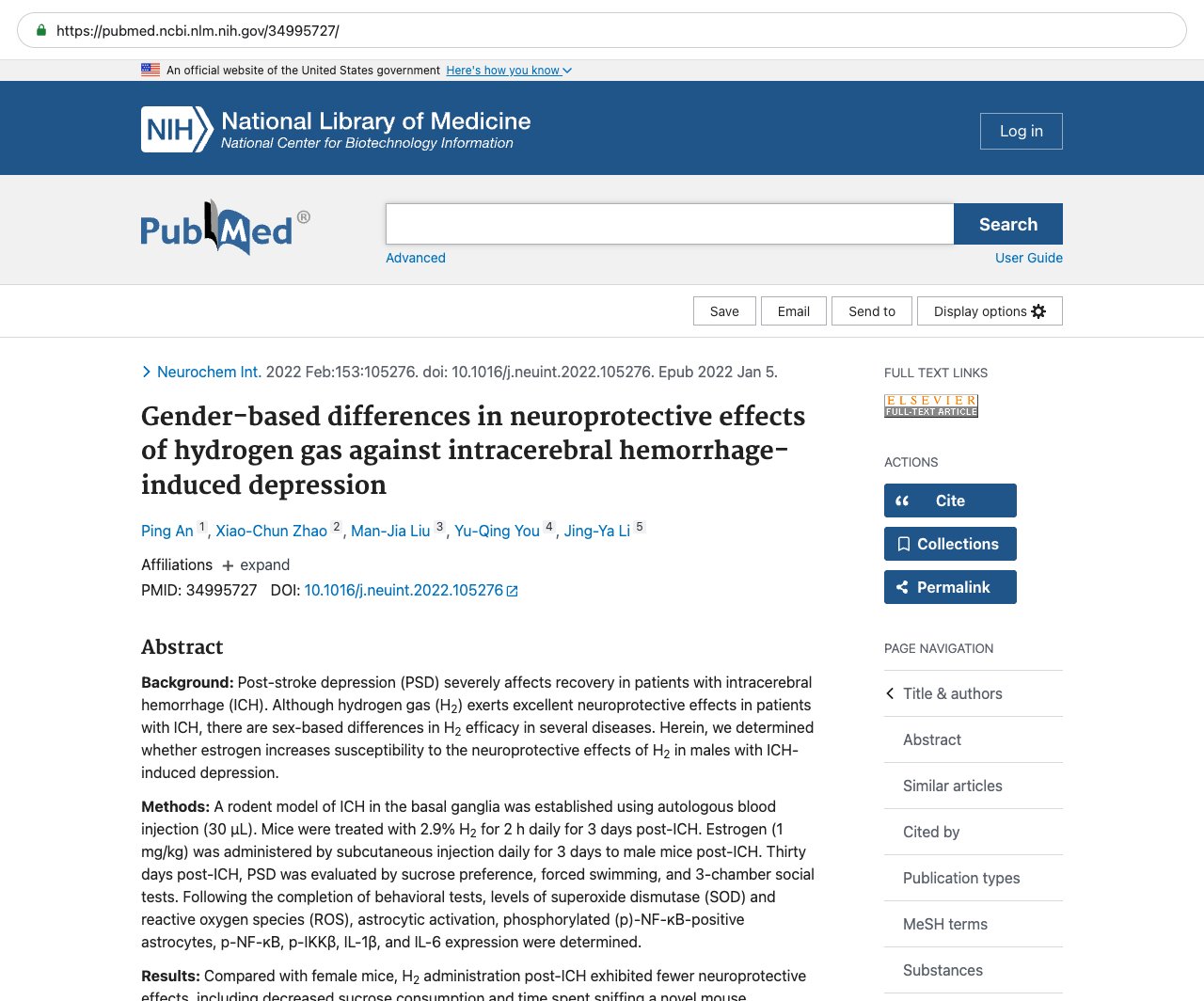
This page mirrors the published abstract (© the authors / publisher) for reference and citation. The canonical source is the PubMed record linked above. This is not medical advice.