2025 · Seya — Hydrogen-rich Gas Enhances Mitochondrial Membrane Potential and Respiratory Function Recovery in Caco-2 Cells Post-ischemia-reperfusion Injury
Super-Abstract
Hydrogen-rich gas restored mitochondrial function in human intestinal cells (Caco-2) after simulated ischemia-reperfusion injury, improving ATP production, mitochondrial membrane potential, and oxygen consumption while reducing cell death signals. This in-vitro study in cultured cells builds on prior animal work and proposes that H₂ acts upstream of the hypoxia-driven HIF1α signalling pathway. (Biochemical and Biophysical Research Communications, 2025.)
Commentary
Ischemia-reperfusion (I/R) injury — where blood flow restoration after a period of deprivation paradoxically damages tissue — is a central problem in transplant surgery, cardiac events, and critical illness. The intestinal epithelium is especially vulnerable. Seya et al. use a cell culture model of I/R (hypoxia followed by reoxygenation) in Caco-2 cells and demonstrate that high-concentration H₂ gas (99% H₂) during the hypoxic phase substantially improves mitochondrial recovery. The finding that H₂ suppresses HIF1α and its downstream effector PDK1 is mechanistically interesting — it suggests H₂ may intervene in the hypoxic signalling cascade rather than simply scavenging ROS after the fact. This is exclusively in-vitro work; the 99% H₂ concentration used is not clinically applicable and serves as a maximal experimental stimulus. The authors' own prior work in rat intestinal transplantation provides biological plausibility, but the jump to human clinical application requires intermediate animal and safety steps.
Key quotes
- „H2 markedly promoting mitochondrial recovery following I/R injury, by enhancing ATP production, restoring mitochondrial membrane potential, and improving oxygen consumption.“ — the three key mitochondrial parameters improved by H₂ treatment
- „H2 suppressed the expression of HIF1α and PDK1, suggesting that H2 may act upstream of hypoxia-driven signaling pathways.“ — a novel mechanistic hypothesis: H₂ as an upstream hypoxia-signalling modulator
- „These insights advance the understanding of H2's potential in addressing I/R injury and provide a foundation for its application in other hypoxia-related conditions.“ — the broader mechanistic implication for H₂ in hypoxia-related disease
Our assessment
This is an in-vitro cell study — no animal or human data are included. The H₂ concentration used (99%) is experimentally maximal and not translatable to clinical settings. The study advances mechanistic understanding of how H₂ may protect mitochondria from I/R injury, specifically by modulating HIF1α/PDK1 signalling. This is cell biology, not a clinical proof of concept. Further animal studies and then controlled human trials would be required before any clinical conclusions.
Study design
- Type: in-vitro study · Model: Caco-2 human intestinal epithelial cells, hypoxia-reoxygenation I/R model · H₂ delivery: 99% H₂ gas (with 1% O₂) during hypoxic phase; compared with 99% N₂ (hypoxia-only control) and normoxia control
- Result: H₂ enhanced ATP production, restored mitochondrial membrane potential, improved oxygen consumption; reduced ROS and pro-apoptotic signalling; suppressed HIF1α and PDK1 expression; promoted oxidative phosphorylation during reperfusion; all effects across multiple hypoxia durations (3, 6, 24 h) and reoxygenation time points
Abstract
BACKGROUND: Ischemia-reperfusion (I/R) injury induces oxidative stress, leading to damage in highly susceptible intestinal tissues. Molecular hydrogen (H2) has shown therapeutic potential in I/R injuries, with our prior research showing its efficacy in improving outcomes in rat intestinal transplantation models. However, its impact on mitochondrial function remain insufficiently understood. This study aims to elucidate how H2 modulates mitochondrial function impaired by I/R injury. METHODS: To assess the effects of H2 on I/R injury, cells were divided into three groups: a control group, a hypoxic group (99 % N2, 1 % O2, without H2 for 3, 6, or 24 h), and a hypoxic-H2 group (99 % H2, 1 % O2, for the same durations). After treatment, cells were reoxygenated under normoxic conditions (21 % O2) for 1, 2, 4, or 6 h. Mitochondrial membrane potential, oxygen consumption, and ATP production were measured. Reactive oxygen species production and apoptotic and metabolic regulators were also assessed. RESULTS: H2 markedly promoting mitochondrial recovery following I/R injury, by enhancing ATP production, restoring mitochondrial membrane potential, and improving oxygen consumption. It also reduced ROS levels and suppressed pro-apoptotic signaling. Notably, H2 suppressed the expression of HIF1α and PDK1, suggesting that H2 may act upstream of hypoxia-driven signaling pathways. These changes promoted oxidative phosphorylation and overall cellular function during reperfusion. CONCLUSIONS: Our findings reveal that H2 therapy supports mitochondrial function, suppresses ROS, and modulates hypoxia-driven pathways in I/R injury. These insights advance the understanding of H2's potential in addressing I/R injury and provide a foundation for its application in other hypoxia-related conditions.
Source & links
Screenshot of the PubMed page
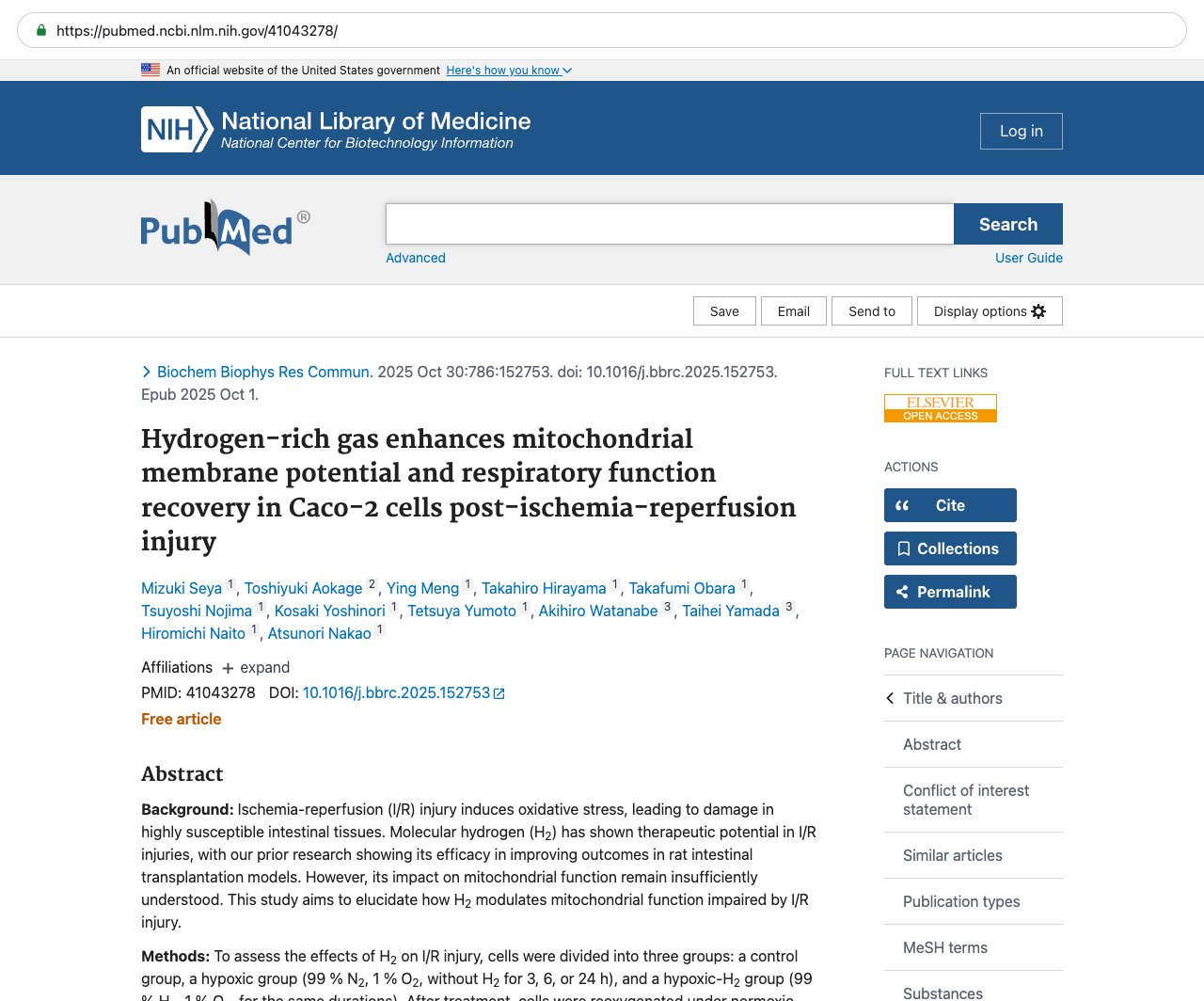
This page mirrors the published abstract (© the authors / publisher) for reference and citation. The canonical source is the PubMed record linked above. This is not medical advice.