2025 · Qiu — 3D printing combined with pH-induced 4D printed iron(III)-oxidized starch gels for controlled iron delivery and enhanced iron supplementation.
Super-Abstract
Iron deficiency anaemia can be treated more effectively with a new type of 3D-/4D-printed starch gel that releases iron only in the small intestine, not in the stomach — improving bioavailability while reducing side effects. The study uses oxidised starch cross-linked with iron ions; hydrogen plays a structural role in the starch network, not a therapeutic one. This is an in-vitro and animal study; the connection to hydrogen gas therapy is indirect and structural. (Carbohydrate Polymers, 2025.)
Commentary
This study is primarily about iron supplementation technology for treating iron deficiency anaemia (IDA) — its connection to molecular hydrogen (H₂) therapy is structural rather than pharmacological. The paper uses „molecular hydrogen bonding“ (intramolecular starch interactions) as a descriptor of the material's structural properties, not as a therapeutic modality. The 4D-printed gels exploit pH-responsive behaviour: they resist iron release in gastric acid (<30%) but release rapidly in the small intestine (>85%), aiming at the proximal small intestine where iron absorption is maximal. In anaemic mice, biochemical and haematological recovery was better than iron salts. This is a clever materials-science approach to an old nutritional problem. However, the study uses hydrogen-rich water (drinking-hrw) only in the sense of background chemistry — not as an H₂ therapy. Any therapeutic role of H₂ gas is not addressed in this study.
Key quotes
- „Rheological analysis revealed Fe3+ hydrolysis disrupted starch molecular hydrogen bonding and reducing molecular weight, leading to diminished gel network uniformity and density.“ — „hydrogen“ here refers to intermolecular hydrogen bonds in starch — not to H₂ gas
- „In vitro digestion demonstrated gastric resistance (<30 % Fe3+ release) and rapid iron release (>85 %) in the proximal small intestine.“ — the key pharmacokinetic property: protected in the stomach, released where needed
- „In vivo evaluation in IDA mice showed that 4D-FeOMS significantly restored biochemical and hematological parameters, increased organ iron stores (restored >94.6 %), and enhanced antioxidant enzyme activity.“ — animal efficacy data — iron supplementation, not hydrogen therapy
Our assessment
This study has limited direct relevance to molecular hydrogen (H₂) therapy. The term „hydrogen“ in the paper describes chemical hydrogen bonding in starch networks — a standard structural chemistry concept — not therapeutic hydrogen gas or hydrogen-rich water. The study itself is a materials-science contribution to iron supplementation technology, with solid in-vitro and animal data showing improved iron bioavailability. As a preclinical study, results are not directly transferable to human patients. The 4D-printing concept for targeted mineral delivery is innovative and warrants further clinical evaluation — but as an iron supplement technology, not as H₂ therapy.
Study design
- Type: in-vitro + animal study (preclinical) · Model: iron deficiency anaemia (IDA) mice + in-vitro digestion simulation · H₂ role: „molecular hydrogen bonding“ = structural starch chemistry, not therapeutic H₂ gas
- Material: 4D-printed ferric-oxidised starch gels (4D-FeOMS) — pH-triggered transformation; gastric resistance < 30 % Fe³⁺ release, proximal small intestine > 85 % release
- Result: superior recovery of biochemical and haematological parameters vs. iron salts and 3D-FeOMS in IDA mice; organ iron stores restored > 94.6 %; enhanced antioxidant enzyme activity
Abstract
Iron deficiency anemia (IDA) necessitates effective iron supplementation with high bioavailability and controlled release. This study developed 4D-printed ferric-oxidized starch gels (4D-FeOMS) as a stimulus-responsive platform for targeted iron delivery. By combining hot-extrusion 3D printing with pH-triggered 4D transformation, Fe3+ was effectively coordinated within oxidized starch networks via ionic crosslinking. Rheological analysis revealed Fe3+ hydrolysis disrupted starch molecular hydrogen bonding and reducing molecular weight, leading to diminished gel network uniformity and density. Compared to 3D-printed samples (3D-FeOMS), 4D-FeOMS exhibited red-shifted CO FTIR peaks, lower Fe 2p XPS binding energies, and reduced correlation length (ξ), indicating improved molecular entanglement and network uniformity. In vitro digestion demonstrated gastric resistance (<30 % Fe3+ release) and rapid iron release (>85 %) in the proximal small intestine. In vivo evaluation in IDA mice showed that 4D-FeOMS significantly restored biochemical and hematological parameters, increased organ iron stores (restored >94.6 %), and enhanced antioxidant enzyme activity, outperforming iron salts and 3D-FeOMS. Mechanistically, 4D-FeOMS optimized hepcidin expression and regulated ferritin/transferrin levels, facilitating systemic iron transport. Notably, 4D-FeOMS-10 % demonstrated iron supplementation efficacy performance due to the appropriate iron addition and optimal Fe3+ complexation. These findings highlighted the potential of 4D-printed starch-based platforms as intelligent mineral delivery systems for treating micronutrient deficiencies.
Source & links
Screenshot of the PubMed page
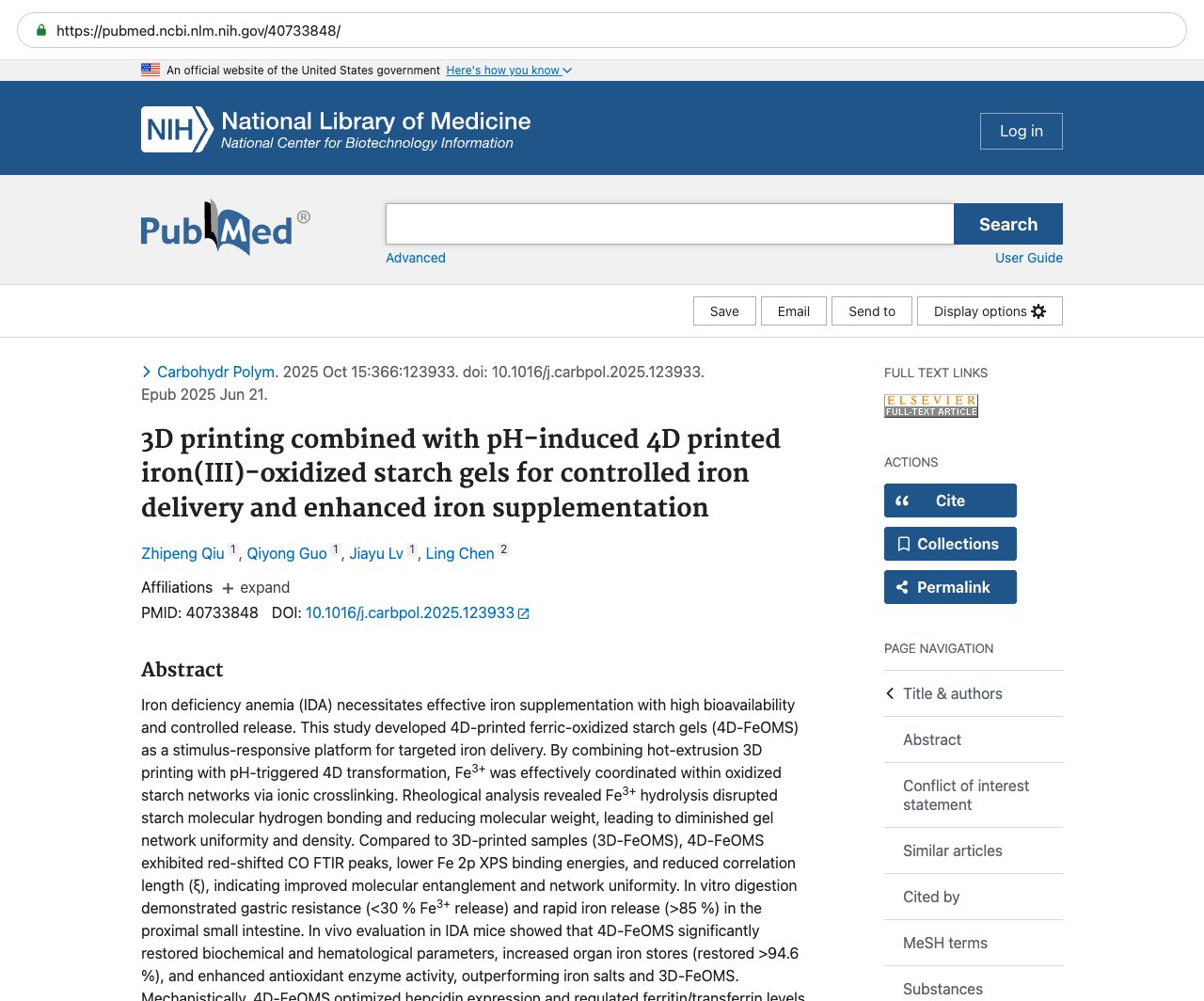
This page mirrors the published abstract (© the authors / publisher) for reference and citation. The canonical source is the PubMed record linked above. This is not medical advice.