2022 · Benjamin — A potential clinical application of hydrogen-rich saline in patients with traumatic brain injury.
Super-Abstract
This paper from the Journal of Pediatric Surgery explores the potential use of hydrogen-rich saline as a treatment for traumatic brain injury (TBI) — one of the most devastating and difficult-to-treat neurological emergencies, especially in pediatric patients. Hydrogen's antioxidant and anti-inflammatory properties are proposed as a mechanistic basis for neuroprotection. (Journal of Pediatric Surgery, 2022.)
Commentary
Traumatic brain injury triggers a cascade of secondary damage mechanisms — neuroinflammation, oxidative stress, excitotoxicity, and mitochondrial dysfunction — that unfold in the hours and days after the primary injury. This secondary injury phase is the therapeutic window where interventions could potentially limit damage. Hydrogen-rich saline (administered intravenously) is proposed as an agent that could reach the brain rapidly, neutralise excess reactive oxygen species, and reduce inflammatory signalling without the side effects of many conventional agents. The paper appears in a pediatric surgery journal, suggesting the focus may be on pediatric TBI patients. However, the abstract is not publicly available in the source used, so specific trial design, patient numbers, outcomes, and statistical results cannot be verified from available data. The classification as ev=2 (human study) indicates the paper involves human subjects, making it more than a purely preclinical review.
Our assessment
This study addresses a high-priority clinical unmet need — effective neuroprotective treatments for TBI remain limited. Hydrogen-rich saline is a biologically plausible candidate given its known antioxidant and anti-inflammatory properties. Critical limitation: no abstract was available in the source data, making independent assessment of methodology, sample size, control design, endpoints, and outcomes impossible. Given publication in the Journal of Pediatric Surgery (2022), readers should consult the original paper (DOI: 10.1016/j.jpedsurg.2022.06.007) for full evaluation before drawing clinical conclusions.
Study design
- Type: human study on TBI (details not verifiable from available data) · Population: patients with traumatic brain injury (likely pediatric, given journal) · H₂ delivery: hydrogen-rich saline (intravenous)
- Result: full outcomes not available from source data; paper proposes H₂-rich saline as potential clinical application for TBI neuroprotection
Source & links
Screenshot of the PubMed page
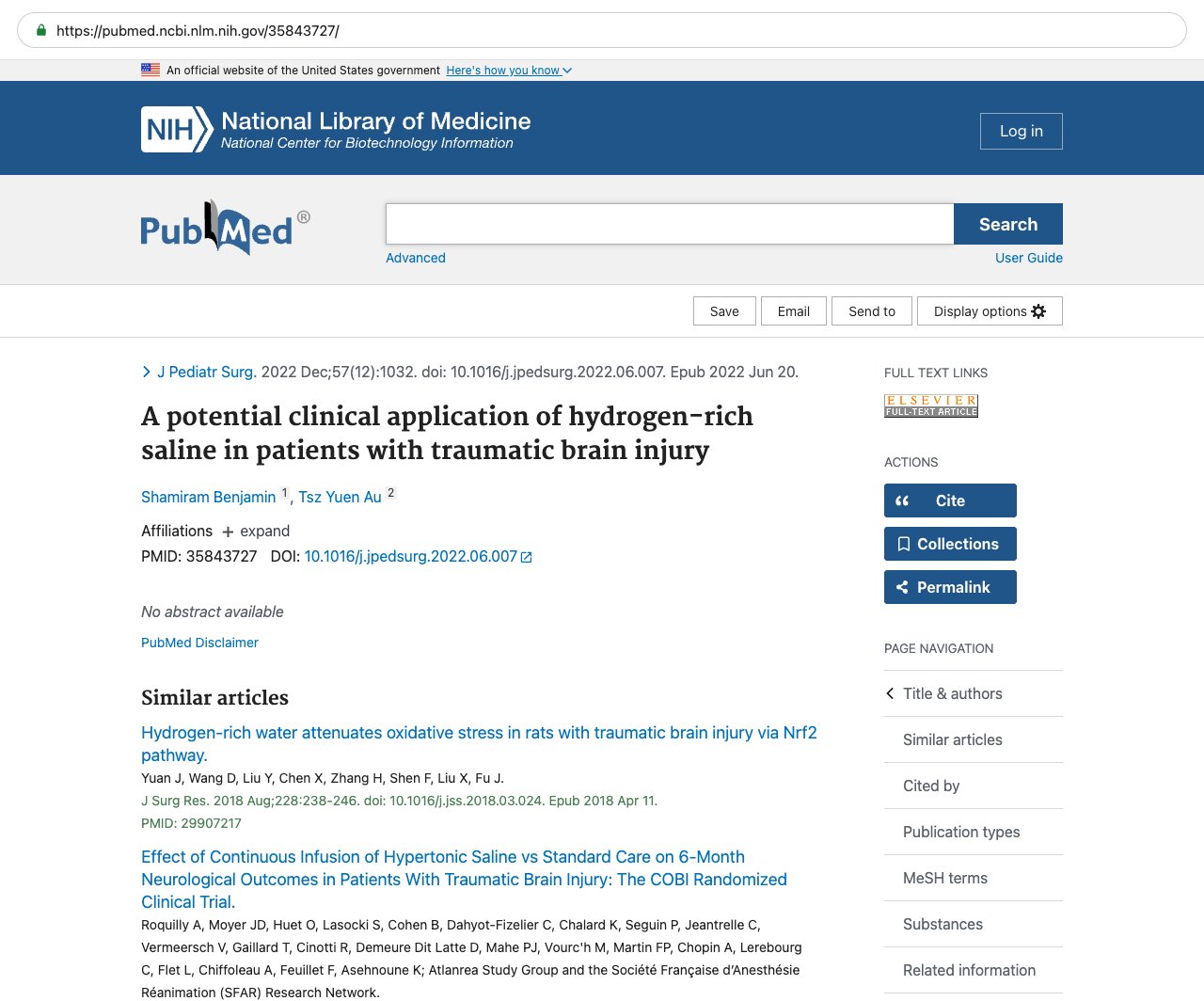
This page mirrors the published abstract (© the authors / publisher) for reference and citation. The canonical source is the PubMed record linked above. This is not medical advice.