2010 · Liu — Oral administration of mannitol may be an effective treatment for ischemia-reperfusion injury.
Super-Abstract
This hypothesis paper proposes that oral mannitol — a sugar alcohol that promotes bacterial hydrogen gas production in the colon — could protect organs from ischaemia-reperfusion injury by raising endogenous H₂ levels. The authors previously showed that intraperitoneal H₂-rich saline protects the brain, heart and intestine from reperfusion injury in rats, and now extend that logic to an oral mannitol strategy for boosting the body's own H₂ production. This is a theoretical proposal, not a clinical trial.
Commentary
This paper builds on the team's own preclinical work with H₂-rich saline and proposes a new delivery route: rather than administering H₂ externally, mannitol fermentation by colonic bacteria could generate endogenous H₂ in situ. Preliminary human and animal data mentioned in the abstract suggest mannitol does raise breath hydrogen levels, but no controlled efficacy data for ischaemia-reperfusion outcomes in humans are presented. The hypothesis is mechanistically plausible — endogenous colonic H₂ has been detected in the bloodstream and may have systemic antioxidant effects. However, this remains speculative and requires rigorous experimental validation before any clinical conclusions can be drawn.
Key quotes
- „Inhalation of hydrogen gas has been proved to be an effective treatment for ischemia-reperfusion injury.“ — the preclinical evidence base the hypothesis builds upon
- „Bacteria in the large intestinal can produce endogenous hydrogen, and our preliminary experiments revealed that oral administration of mannitol in humans and animals can significantly increase the level of endogenous hydrogen.“ — the key observation: mannitol raises endogenous H₂ via colonic fermentation
- „We speculated that oral administration of mannitol may be effective against ischemia-reperfusion injury, which is a convenient, effective and unique treatment for ischemia-reperfusion injury.“ — the central hypothesis — authors themselves use „speculated”, indicating its preliminary nature
Our assessment
This is a hypothesis paper proposing oral mannitol as an indirect H₂ delivery strategy for ischaemia-reperfusion protection. It is not a clinical trial or controlled animal study. The mechanistic basis (colonic bacterial H₂ → blood H₂ → organ protection) is biologically plausible and consistent with the known biology of endogenous H₂. However, no efficacy data in humans are presented, and the leap from breath H₂ levels to organ protection against ischaemia is significant and untested here. It represents an interesting hypothesis for future investigation.
Study design
- Type: hypothesis / theory paper · n: n/a (preliminary pilot observations mentioned but not fully reported) · H₂ delivery: oral mannitol → colonic bacterial H₂ production (proposed indirect route); also references inhalation and i.p. saline data from prior work
- Result: no efficacy outcomes reported; preliminary observation that mannitol raises breath H₂ in humans and animals; hypothesis proposed for future experimental testing
Abstract
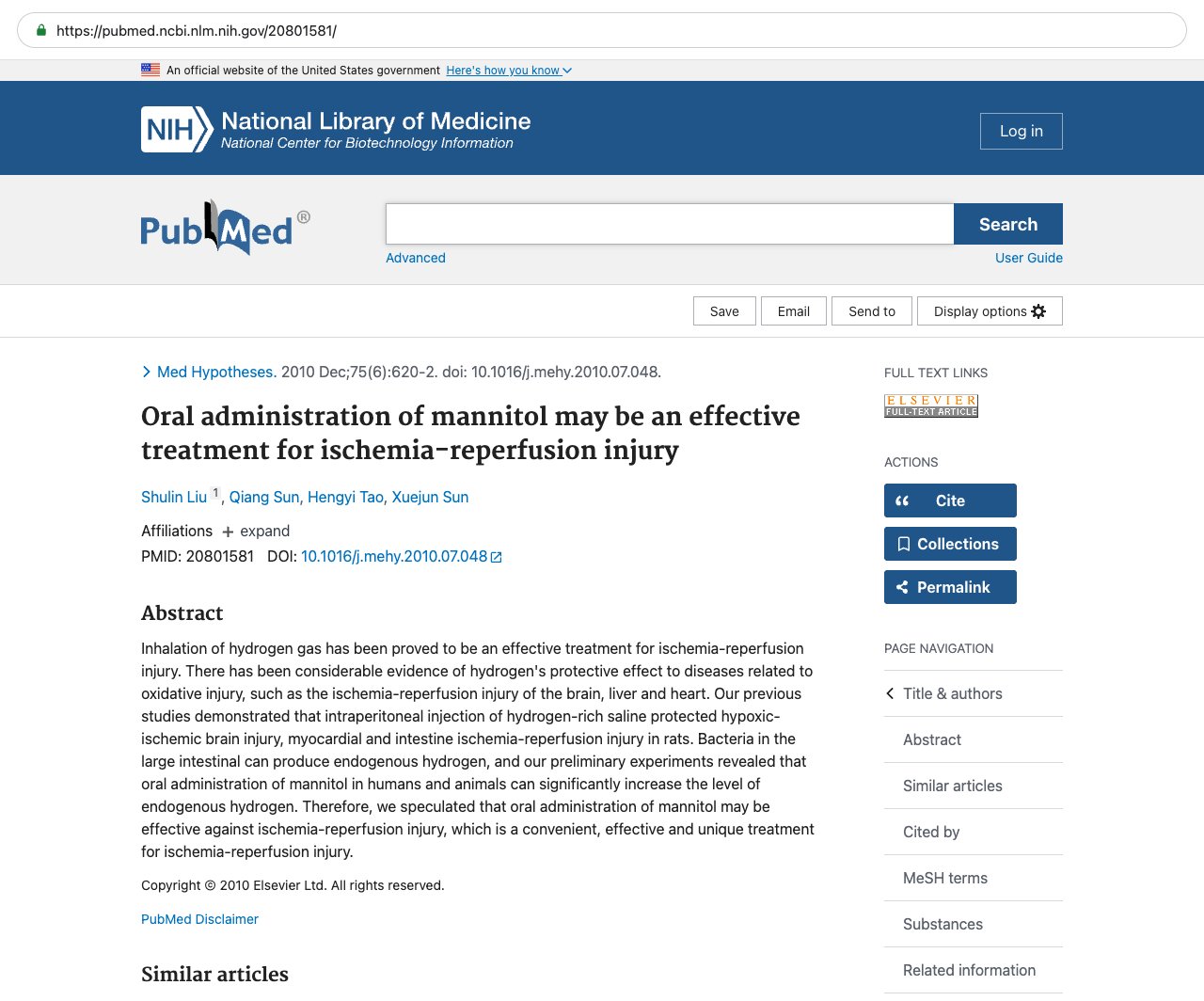
Inhalation of hydrogen gas has been proved to be an effective treatment for ischemia-reperfusion injury. There has been considerable evidence of hydrogen's protective effect to diseases related to oxidative injury, such as the ischemia-reperfusion injury of the brain, liver and heart. Our previous studies demonstrated that intraperitoneal injection of hydrogen-rich saline protected hypoxic-ischemic brain injury, myocardial and intestine ischemia-reperfusion injury in rats. Bacteria in the large intestinal can produce endogenous hydrogen, and our preliminary experiments revealed that oral administration of mannitol in humans and animals can significantly increase the level of endogenous hydrogen. Therefore, we speculated that oral administration of mannitol may be effective against ischemia-reperfusion injury, which is a convenient, effective and unique treatment for ischemia-reperfusion injury.
Source & links
Screenshot of the PubMed page
This page mirrors the published abstract (© the authors / publisher) for reference and citation. The canonical source is the PubMed record linked above. This is not medical advice.