2016 · Zhang — Treatment with Hydrogen-Rich Saline Delays Disease Progression in a Mouse Model of Amyotrophic Lateral Sclerosis
Super-Abstract
In a transgenic mouse model of ALS, hydrogen-rich saline (HRS) significantly delayed disease onset, prolonged survival, and protected motor neurons from oxidative damage and mitochondrial dysfunction. Classical antioxidants have repeatedly failed in ALS clinical trials; H₂ offers a mechanistically distinct profile. This is a preclinical animal study — no human ALS data exist for H₂. (Neurochemical Research, 2016.)
Commentary
ALS (amyotrophic lateral sclerosis) is a devastating motor neuron disease with very limited treatment options. Oxidative stress — particularly from mutant SOD1 — is strongly implicated in its pathogenesis, yet classical antioxidants like vitamin E or CoQ10 have not succeeded in clinical trials, possibly because they fail to reach mitochondria in sufficient concentrations or act too upstream/downstream in the damage cascade. Zhang et al. treated SOD1-G93A transgenic mice (a standard ALS model) with daily intraperitoneal HRS and found delayed disease onset and prolonged survival. Mechanistically, HRS inhibited mitochondrial apoptogenic factor release and downstream caspase-3 activation, reduced protein carbonyl and 3-nitrotyrosine levels, suppressed ROS and peroxynitrite, and preserved mitochondrial respiratory complex I and IV activities — recovering ATP synthesis. Motor neuron loss was attenuated and microglial/glial activation suppressed. The mitochondria-targeted mechanism (H₂ diffuses freely into mitochondria) may explain why H₂ succeeds where larger antioxidant molecules have not in this model. However, the SOD1-G93A model does not fully capture human ALS pathology.
Key quotes
- „Treatment of mutant SOD1 G93A mice with HRS significantly delayed disease onset and prolonged survival, and attenuated loss of motor neurons and suppressed microglial and glial activation.“ — primary survival and neuroprotection outcomes
- „Treatment with HRS preserved mitochondrial function, marked by restored activities of Complex I and IV, reduced mitochondrial ROS formation and enhanced mitochondrial adenosine triphosphate synthesis.“ — key mitochondria-protective mechanism
- „Classical antioxidants have not performed well in clinical trials.“ — context explaining the rationale for testing H₂ in ALS — H₂ reaches mitochondria differently
Our assessment
This is a preclinical mouse study — not a human clinical trial. The findings are encouraging: HRS delayed ALS progression in the standard SOD1-G93A model via a multi-target mitochondria-protective mechanism. The SOD1-G93A model is the most-used ALS model but represents only ~2 % of human ALS cases (familial SOD1 mutations), so generalizability to sporadic ALS is limited. Daily i.p. injections are not a realistic clinical route. No human safety or dose data exist for H₂ in ALS. These results justify further translational research but cannot be interpreted as evidence for H₂ efficacy in human ALS patients.
Study design
- Type: animal study (in vivo, transgenic mouse model of ALS) · Model: SOD1-G93A transgenic mice · H₂ delivery: hydrogen-rich saline (HRS), daily intraperitoneal injection
- Result: delayed disease onset, prolonged survival; ↓motor neuron loss, ↓microglial activation; ↓caspase-3, ↓cytochrome c release; ↓protein carbonyl, ↓3-nitrotyrosine, ↓ROS, ↓peroxynitrite, ↓MDA; ↑Complex I+IV activity, ↓mitochondrial ROS, ↑ATP synthesis — all in SOD1-G93A mice only
Abstract
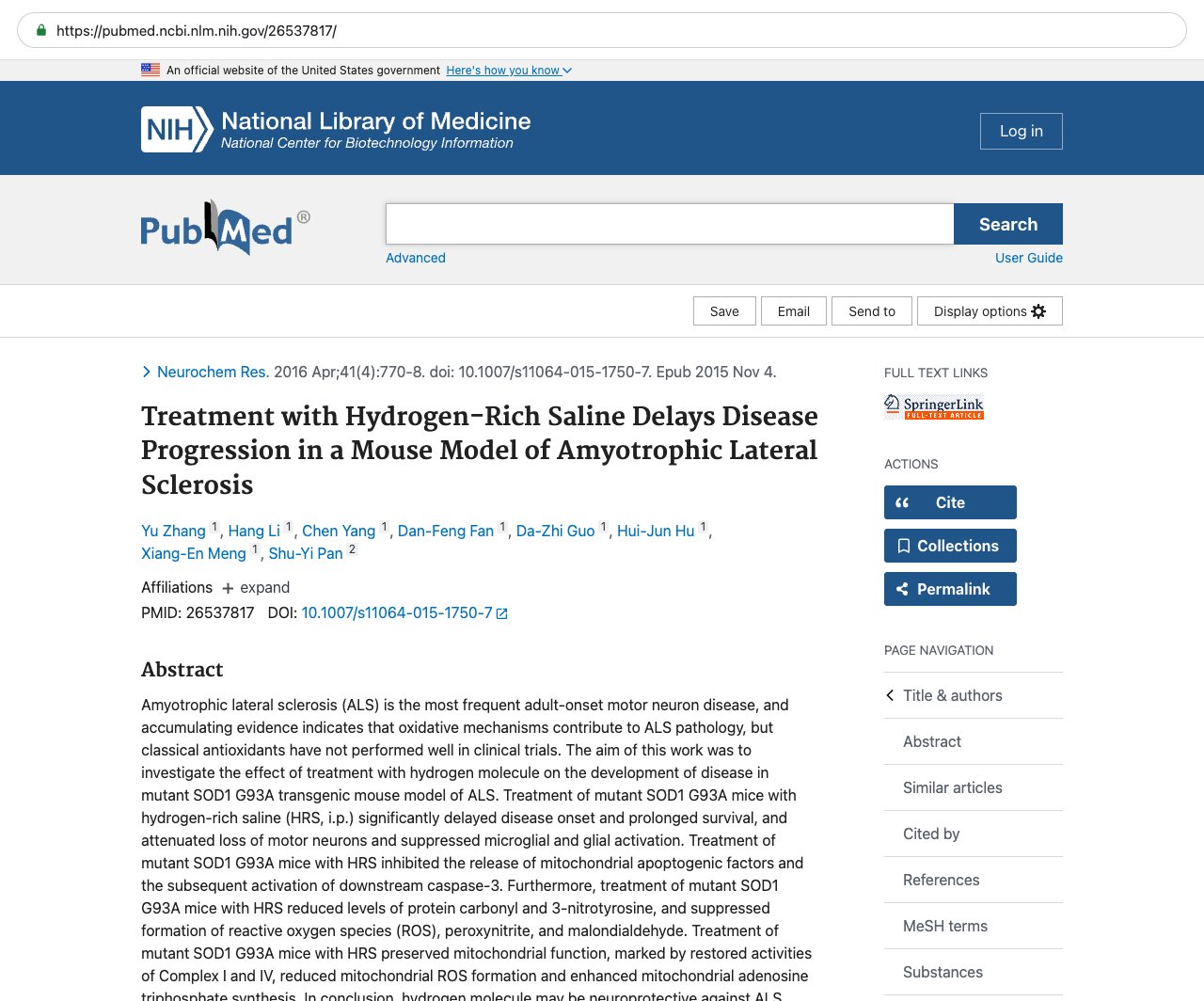
Amyotrophic lateral sclerosis (ALS) is the most frequent adult-onset motor neuron disease, and accumulating evidence indicates that oxidative mechanisms contribute to ALS pathology, but classical antioxidants have not performed well in clinical trials. The aim of this work was to investigate the effect of treatment with hydrogen molecule on the development of disease in mutant SOD1 G93A transgenic mouse model of ALS. Treatment of mutant SOD1 G93A mice with hydrogen-rich saline (HRS, i.p.) significantly delayed disease onset and prolonged survival, and attenuated loss of motor neurons and suppressed microglial and glial activation. Treatment of mutant SOD1 G93A mice with HRS inhibited the release of mitochondrial apoptogenic factors and the subsequent activation of downstream caspase-3. Furthermore, treatment of mutant SOD1 G93A mice with HRS reduced levels of protein carbonyl and 3-nitrotyrosine, and suppressed formation of reactive oxygen species (ROS), peroxynitrite, and malondialdehyde. Treatment of mutant SOD1 G93A mice with HRS preserved mitochondrial function, marked by restored activities of Complex I and IV, reduced mitochondrial ROS formation and enhanced mitochondrial adenosine triphosphate synthesis. In conclusion, hydrogen molecule may be neuroprotective against ALS, possibly through abating oxidative and nitrosative stress and preserving mitochondrial function.
Source & links
Screenshot of the PubMed page
This page mirrors the published abstract (© the authors / publisher) for reference and citation. The canonical source is the PubMed record linked above. This is not medical advice.