2020 · Jiao — Protective effects of hydrogen-rich saline against experimental diabetic peripheral neuropathy via activation of the mitochondrial ATP-sensitive potassium channel in rats.
Super-Abstract
In streptozotocin-induced diabetic rats, hydrogen-rich saline injected intraperitoneally for four weeks reduced behavioural, biochemical, and molecular markers of diabetic peripheral neuropathy (DPN), with effects partially mediated through mitochondrial ATP-sensitive potassium (Mito-K-ATP) channels. This is an animal study in rats; the findings are promising but not transferable to humans without clinical trials.
Commentary
Diabetic peripheral neuropathy affects a large proportion of diabetic patients and has limited effective treatments. This rat study adds to the mechanistic evidence for H₂ in DPN by implicating a specific mitochondrial channel — the Mito-K-ATP channel — as part of the protective pathway. The dose-response design (three doses of hydrogen-rich saline: 2.5, 5, and 10 ml/kg) and the use of a selective Mito-K-ATP channel inhibitor (5-hydroxydecanoate, 5-HD) to partially reverse H₂ effects is a technically credible approach. The observed reduction in oxidative stress, inflammatory cytokines, and apoptosis markers alongside improved nerve function scores (behavioural outcomes) makes this a relatively comprehensive preclinical dataset. Important caveats: STZ-induced diabetes in rats is an imperfect model of human type 2 diabetes; intraperitoneal injection of hydrogen-rich saline is not a typical delivery route for humans; and the partial reversal by 5-HD implies that other mechanisms also contribute.
Key quotes
- „HS significantly reduced behavioral, biochemical and molecular effects caused by DPN.“ — hydrogen-rich saline broadly improved DPN outcomes in the rat model
- „5-hydroxydecanoate, a selective Mito-K-ATP channels general pathway inhibitor, partially eliminated the therapeutic effect of HS on DPN.“ — Mito-K-ATP channel involvement confirmed by partial reversal with inhibitor
- „the use of HS may be a novel strategy to treat DPN by activating the Mito-K-ATP pathway and reducing oxidative stress, inflammatory cytokines and apoptosis.“ — authors' conclusion — promising preclinical direction, clinical evidence absent
Our assessment
This is an animal study (rats) — not a clinical trial. The Mito-K-ATP channel mechanism identified here is a credible addition to the understanding of H₂ in diabetic neuropathy. The multi-parameter assessment (behaviour, biochemistry, molecular markers) is a strength. Limitations: STZ-induced diabetes in rats differs substantially from human DPN; intraperitoneal injection is not a standard clinical H₂ delivery route; partial reversal by 5-HD means the full mechanism is not yet elucidated. No clinical conclusions for human DPN treatment can be drawn. This study supports further preclinical and eventually clinical investigation.
Study design
- Type: animal study (in-vivo) · Model: streptozotocin (STZ)-induced diabetic rats · H₂ delivery: hydrogen-rich saline intraperitoneal injection (2.5, 5, and 10 ml/kg/day) from week 5 post-STZ for 4 weeks
- Outcome: dose-dependent improvement in behavioural neuropathy scores, reduced oxidative stress markers, lower inflammatory cytokines, reduced apoptosis; selective Mito-K-ATP inhibitor 5-HD partially reversed protective effects
Abstract
It has previously been demonstrated that hyperglycemia‑induced oxidative stress and inflammation are closely associated with the development of diabetic complications, including diabetic neuropathy. Additionally, mitochondrial ATP‑sensitive potassium (Mito‑K‑ATP) channels play a homeostatic role on blood glucose regulation in organisms. Molecular hydrogen (H2) exhibits anti‑inflammatory, anti‑antioxidative and anti‑apoptotic properties and can be used to treat more than 71 diseases safely. In addition, the diabetes animal models which are set up using streptozotocin (STZ) injection, is a type of high long‑term stability, low animal mortality rate and security method. The aim of the current study was to assess the value of hydrogen‑rich saline (HS) in diabetic peripheral neuropathy (DPN) treatment and to determine its associated mechanisms in STZ‑induced diabetic experimental rats. Additionally, the effects of the Mito‑K‑ATP channels, oxidative stress, inflammatory cytokines and apoptosis on DPN were also evaluated. From week 5 of STZ injections, HS (2.5, 5 and 10 ml/kg) was injected into the rat abdominal cavity every day for a period of 4 weeks. The results of the current study demonstrated that HS significantly reduced behavioral, biochemical and molecular effects caused by DPN. However, 5‑hydroxydecanoate, a selective Mito‑K‑ATP channels general pathway inhibitor, partially eliminated the therapeutic effect of HS on DPN. These results indicated that the use of HS may be a novel strategy to treat DPN by activating the Mito‑K‑ATP pathway and reducing oxidative stress, inflammatory cytokines and apoptosis.
Source & links
Screenshot of the PubMed page
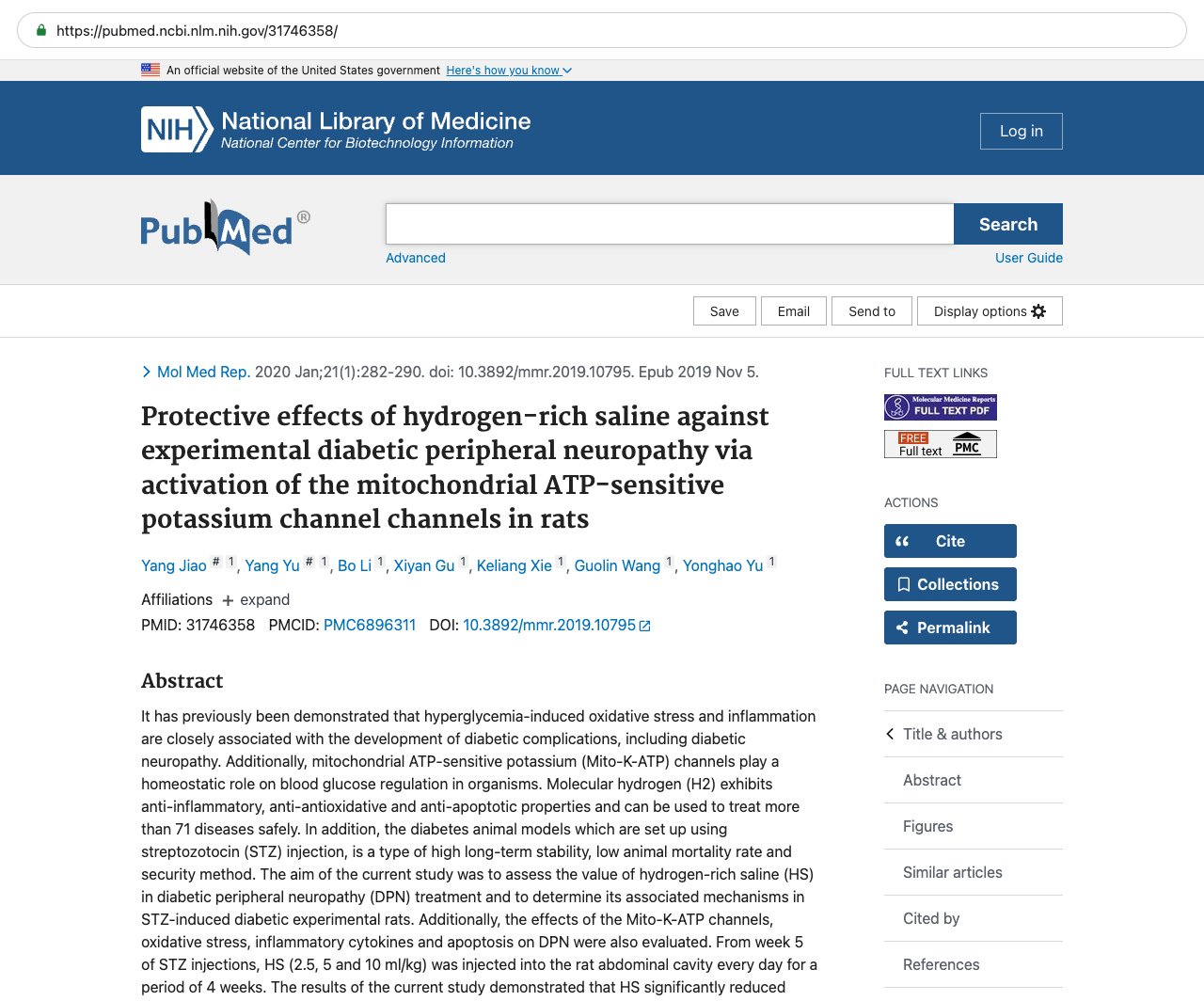
This page mirrors the published abstract (© the authors / publisher) for reference and citation. The canonical source is the PubMed record linked above. This is not medical advice.