2022 · Biswas — Electrocoagulation and electrooxidation technologies for pesticide removal from water or wastewater: A review
Super-Abstract
This review covers electrochemical methods — electrocoagulation and electrooxidation — for removing pesticides from water, and notes that H₂ gas is generated as a byproduct at the cathode during electrocoagulation. This is an environmental engineering review with no connection to H₂ medicine, therapy, or health effects of molecular hydrogen. H₂ appears solely as a technical process byproduct.
Commentary
This review is an environmental water treatment paper, not a biomedical H₂ study. Its focus is on the removal of agricultural pesticide contamination from water using electrochemical methods. H₂ is mentioned only in the context of the electrocoagulation process: during electrolysis, H₂ gas evolves at the cathode and creates hydrogen bubbles that float contaminant flocs to the water surface (electro-flotation). This is a technical process description, not a health or therapy claim. The review provides useful engineering context — electrode materials, current density effects, removal efficiencies — but has no direct relevance to H₂ therapy, H₂ water, or any health application. Its presence in an H₂ database reflects a categorization by method (electrochemical H₂ generation) rather than by therapeutic intent.
Key quotes
- „electro-flotation occurs at the cathode and results in the evolution of hydrogen gas bubbles, leading to flotation of floc to the top surface of the reactor.“ — the only H₂-relevant passage: H₂ is a cathode byproduct enabling flotation of contaminants — not a therapy
- „Greater than 99% removal efficiency was observed in both processes.“ — the headline efficacy result for pesticide removal — water treatment, not health
- „aluminum and iron are the most common electrodes used for pesticide removal using electrocoagulation, while boron-doped diamond was used to a far greater extent as the electrode in electrooxidation studies.“ — electrode material summary — technical process detail
Our assessment
This review is not relevant to H₂ medicine or therapy. It is a water-treatment engineering paper in which H₂ appears solely as an incidental byproduct of the electrocoagulation process. No health, therapeutic, or biomedical conclusions can be drawn from this paper. Its inclusion in an H₂ research database is a categorization artifact. Readers seeking evidence about health effects of molecular hydrogen should consult dedicated H₂ medicine literature.
Study design
- Type: engineering/environmental review · Topic: electrochemical pesticide removal from water/wastewater · H₂ relevance: H₂ gas evolution as cathode byproduct in electrocoagulation — not therapeutic
- Result: >99% pesticide removal efficiency demonstrated; H₂ functions as flotation agent for contaminant flocs — no health-related outcome
Abstract
Pesticides are known to be threats to the environment and human health. Excessive use of pesticides in agricultural practice can contaminate water bodies, leading to cancer, asthma, neurological disorders, reproductive defects, and hormonal disruption. Electrochemical methods such as electrocoagulation and electrooxidation can be used for pesticide removal due to their numerous advantages such as high efficiency, less sludge production, and low operational cost. During electrocoagulation, dissolution of anode metals results in metal hydroxide complexes, which precipitate with the contaminant present in the reactor. Simultaneously, electro-flotation occurs at the cathode and results in the evolution of hydrogen gas bubbles, leading to flotation of floc to the top surface of the reactor. This review focuses on the removal mechanisms, kinetics, modeling, effects of influencing factors, and sludge characterization of pesticide removal using electrocoagulation and electrooxidation. Major influencing factors include cell configuration, electrode material, current density, pH, supporting electrolyte concentration. In general, aluminum and iron are the most common electrodes used for pesticide removal using electrocoagulation, while boron-doped diamond was used to a far greater extent as the electrode in electrooxidation studies. Greater than 99% removal efficiency was observed in both processes. Overall, this review summarizes the use of electrochemical methods for pesticide removal and offers valuable information to researchers in this area of study.
Source & links
Screenshot of the PubMed page
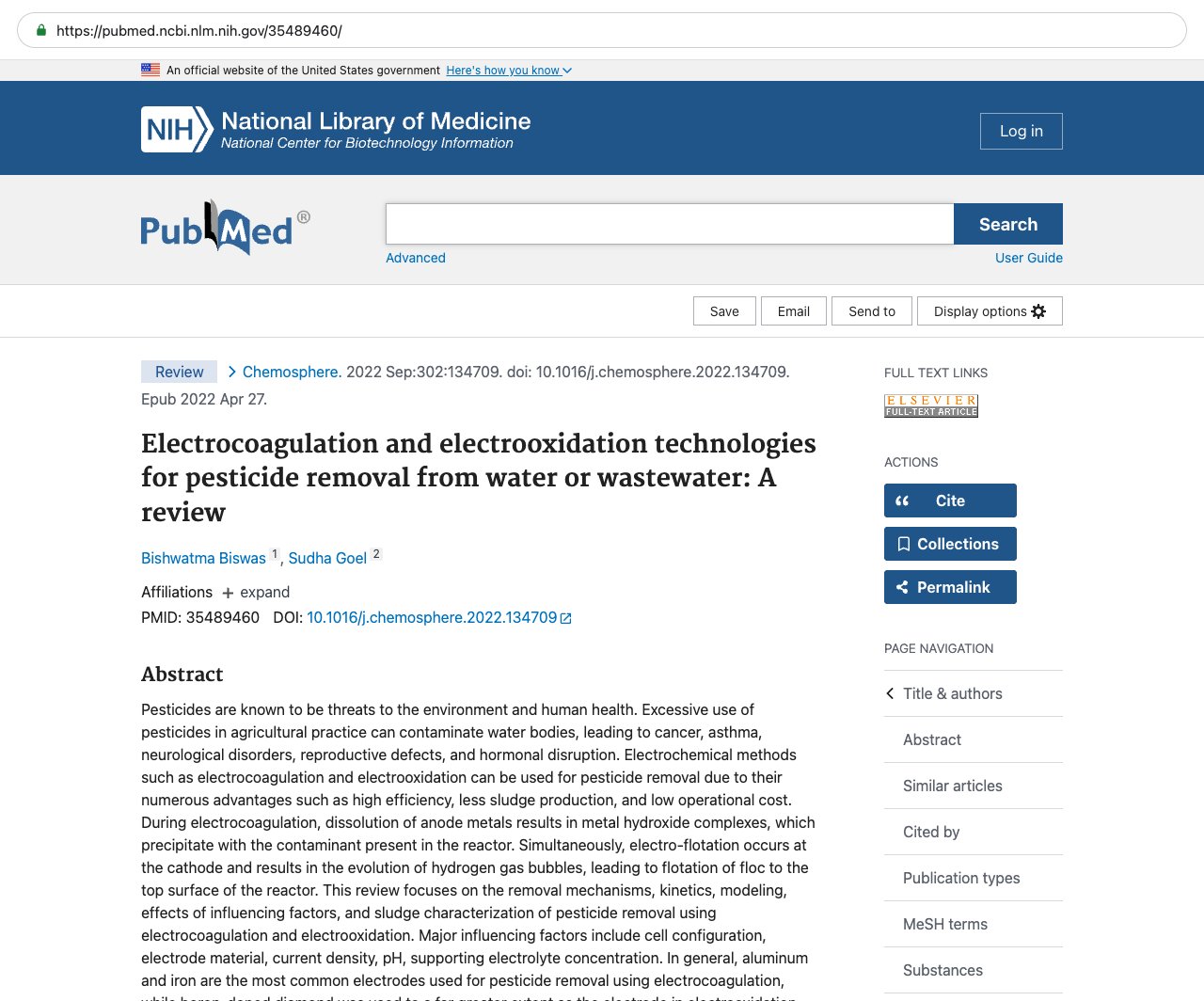
This page mirrors the published abstract (© the authors / publisher) for reference and citation. The canonical source is the PubMed record linked above. This is not medical advice.