2021 · Matsuura — Hydrogen Gas Therapy Attenuates Inflammatory Pathway Signaling in Septic Mice
Super-Abstract
In a mouse cecal ligation and puncture (CLP) sepsis model, continuous H₂ inhalation improved 7-day survival from 40% to 75% and suppressed systemic and organ-level inflammatory signalling. RNA sequencing of liver, intestine, and lungs revealed that H₂ inactivated multiple canonical inflammatory pathways. This is a preclinical study in mice — no human sepsis patients were studied.
Commentary
Sepsis remains a major cause of intensive-care mortality with very few disease-modifying treatments. This study uses the CLP model — considered the gold standard for preclinical sepsis research — and adds a transcriptomic (RNA-seq) layer that goes beyond typical cytokine snapshots. The survival improvement is substantial (75% vs. 40%), and the blood glucose maintenance in H₂-treated animals is clinically relevant as hypoglycaemia is a major complication in sepsis. The RNA-seq data, analysed through Ingenuity Pathway Analysis, showed inactivation of acute-phase response signalling and STAT3 pathways in the liver and intestine, with reduced expression of upstream regulators including CD14 and multiple cytokine receptor genes. This is hypothesis-generating at the molecular level. However, CLP mice are not human sepsis patients, and the survival benefit in mice has historically not reliably predicted clinical trial outcomes.
Key quotes
- „Seven-day survival rate in septic mice was significantly improved in the H2 inhalation group compared with that in the control group (75% versus 40%, P < 0.05).“ — headline efficacy result: a substantial survival benefit in mouse sepsis
- „H2 treatment attenuated serum interleukin-6 and tumor necrosis factor-α levels at 24 h after CLP, and blood glucose levels were maintained in the H2-treated group.“ — systemic anti-inflammatory and metabolic effects observed
- „canonical pathway analysis revealed inactivity of various inflammatory signaling pathways, for example, acute phase response signaling and STAT3 pathways, in the liver and intestine in the CLP model after 24-h H2 inhalation.“ — RNA-seq finding: H₂ broadly dampens inflammatory transcriptional programmes across organs
Our assessment
A technically solid preclinical study in an established sepsis model, with the added value of multi-organ transcriptomics. The survival data are encouraging but must be interpreted cautiously: CLP survival outcomes in mice rarely translate directly to human sepsis clinical trials. The RNA-seq findings are exploratory and require independent validation. The authors appropriately frame their conclusion as contributing to „clarifying the mechanism of action“ rather than claiming clinical proof. No therapeutic recommendation for humans can be derived from this data.
Study design
- Type: animal (preclinical) · Model: cecal ligation and puncture (CLP) sepsis, C57BL/6 male mice · H₂ delivery: 7% H₂ continuous inhalation
- Endpoints: 7-day survival, serum IL-6 and TNF-α at 24 h, blood glucose, organ histology; RNA-seq of liver, intestine, lungs with Ingenuity Pathway Analysis
- Key finding: survival 75% (H₂) vs. 40% (control); IL-6 and TNF-α attenuated; blood glucose maintained; RNA-seq: inactivation of acute-phase response + STAT3 signalling; reduced CD14 and cytokine receptor gene expression across organs
Abstract
BACKGROUND: Molecular hydrogen (H2) has been used in clinical cases. However, there are few studies of H2 therapy to treat sepsis, and anti-inflammatory mechanisms of H2 are mostly unknown. We aimed to confirm effects of H2 therapy on sepsis and reveal its therapeutic mechanism via RNA sequencing in multiple organs in septic mice. METHODS: Nine-week-old C57BL/6 male mice underwent cecal ligation and puncture (CLP) or sham procedure. Subsequently, the CLP model received immediate ± continuous inhalation of 7% H2. Mice were observed for a week to assess survival rates. Serum inflammatory cytokines were evaluated at 24 h after CLP procedure. Liver, intestine, and lungs in CLP mice receiving 24-h ± H2 therapy were assessed by RNA sequencing. Data were analyzed with Ingenuity Pathways Analysis (QIAGEN Inc). RESULTS: Seven-day survival rate in septic mice was significantly improved in the H2 inhalation group compared with that in the control group (75% versus 40%, P < 0.05). H2 treatment attenuated serum interleukin-6 and tumor necrosis factor-α levels at 24 h after CLP, and blood glucose levels were maintained in the H2-treated group. In RNA sequencing, canonical pathway analysis revealed inactivity of various inflammatory signaling pathways, for example, acute phase response signaling and STAT3 pathways, in the liver and intestine in the CLP model after 24-h H2 inhalation. We detected significantly decreased expressions of upstream regulator genes such as the CD14 antigen gene in the liver and various cytokine receptor genes in the intestine and lungs in the H2-treated group. CONCLUSIONS: These findings may contribute to clarifying the mechanism of action of H2 therapy in sepsis.
Source & links
Screenshot of the PubMed page
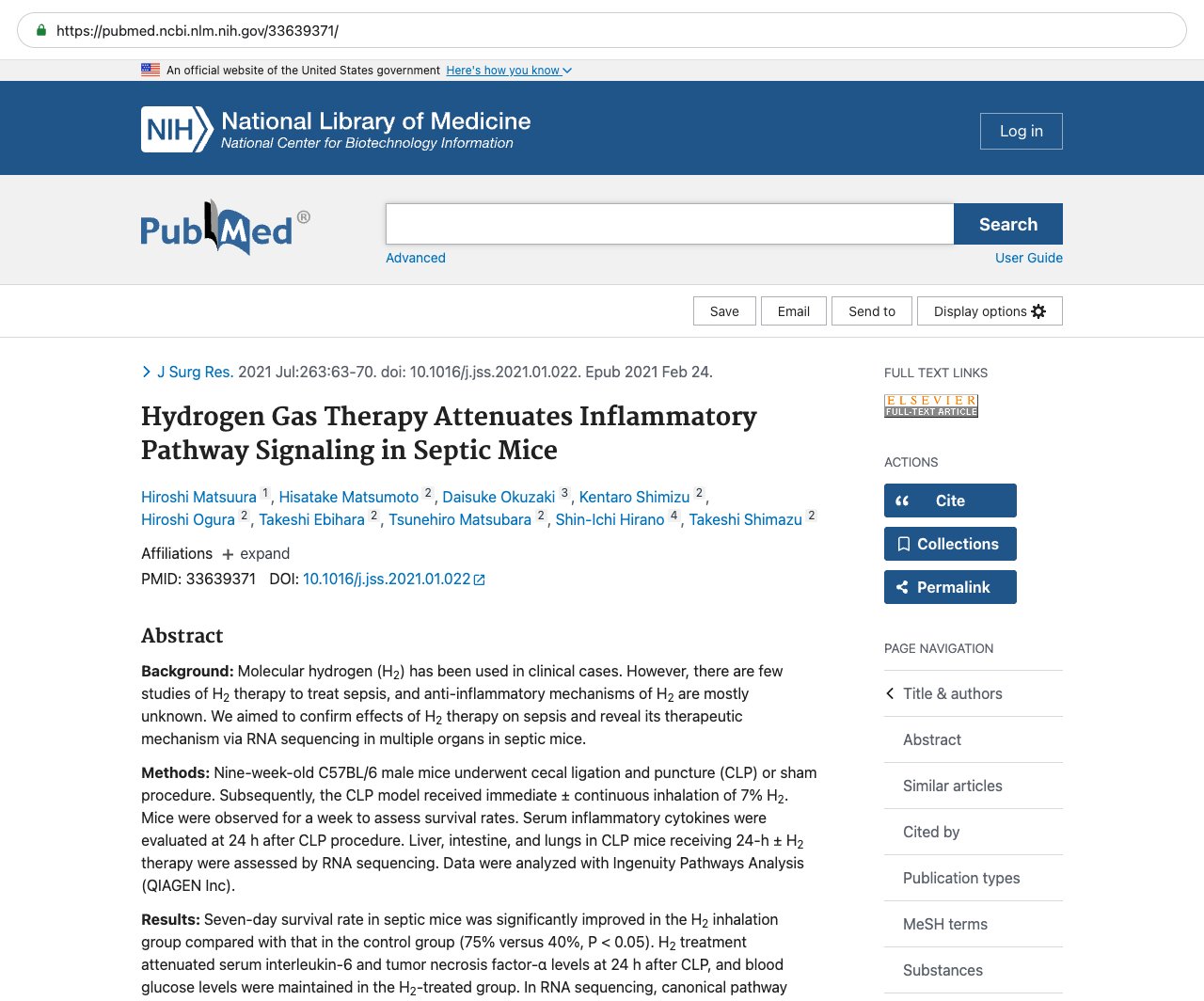
This page mirrors the published abstract (© the authors / publisher) for reference and citation. The canonical source is the PubMed record linked above. This is not medical advice.