2026 · Nguyen Puente — Emerging Clinical Applications for Molecular Hydrogen
Super-Abstract
Inhaled molecular hydrogen (H₂) has accumulated a growing body of encouraging clinical findings across neurological, cardiovascular, oncological and respiratory conditions — yet the evidence base remains constrained by small study sizes, inconsistent methodology, and a lack of standardised delivery systems. This narrative review synthesises current clinical experience and critically examines the field's key limitations. The authors call for validated delivery technologies to enable more rigorous large-scale trials. (Respiratory Care, 2026.)
Commentary
This review by Nguyen Puente and colleagues is a concise, clinically oriented survey of where inhaled H₂ therapy stands today. Its strength is the honest appraisal of the literature's weaknesses: the authors do not oversell findings but consistently note that data come from heterogeneous protocols with small sample sizes. The focus on inhalation as the primary delivery route reflects the most clinically developed application in critical care settings. Notably, the call for a standardised, validated delivery system points to a structural gap that limits not only clinical adoption but also the comparability of existing research. This is a useful orientation paper for clinicians and researchers entering the field rather than a meta-analytic proof of efficacy.
Key quotes
- „Substantial preclinical studies attribute its benefits to selective antioxidant, anti-inflammatory, and cytoprotective properties.“ — the mechanistic foundation behind H₂ clinical interest
- „Published clinical findings are encouraging, although data are limited by small sample sizes, methodological variability, and the absence of standardized and validated commercially available delivery systems.“ — the authors' honest assessment of current evidence quality
- „This narrative review summarizes the current clinical experience with inhaled H2 therapy, discusses key challenges and limitations in the existing literature, and identifies areas of interest for future research.“ — scope and purpose of the review
Our assessment
This is a narrative review, not a systematic review or meta-analysis — no pooled effect sizes are computed. The clinical findings summarised are encouraging but come from a literature characterised by small samples and variable methodology. The authors' call for standardised delivery systems underscores that H₂ inhalation therapy is still in an early clinical development phase. This paper is appropriate for orientation but cannot substitute for individual assessment of the primary trials it references.
Study design
- Type: narrative review · n: n/a (literature synthesis) · H₂ delivery: inhalation (primary focus)
- Conditions covered: neurological, cardiovascular, oncological, respiratory diseases, skin aging, immune and oxidative-stress conditions
- Conclusion: clinical interest justified by preclinical evidence; human data encouraging but limited; standardised delivery validation identified as critical next step
Abstract
Molecular hydrogen (H2) has emerged as a promising therapeutic agent with potential applications across a wide range of conditions, including neurological, cardiovascular, oncologic, and respiratory diseases. Substantial preclinical studies attribute its benefits to selective antioxidant, anti-inflammatory, and cytoprotective properties. Published clinical findings are encouraging, although data are limited by small sample sizes, methodological variability, and the absence of standardized and validated commercially available delivery systems. This narrative review summarizes the current clinical experience with inhaled H2 therapy, discusses key challenges and limitations in the existing literature, and identifies areas of interest for future research, including the development of a validated delivery system to enable broader clinical investigation and application of H2 therapy.
Source & links
Screenshot of the PubMed page
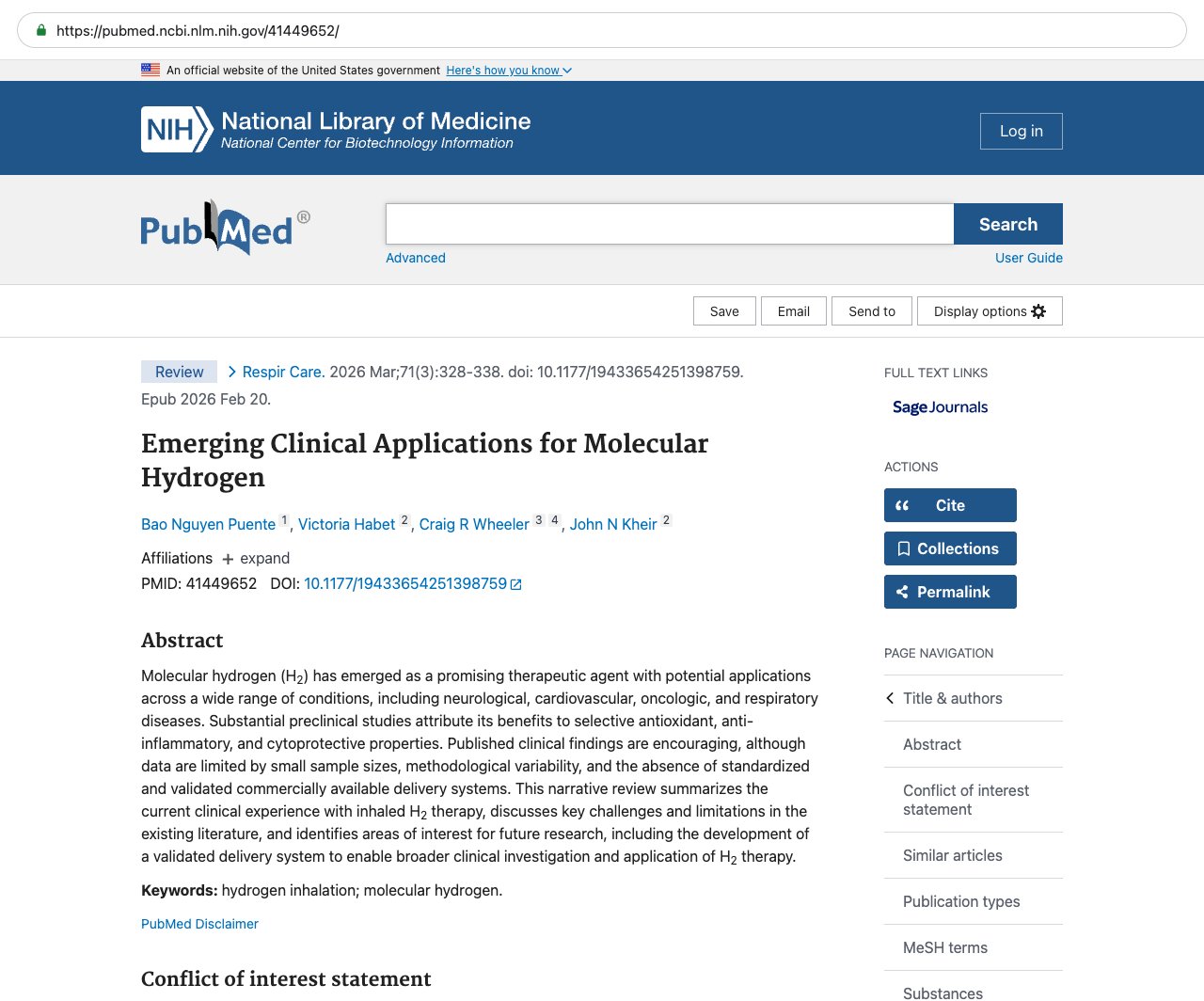
This page mirrors the published abstract (© the authors / publisher) for reference and citation. The canonical source is the PubMed record linked above. This is not medical advice.