2021 · Yin et al. — Hydrogen Gas with Extracorporeal Cardiopulmonary Resuscitation Improves Survival after Prolonged Cardiac Arrest in Rats
Super-Abstract
In a rat model of prolonged cardiac arrest, adding hydrogen gas (H₂) to extracorporeal cardiopulmonary resuscitation (ECPR) dramatically improved 4-hour survival: 78% with H₂ versus 22% without. H₂ also restored brain electrical activity, protected blood vessel lining, and reduced inflammatory damage. This is a preclinical animal study — the findings cannot be directly transferred to humans without further clinical validation.
Commentary
Extracorporeal membrane oxygenation (ECMO)-based CPR is increasingly used for cardiac arrest patients who do not respond to standard resuscitation. However, ECMO itself generates severe oxidative stress and inflammation through contact between blood and artificial circuits — a paradox that limits its benefit. This rat study tested whether co-administering H₂ gas through the ECMO membrane and mechanical ventilation could counteract this ischemia-reperfusion injury. The results are striking: H₂ nearly quadrupled 4-hour survival and restored electroencephalographic (EEG) activity in all treated animals. Mechanistically, H₂ preserved endothelial integrity (measured by syndecan-1, a marker of vessel lining damage), elevated anti-inflammatory interleukin-10, and shifted metabolomics toward protective glutamate metabolism patterns. The 4-hour observation window is short, and this is a highly artificial laboratory model. The clinical relevance remains to be established, but the mechanistic rationale is coherent and the effect size is large enough to justify further translational research.
Key quotes
- „The survival rate at 4 h was 77.8% (7 out of 9) in the H2 group and 22.2% (2 out of 9) in the placebo group.“ — the primary outcome: near-fourfold survival improvement in a rat model
- „H2 attenuated an increase in syndecan-1 levels and enhanced an increase in interleukin-10, vascular endothelial growth factor, and leptin levels after ECPR.“ — the mechanistic signal: endothelial protection and anti-inflammatory shift
- „Further studies are warranted to elucidate the mechanisms responsible for the beneficial effects of H2 on ischemia-reperfusion injury in critically ill patients who require ECMO support.“ — the authors' own call for caution: human evidence is absent
Our assessment
This is a well-designed preclinical study with a compelling effect size in a high-mortality model. The mechanistic explanations are consistent with established H₂ biology (oxidative stress reduction, endothelial protection). Critical limitations: this is a rat study with only 9 animals per group and a 4-hour endpoint — far from clinical practice. Asphyxial cardiac arrest in rats does not replicate the heterogeneity of human cardiac arrest patients. ECMO/ECPR studies in humans already face enormous complexity. This paper contributes meaningful preclinical groundwork but does not constitute evidence of efficacy in humans.
Study design
- Type: randomized controlled animal study (rat, asphyxial cardiac arrest) · n: 18 rats (9 H₂, 9 placebo) · H₂ delivery: gas via ECMO membrane + mechanical ventilation
- Model: 20-minute asphyxial cardiac arrest + ECPR · Primary endpoint: 4-hour survival · Result: survival 78% vs. 22% (log-rank p=0.025); EEG recovery in all H₂ animals; improved endothelial and inflammatory markers
Abstract
BACKGROUND: Despite the benefits of extracorporeal cardiopulmonary resuscitation (ECPR) in cohorts of selected patients with cardiac arrest (CA), extracorporeal membrane oxygenation (ECMO) includes an artificial oxygenation membrane and circuits that contact the circulating blood and induce excessive oxidative stress and inflammatory responses, resulting in coagulopathy and endothelial cell damage. There is currently no pharmacological treatment that has been proven to improve outcomes after CA/ECPR. We aimed to test the hypothesis that administration of hydrogen gas (H2) combined with ECPR could improve outcomes after CA/ECPR in rats. METHODS: Rats were subjected to 20 min of asphyxial CA and were resuscitated by ECPR. Mechanical ventilation (MV) was initiated at the beginning of ECPR. Animals were randomly assigned to the placebo or H2 gas treatment groups. The supplement gas was administered with O2 through the ECMO membrane and MV. Survival time, electroencephalography (EEG), brain functional status, and brain tissue oxygenation were measured. Changes in the plasma levels of syndecan-1 (a marker of endothelial damage), multiple cytokines, chemokines, and metabolites were also evaluated. RESULTS: The survival rate at 4 h was 77.8% (7 out of 9) in the H2 group and 22.2% (2 out of 9) in the placebo group. The Kaplan-Meier analysis showed that H2 significantly improved the 4 h-survival endpoint (log-rank P = 0.025 vs. placebo). All animals treated with H2 regained EEG activity, whereas no recovery was observed in animals treated with placebo. H2 therapy markedly improved intra-resuscitation brain tissue oxygenation and prevented an increase in central venous pressure after ECPR. H2 attenuated an increase in syndecan-1 levels and enhanced an increase in interleukin-10, vascular endothelial growth factor, and leptin levels after ECPR. Metabolomics analysis identified significant changes at 2 h after CA/ECPR between the two groups, particularly in D-glutamine and D-glutamate metabolism. CONCLUSIONS: H2 therapy improved mortality in highly lethal CA rats rescued by ECPR and helped recover brain electrical activity. The underlying mechanism might be linked to protective effects against endothelial damage. Further studies are warranted to elucidate the mechanisms responsible for the beneficial effects of H2 on ischemia-reperfusion injury in critically ill patients who require ECMO support.
Source & links
Screenshot of the PubMed page
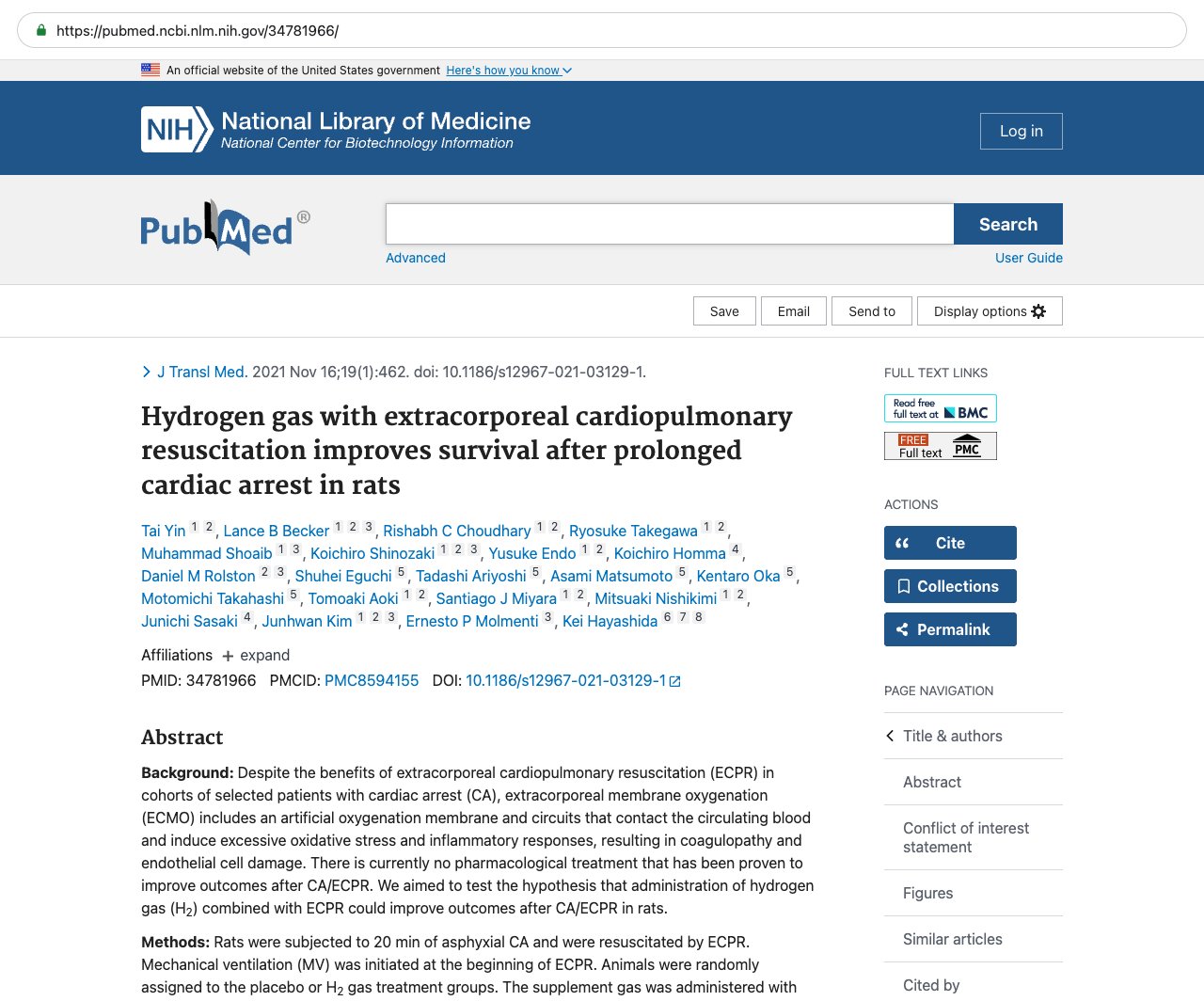
This page mirrors the published abstract (© the authors / publisher) for reference and citation. The canonical source is the PubMed record linked above. This is not medical advice.