2022 · Bulut — Hydrogen-rich water can reduce the formation of biogenic amines in butter
Super-Abstract
Washing raw butter with hydrogen-rich water — prepared either by bubbling hydrogen gas or by adding magnesium — significantly reduced the formation of biogenic amines (including histamine, tryptamine, and spermidine) during 90 days of storage. This is a food-chemistry in-vitro study; it tests H₂ as a food-safety tool, not as a health intervention in humans. (Food Chemistry, 2022.)
Commentary
Biogenic amines such as histamine, tyramine, tryptamine, and cadaverine accumulate in dairy products through microbial decarboxylation of amino acids during storage. High levels are a food-safety concern and can cause adverse reactions in sensitive individuals. This study explores whether hydrogen-rich water (HRW), already recognized for its antimicrobial and antioxidant properties, can suppress this amine formation when used as a butter-washing agent. Two HRW preparations were compared: hydrogen-saturated water (made by bubbling H₂ gas) and magnesium-enriched water (where magnesium reacts with water to release H₂). Both consistently outperformed normal water in limiting biogenic amine accumulation over 90 days. Critically, HRW washing had no inhibitory effect on yogurt bacteria — meaning it does not simply function as a broad bactericide that would impair desirable fermentation cultures. The study opens an applied agricultural/food-technology dimension for hydrogen that is distinct from hydrogen-medicine research.
Key quotes
- „the lowest formation levels of biogenic amines were shown for butter samples washed with HRW (H2 water and Mg water), while the highest levels were identified for the butter samples washed with normal water.“ — the central result: HRW outperforms normal water in limiting amine accumulation
- „Washing butter with HRW revealed no inhibiting effect on yogurt bacteria during storage.“ — important selectivity: HRW does not harm desirable dairy cultures
- „The proposed method involves molecular hydrogen which is non-toxic for humans and the environment.“ — safety argument from the authors
Our assessment
This is a food-chemistry in-vitro study, not a clinical or animal experiment. Its relevance is to food safety and food technology, not to hydrogen-medicine endpoints. No human health outcomes are tested. The findings are technically interesting and potentially applicable in dairy production, but they do not speak to any therapeutic use of molecular hydrogen in the body.
Study design
- Type: in-vitro food-chemistry study · Model: raw butter washed with HRW (H₂-saturated water or Mg-water) vs. normal water, 90-day storage · H₂ delivery: HRW as butter-washing agent (not consumed by humans)
- Result: HRW-washed butter showed significantly lower biogenic amine levels (histamine, tryptamine, 2-phenylethylamine, spermidine, spermine) than normal-water-washed butter; no inhibition of yogurt bacteria
Abstract
The formation of biogenic amines in food products forms a serious challenge for food producers and a hazard for consumers. Butter was washed by hydrogen-rich water (HRW) prepared using two methods, i.e. hydrogen-bubbled water (H2 water) and magnesium-incorporated water (Mg water). After 90 days of storage, the lowest formation levels of biogenic amines were shown for butter samples washed with HRW (H2 water and Mg water), while the highest levels were identified for the butter samples washed with normal water. Washing raw butter with HRW led to a significant decrease in tryptamine, 2-phenylethylamine, spermidine, and spermine formation. The lowest histamine level was shown for butter samples washed with H2 and Mg, while the highest level was found for butter washed with normal water. Washing butter with HRW revealed no inhibiting effect on yogurt bacteria during storage. The proposed method involves molecular hydrogen which is non-toxic for humans and the environment.
Source & links
Screenshot of the PubMed page
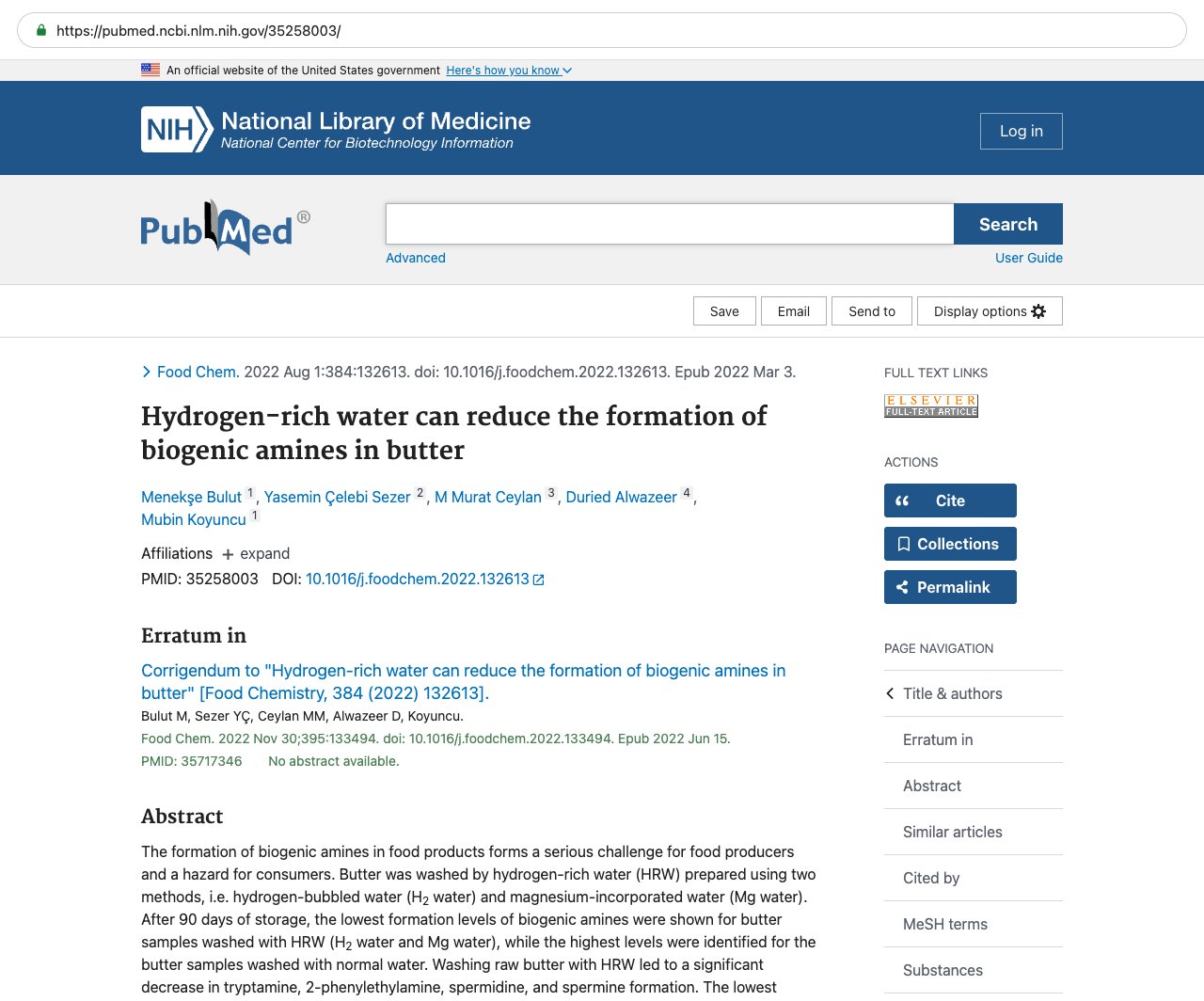
This page mirrors the published abstract (© the authors / publisher) for reference and citation. The canonical source is the PubMed record linked above. This is not medical advice.