1991 Nihon yakurigaku zasshi. Folia pharmacologica Japonica Mechanism / Preclinical InhalationDrinking (HRW)
1991 · Kawano — Protective Effect of Rebamipide (OPC-12759) on the Gastric Mucosa in Rats and Humans
Super-Abstract
This combined animal and small human study showed that rebamipide — a gastric mucosal protective drug — prevents HCl-ethanol-induced gastric lesions in rats dose-dependently and significantly inhibits mucosal damage in healthy human volunteers, partly by improving mucosal microcirculation as measured by hydrogen gas clearance. The hydrogen gas clearance method is used here as a blood-flow measurement tool, not as a therapy. (Nihon Yakurigaku Zasshi / Folia Pharmacologica Japonica, 1991.)
Commentary
This study is primarily about the gastroprotective drug rebamipide (OPC-12759), not about molecular hydrogen therapy. Hydrogen appears here in the methodological role: the „hydrogen gas clearance method” is an established technique for measuring gastric mucosal blood flow — hydrogen gas is administered locally and its clearance from the tissue reflects perfusion. The drug rebamipide was shown to increase mucosal blood flow by continuous intravenous dosing and to inhibit mucosal lesion formation in a double-blind human crossover study (n=6 volunteers). While the human study is small and in healthy volunteers with experimentally induced damage (HCl-ethanol), it provides controlled mechanistic evidence for rebamipide's cytoprotective role. The H₂ clearance method is unrelated to therapeutic H₂ administration.
Key quotes
- „rebamipide significantly (P less than 0.05) increased mucosal blood flow by continuous i.v. dosing at 10 mg/kg/hr by the hydrogen gas clearance method“ — H₂ clearance used as a mucosal blood flow measurement — not a therapy
- „Rebamipide significantly (P less than 0.05) inhibited formation of mucosal lesion, decrease in the number of mucous granules and dilatation of intercellular space.“ — human crossover study finding: rebamipide is cytoprotective at clinical dose
- „the mechanism of this gastric effect was considered to involve, in part, the improvement of mucosal microcirculation.“ — proposed mechanistic explanation for rebamipide's gastroprotection
Our assessment
This is a mixed animal and small human study on the gastroprotective drug rebamipide — not a hydrogen therapy study. Hydrogen gas appears only as a measurement tool (mucosal blood flow via H₂ clearance), not as a therapeutic agent. No conclusions about molecular H₂ therapy can be drawn from this paper. The human component involves only 6 healthy volunteers with experimentally induced gastric damage — results should be interpreted cautiously. The study is relevant to gastroenterological pharmacology, not to hydrogen medicine.
Study design
- Type: combined animal study (rats, dose-response) + double-blind crossover human study (n=6 healthy male volunteers) · H₂ delivery: hydrogen gas clearance method used for mucosal blood flow measurement only — not a therapeutic H₂ intervention
- Result: Rat data: rebamipide 30–300 mg/kg i.p. significantly prevented HCl-ethanol mucosal lesions; 10 mg/kg i.v. increased mucosal blood flow. Human data: rebamipide 300 mg/day for 7 days significantly inhibited experimentally induced mucosal lesion formation (P<0.05)
Abstract
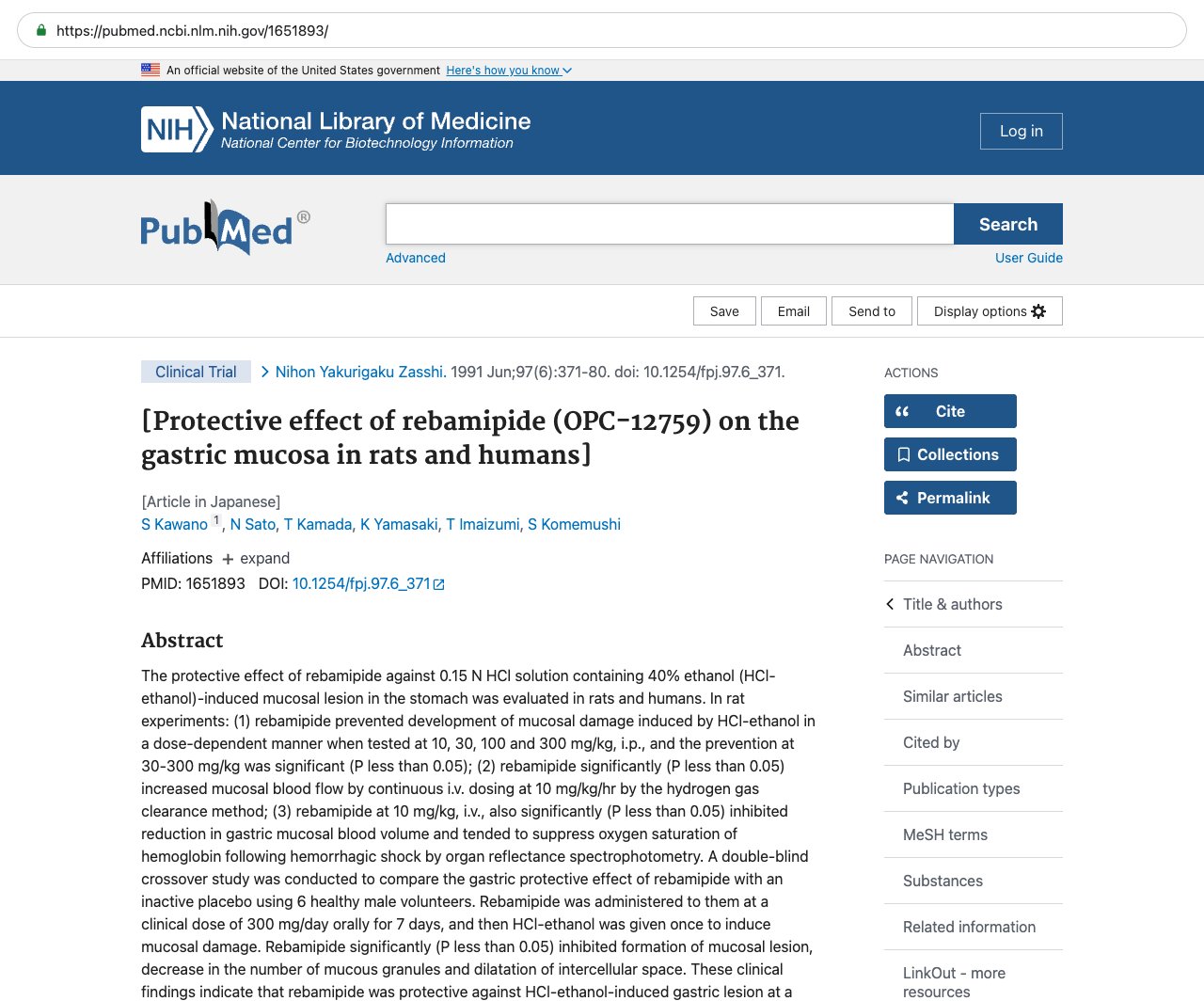
The protective effect of rebamipide against 0.15 N HCl solution containing 40% ethanol (HCl-ethanol)-induced mucosal lesion in the stomach was evaluated in rats and humans. In rat experiments: (1) rebamipide prevented development of mucosal damage induced by HCl-ethanol in a dose-dependent manner when tested at 10, 30, 100 and 300 mg/kg, i.p., and the prevention at 30-300 mg/kg was significant (P less than 0.05); (2) rebamipide significantly (P less than 0.05) increased mucosal blood flow by continuous i.v. dosing at 10 mg/kg/hr by the hydrogen gas clearance method; (3) rebamipide at 10 mg/kg, i.v., also significantly (P less than 0.05) inhibited reduction in gastric mucosal blood volume and tended to suppress oxygen saturation of hemoglobin following hemorrhagic shock by organ reflectance spectrophotometry. A double-blind crossover study was conducted to compare the gastric protective effect of rebamipide with an inactive placebo using 6 healthy male volunteers. Rebamipide was administered to them at a clinical dose of 300 mg/day orally for 7 days, and then HCl-ethanol was given once to induce mucosal damage. Rebamipide significantly (P less than 0.05) inhibited formation of mucosal lesion, decrease in the number of mucous granules and dilatation of intercellular space. These clinical findings indicate that rebamipide was protective against HCl-ethanol-induced gastric lesion at a clinical dose, and the mechanism of this gastric effect was considered to involve, in part, the improvement of mucosal microcirculation.
Source & links
Screenshot of the PubMed page
This page mirrors the published abstract (© the authors / publisher) for reference and citation. The canonical source is the PubMed record linked above. This is not medical advice.