2000 · Pletnev — Crystal structure of bovine duodenase, a serine protease, with dual trypsin and chymotrypsin-like specificities.
Super-Abstract
This in-vitro structural study resolves the three-dimensional crystal structure of duodenase, a serine protease from bovine duodenum, at 2.4 Å resolution. The enzyme can cleave both trypsin-type and chymotrypsin-type substrates — a specificity long thought impossible — and its active site contains a hydrogen water network that may be key to its catalytic mechanism. (Proteins, 2000.)
Commentary
This is a protein crystallography study, and the mention of „hydrogen“ refers entirely to hydrogen bonds and water molecules within the active site architecture of the enzyme — not to molecular hydrogen (H₂) gas or H₂ therapy. The study reveals the structural basis for duodenase's unusually broad substrate specificity and proposes a „fourth member“ of the catalytic triad — a conserved serine residue (Ser214) coordinated via a hydrogen water network. This is fundamental structural biochemistry with potential relevance to enzyme engineering but no connection to therapeutic H₂ use.
Key quotes
- „participation in a hydrogen water network involving the catalytic triad (His57, Asp107, and Ser195) argues for its having an important role in the mechanism of action.“ — the hydrogen water network as structural feature — note: this refers to hydrogen bonds, not H₂ gas
- „Computer modeling reveals that the S1 subsite of duodenase has structural features compatible with effective accommodation of P1 residues typical of trypsin (Arg/Lys) and chymotrypsin (Tyr/Phe) substrates.“ — structural explanation for dual substrate specificity
- „The determination of structural features associated with functional variation in the enzyme family may permit design of enzymes with a specific ratio of trypsin and chymotrypsin activities.“ — applied implication: rational enzyme engineering
Our assessment
This is a basic structural biochemistry study — it has no relevance to molecular H₂ therapy. The „hydrogen“ in this paper refers exclusively to hydrogen bonds and water molecules in the enzyme active site. The study is of interest for enzymology and structural biology but provides no evidence for health effects of H₂ in any model. The inclusion in a hydrogen-related database appears to be based on keyword overlap rather than biological relevance.
Study design
- Type: in-vitro structural biology (X-ray crystallography) · Model: purified bovine duodenase · H₂ relevance: none — hydrogen refers to hydrogen bonds in enzyme structure
- Result: 2.4 Å crystal structure resolved; dual trypsin/chymotrypsin specificity explained by S1-subsite geometry; Ser214 proposed as fourth catalytic triad member via hydrogen-bond water network
Abstract
The three-dimensional structure of duodenase, a serine protease from bovine duodenum mucosa, has been determined at 2.4A resolution. The enzyme, which has both trypsin-like and chymotrypsin-like activities, most closely resembles human cathepsin G with which it shares 57% sequence identity and similar specificity. The catalytic Ser195 in duodenase adopts the energetically favored conformation typical of serine proteinases and unlike the strained state typical of lipase/esterases. Of several waters in the active site of duodenase, the one associated with Ser214 is found in all serine proteinases and most lipase/esterases. The conservation of the Ser214 residue in serine proteinase, its presence in the active site, and participation in a hydrogen water network involving the catalytic triad (His57, Asp107, and Ser195) argues for its having an important role in the mechanism of action. It may be referred to as a fourth member of the catalytic triad. Duodenase is one of a growing family of enzymes that possesses trypsin-like and chymotrypsin-like activity. Not long ago, these activities were considered to be mutually exclusive. Computer modeling reveals that the S1 subsite of duodenase has structural features compatible with effective accommodation of P1 residues typical of trypsin (Arg/Lys) and chymotrypsin (Tyr/Phe) substrates. The determination of structural features associated with functional variation in the enzyme family may permit design of enzymes with a specific ratio of trypsin and chymotrypsin activities.
Source & links
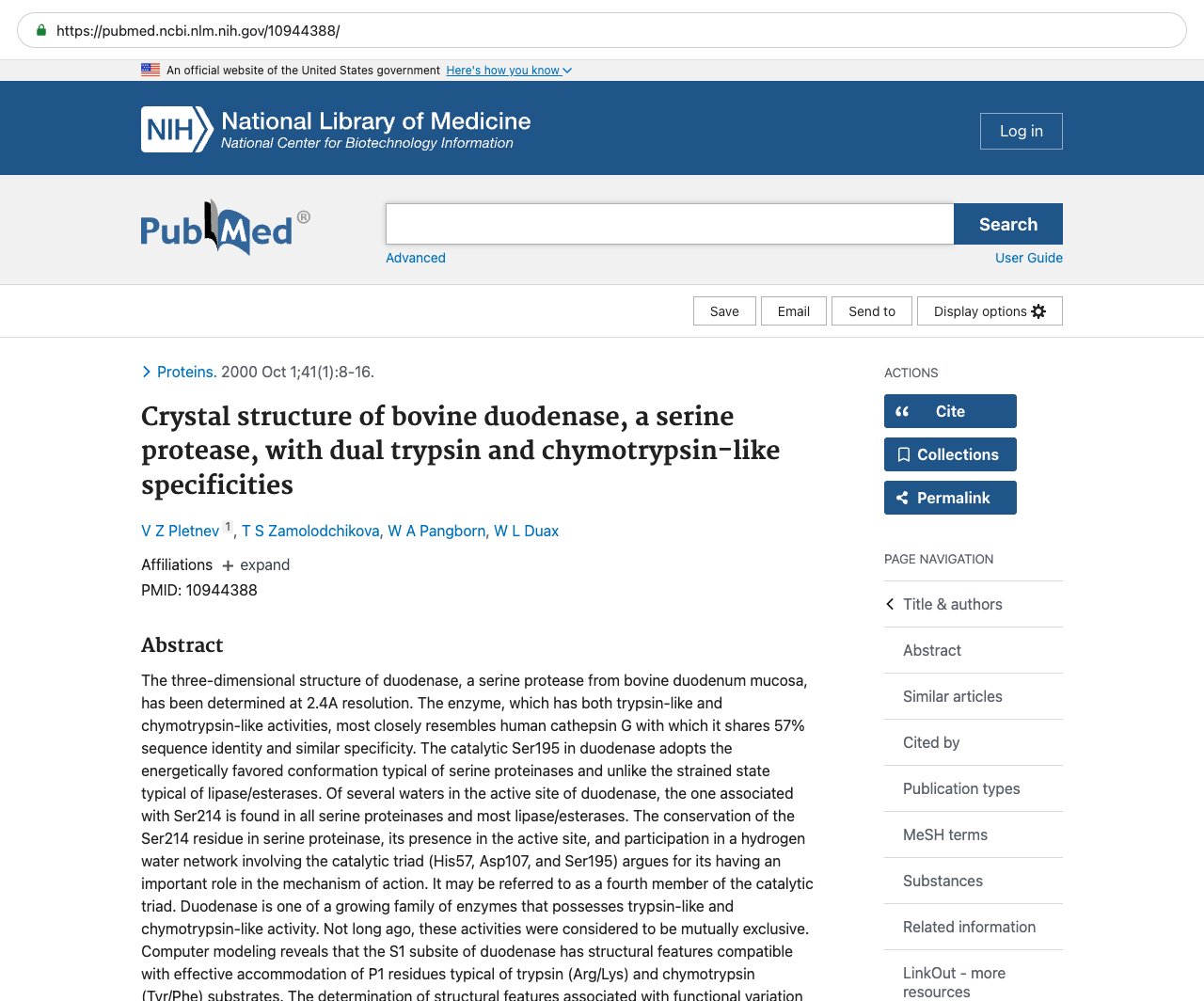
Screenshot of the PubMed page
This page mirrors the published abstract (© the authors / publisher) for reference and citation. The canonical source is the PubMed record linked above. This is not medical advice.