2010 · Bolca — Microbial equol production attenuates colonic methanogenesis and sulphidogenesis in vitro.
Super-Abstract
This in-vitro gut microbiology study showed that equol-producing bacteria — which consume H₂ gas as part of converting the soy isoflavone daidzein into equol — competitively reduce methane and hydrogen sulphide production in the colon. When equol-producers are active, they draw down the shared H₂ pool that methanogens and sulphate-reducing bacteria depend on, decreasing production of the gases that cause bloating and flatulence. This is a laboratory study using simulated gut conditions, not a human trial.
Commentary
This study contributes to gut microbiome science: colonic bacteria produce H₂ during fermentation, and different microbial groups compete to consume this H₂. Methanogens convert H₂ to methane, sulphate-reducing bacteria (SRB) convert it to H₂S, and — as this paper demonstrates — equol-producing bacteria also consume H₂ when the soy isoflavone daidzein is present. By competing for the H₂ pool, equol-producers suppress methane and H₂S output. The study connects gut H₂ metabolism to potential health benefits from soy consumption, but the link to any H₂ therapy is indirect: here H₂ is an endogenous metabolic intermediate produced and consumed by gut bacteria, not administered therapeutically. Applicability to human gut conditions would require in-vivo confirmation.
Key quotes
- „In the presence of daidzein, the equol-producing bacterial consortium EPC4 gave rise to equol production in cultures of Methanobrevibacter smithii or Desulfovibrio sp. as well as in faecal samples with methanogenic or sulphate-reducing abilities.“ — the core experimental finding: equol-producing bacteria out-compete methanogens and SRB for H₂
- „This supplementation significantly (P<0.001) decreased the methanogenesis and sulphidogenesis.“ — quantified reduction in methane and hydrogen sulphide production — statistically significant
- „Abdominal discomfort such as bloating and flatulence are related to colonic gas production, whereas equol has potential health benefits.“ — the dual relevance: gut comfort and the health interest in equol as a phytoestrogen
Our assessment
This is an in-vitro gut microbiology study simulating colonic fermentation conditions — not a human trial. The results show that equol-producing bacteria competitively suppress methane and H₂S production by utilising the shared colonic H₂ pool. The paper is relevant to understanding endogenous H₂ metabolism in the gut (H₂ as a fermentation by-product) but does not involve therapeutic administration of molecular H₂. Results cannot be extrapolated to human digestive outcomes without clinical confirmation.
Study design
- Type: in-vitro study · Model: simulated intestinal conditions using bacterial cultures and faecal samples · H₂ relevance: endogenous colonic H₂ as metabolic intermediate (not therapeutic H₂)
- Result: daidzein supplementation enabled equol-producing bacteria to significantly reduce methane and H₂S output (P<0.001); effect was dose-dependent on equol-producer concentration; equol production remained constant
Abstract
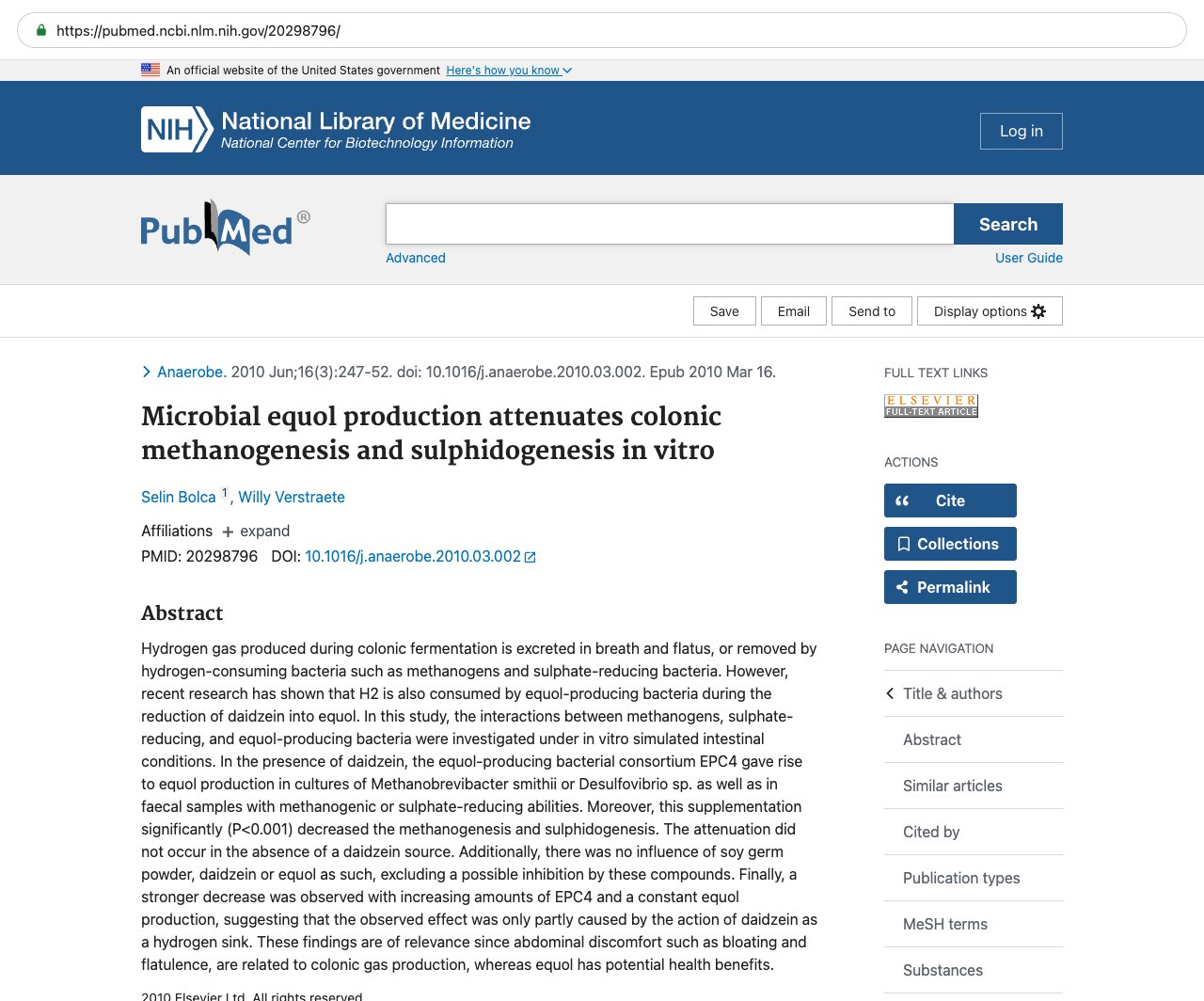
Hydrogen gas produced during colonic fermentation is excreted in breath and flatus, or removed by hydrogen-consuming bacteria such as methanogens and sulphate-reducing bacteria. However, recent research has shown that H2 is also consumed by equol-producing bacteria during the reduction of daidzein into equol. In this study, the interactions between methanogens, sulphate-reducing, and equol-producing bacteria were investigated under in vitro simulated intestinal conditions. In the presence of daidzein, the equol-producing bacterial consortium EPC4 gave rise to equol production in cultures of Methanobrevibacter smithii or Desulfovibrio sp. as well as in faecal samples with methanogenic or sulphate-reducing abilities. Moreover, this supplementation significantly (P<0.001) decreased the methanogenesis and sulphidogenesis. The attenuation did not occur in the absence of a daidzein source. Additionally, there was no influence of soy germ powder, daidzein or equol as such, excluding a possible inhibition by these compounds. Finally, a stronger decrease was observed with increasing amounts of EPC4 and a constant equol production, suggesting that the observed effect was only partly caused by the action of daidzein as a hydrogen sink. These findings are of relevance since abdominal discomfort such as bloating and flatulence, are related to colonic gas production, whereas equol has potential health benefits.
Source & links
Screenshot of the PubMed page
This page mirrors the published abstract (© the authors / publisher) for reference and citation. The canonical source is the PubMed record linked above. This is not medical advice.