1995 Clinical infectious diseases : an official publication of the Infectious Diseases Society of America Mechanism / Preclinical Drinking (HRW)
1995 · Gillespie — Energetics of Molecular Hydrogen Oxidation in the Oral Pathogen Campylobacter rectus
Super-Abstract
This in-vitro study examined how the oral pathogen Campylobacter rectus oxidizes molecular hydrogen (H₂) as an energy source — a fundamental microbiology question about bacterial hydrogen metabolism in the oral cavity. No abstract is publicly available; details are accessible via the DOI. (Clinical Infectious Diseases, 1995.)
Commentary
This study investigates the bioenergetics of H₂ oxidation in Campylobacter rectus — a gram-negative bacterium associated with periodontal disease. The relevance to „hydrogen medicine” lies in understanding how certain oral bacteria use H₂ as an electron donor. This is basic microbiology, not a therapeutic study. No abstract is available in the database entry; a full assessment requires access to the original publication (DOI: 10.1093/clinids/20.supplement_2.s172). Results should not be extrapolated to therapeutic H₂ in humans.
Key quotes
- „Energetics of molecular hydrogen oxidation in the oral pathogen Campylobacter rectus.“ — title only — no abstract available; all quotes are drawn from the title
Our assessment
This is an in-vitro microbiology study on bacterial H₂ metabolism — not a therapeutic hydrogen study. Because no abstract is available in the record, a full evaluation is not possible here. This is not evidence for any human health effect of H₂. The study is of basic scientific interest for understanding bacterial energy metabolism in the oral microbiome. Readers seeking clinical evidence on H₂ therapy should consult the original paper directly via its DOI.
Study design
- Type: in-vitro microbiology study · Model: Campylobacter rectus (oral pathogen) · H₂ delivery: molecular H₂ as bacterial energy substrate
- Result: no abstract available — refer to original publication (DOI: 10.1093/clinids/20.supplement_2.s172)
Source & links
Screenshot of the PubMed page
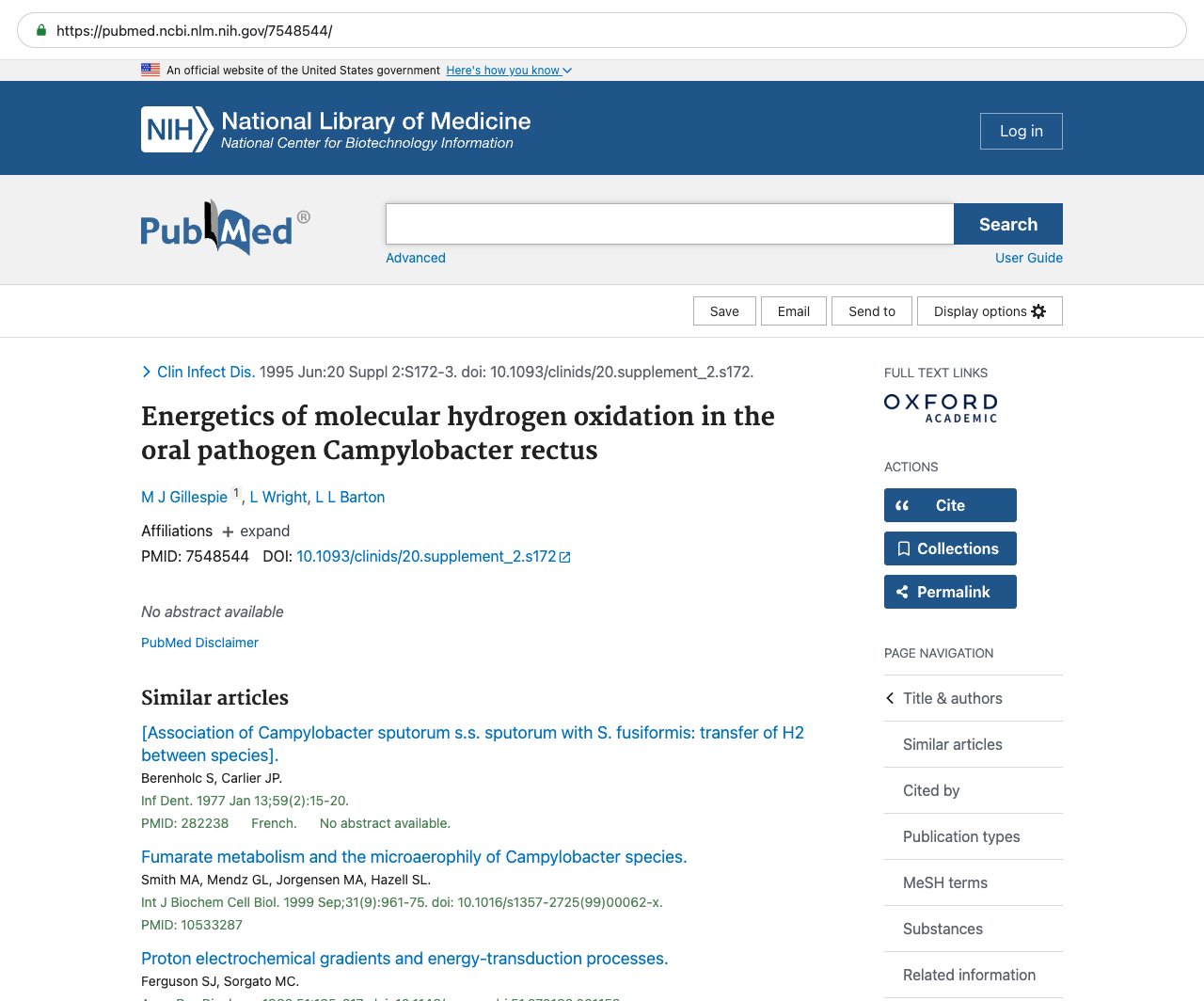
This page mirrors the published abstract (© the authors / publisher) for reference and citation. The canonical source is the PubMed record linked above. This is not medical advice.