2020 · Chen et al. — The future of cryoablation: An abscopal effect
Super-Abstract
This review on cryoablation for cancer treatment briefly mentions molecular hydrogen (H₂) as a potential combination partner — specifically because H₂ may rescue exhausted CD8+ T cells and thereby amplify the immune response triggered by tumour ablation. H₂ is not the main subject of this paper but appears as one of several proposed combination strategies. (Cryobiology, 2020.)
Commentary
This review primarily addresses cryoablation — the use of extreme cold to destroy tumour tissue — and its potential to trigger a systemic immune response against non-ablated tumours (the „abscopal effect”). The authors discuss how cryoablation can be combined with immunotherapies (cyclophosphamide, NK cells, GM-CSF, checkpoint inhibitors such as CTLA-4 and PD-1 inhibitors) to enhance this immune activation. H₂ gas is mentioned in a single passage: citing a study in which H₂ was shown to stimulate PGC-1α and promote mitochondrial function, potentially rescuing exhausted CD8+ T cells and improving progression-free and overall survival in advanced colorectal cancer. This is a preclinical or early clinical reference (the cited study involves inhalation of H₂). The H₂ content in this review is limited and secondary to the main cryoablation topic.
Key quotes
- „Cryoablation could also be combined with Hydrogen gas molecules, which were shown recently to stimulate peroxisome proliferator activated receptor gamma coactivator (PGC)-1α, thereby promoting mitochondrial function, which might rescue exhausted CD8+ T cells, leading to prolonged progression-free survival and overall survival of patients with advanced colorectal cancer.“ — the specific H₂ mechanism proposed as synergy with cryoablation
- „In the future, the use of cryoablation should focus on its abscopal effect.“ — the paper's central thesis: leveraging systemic immune activation after local tumour destruction
Our assessment
This is a narrative review on cryoablation, not on hydrogen therapy per se. The H₂-related content is a brief supporting reference in the context of combination immuno-oncology strategies. The cited H₂ data appear to come from a single oncology study (advanced colorectal cancer) and the proposed mechanism (PGC-1α / CD8+ T cell rescue) is not yet established as a general principle. This paper is relevant to H₂ in oncology as a secondary reference, not as direct evidence of H₂ efficacy.
Study design
- Type: narrative review (cryoablation + immunotherapy combinations) · n: n/a · H₂ delivery: inhalation (referenced in passing — not the primary study)
- Result: review of abscopal effect mechanisms; H₂ mentioned as potential T-cell-rescuing combination agent; no new H₂-specific data generated in this paper
Abstract
Cryoablation has become a popular modality to treat a variety of malignant tumors in solid organs and soft tissues. In the future, the use of cryoablation should focus on its abscopal effect. The present review discusses the increased immune response triggered by cryoablation alone or by cryoablation combined with immunotherapies, which can improve the immune response and limit immunosuppression. First, cryoablative techniques should be improved to increase the area of necrosis and reduce the area of apoptosis. Second, cryoablation should be combined with immunotherapies, for example, cyclophosphamide, natural killer cells, granulocyte monocyte colony stimulating factor (GM-CSF), cytotoxic T lymphocyte-associated antigen (CTLA)-4, and programmed death receptor 1 (PD)-1 inhibitors. Cryoablation could also be combined with Hydrogen gas molecules, which were shown recently to stimulate peroxisome proliferator activated receptor gamma coactivator (PGC)-1α, thereby promoting mitochondrial function, which might rescue exhausted CD8+ T cells, leading to prolonged progression-free survival and overall survival of patients with advanced colorectal cancer.
Source & links
Screenshot of the PubMed page
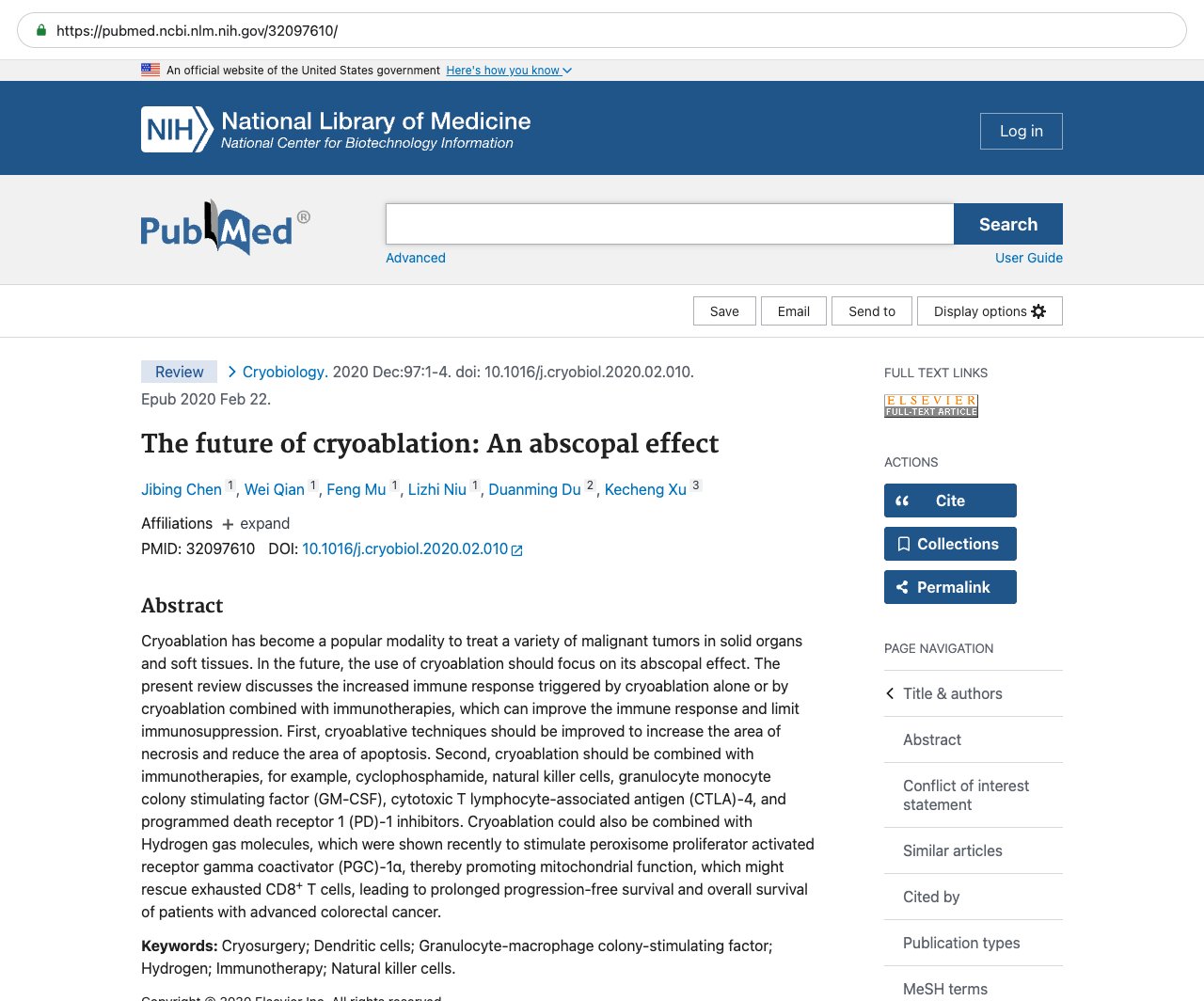
This page mirrors the published abstract (© the authors / publisher) for reference and citation. The canonical source is the PubMed record linked above. This is not medical advice.