2025 · Lin — Galvanic Cell Bipolar Microneedle Patches for Reversing Photoaging Wrinkles.
Super-Abstract
A microneedle patch containing magnesium-based bipolar electrodes generates microcurrents and releases hydrogen gas and magnesium ions directly in the skin via a galvanic cell reaction. In animal experiments, the combined effect of H₂'s antioxidant and anti-inflammatory properties, microcurrent-stimulated cell migration, and magnesium's support for blood-vessel formation successfully reversed UV-induced skin photoaging wrinkles. (Advanced Materials, 2025.)
Commentary
This is a preclinical animal study. The key innovation is the galvanic-cell microneedle (GCMN) patch, which delivers multiple therapeutic signals simultaneously — hydrogen gas, microcurrents, and magnesium ions — without requiring external power. The authors show involvement of the TGF-β/Smad pathway in wrinkle reversal. While the multi-modal synergy is mechanistically plausible and results in UV-aged mouse skin are encouraging, the leap to human clinical efficacy in photoaging reversal remains unproven. Regulatory and safety considerations for skin-penetrating magnesium-electrode devices would need to be addressed before any human use.
Key quotes
- „These patches operate through a galvanic cell mechanism, generating microcurrents and releasing hydrogen gas and magnesium ions via a redox reaction.“ — working principle of the patch
- „The combination of hydrogen's antioxidant and anti-inflammatory properties, microcurrent-induced stimulation of cell migration, and magnesium's promotion of angiogenesis and macrophage M2 anti-inflammatory polarization synergistically works to reverse photoaging wrinkles and rejuvenate the skin.“ — proposed multi-modal synergy mechanism
- „This work examines how GCMNs may influence the transforming growth factor-β/Smad (TGF-β/Smad) pathway.“ — signalling pathway explored in this study
Our assessment
This is a preclinical animal study — results cannot be directly transferred to humans. The concept of combining H₂ delivery with microcurrents and magnesium ions via a dissolvable microneedle patch is original, and the multi-pathway approach to reversing UV-induced wrinkles is mechanistically well-argued. However, all efficacy data come from mouse models, and H₂ is only one of several active components tested jointly. Independent replication and controlled human trials are necessary before drawing conclusions about effectiveness in cosmetic or medical skin care.
Study design
- Type: preclinical animal study · Model: UV-aged mouse skin · H₂ delivery: galvanic-cell microneedle patch (GCMN) with Mg bipolar electrodes (in-situ H₂ generation via redox)
- Endpoints: wrinkle depth, collagen content, macrophage polarisation (M2), TGF-β/Smad pathway activation, angiogenesis markers · Result: significant reversal of photoaging wrinkles vs. control; synergistic effect of H₂ + microcurrent + Mg²⁺
Abstract
Excessive exposure to ultraviolet (UV) radiation is a major factor in the development of skin photoaging wrinkles. While current treatments can slow the progression of photoaging, it is very difficult to achieve complete reversal. This study introduces galvanic cell microneedle (GCMN) patches with magnesium-containing bipolar electrodes. These patches operate through a galvanic cell mechanism, generating microcurrents and releasing hydrogen gas and magnesium ions via a redox reaction. The combination of hydrogen's antioxidant and anti-inflammatory properties, microcurrent-induced stimulation of cell migration, and magnesium's promotion of angiogenesis and macrophage M2 anti-inflammatory polarization synergistically works to reverse photoaging wrinkles and rejuvenate the skin. Furthermore, this work examines how GCMNs may influence the transforming growth factor-β/Smad (TGF-β/Smad) pathway. This approach shows promise for advancing research and development in the field of medical cosmetology.
Source & links
Screenshot of the PubMed page
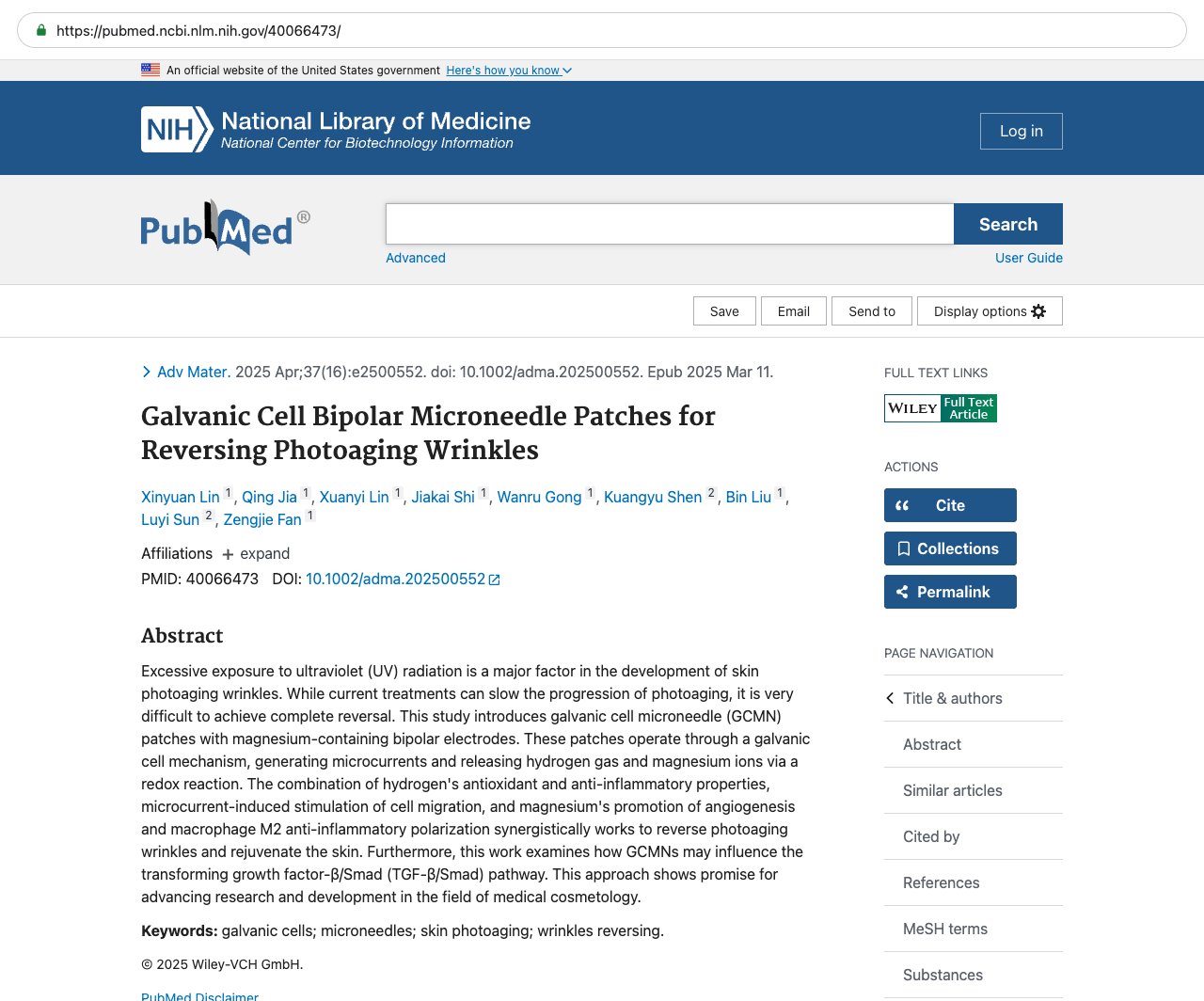
This page mirrors the published abstract (© the authors / publisher) for reference and citation. The canonical source is the PubMed record linked above. This is not medical advice.