2026 · Liang — Synergistic Calcium Overload and Hydrogen Release Potentiate Robust Antitumor Immunity
Super-Abstract
A nanoplatform called Ca@CMPN combines calcium hydride and curcumin to simultaneously flood cancer cells with calcium ions (triggering immunogenic cell death) and release H₂ to reduce oxidative stress and reshape the immunosuppressive tumor microenvironment. Both in-vitro and in-vivo (animal) studies showed enhanced tumor growth inhibition and a stronger immune response, including dendritic cell activation and cytotoxic T-cell recruitment. (Advanced Healthcare Materials, 2026.)
Commentary
Calcium overload is an established trigger of immunogenic cell death (ICD) — a form of tumor-cell death that releases signals alerting the immune system. The challenge is sustaining intracellular calcium dysregulation long enough for robust ICD to occur. This nanoplatform addresses this by co-loading calcium hydride (a H₂ and Ca²⁺ source) and curcumin (a natural compound that disrupts organellar calcium homeostasis, amplifying the overload) in a polydopamine carrier. In the acidic tumor microenvironment, the carrier breaks down and releases both components. H₂ acts as an immunoadjuvant by scavenging harmful ROS and improving the immunosuppressive conditions. The authors report both in-vitro and in-vivo data from animal tumor models — but no human data.
Key quotes
- „Upon encountering the acidic TME, Ca@CMPN disintegrates to release Ca2+, initiating intracellular calcium overload, and concurrently generates hydrogen gas (H2).“ — mechanism trigger: acidic tumor microenvironment activates dual calcium + H₂ release
- „H2 serves as a potent immunoadjuvant to alleviate oxidative stress and remodel the immunosuppressive TME.“ — the specific role of H₂: immune microenvironment remodelling
- „Both in vitro and in vivo studies demonstrate that Ca@CMPN effectively inhibits tumor growth and reprograms the TME, as evidenced by enhanced dendritic cell maturation, activation of cytotoxic T cells, and elevated levels of pro-inflammatory cytokines.“ — summary of the immune activation evidence in cell and animal experiments
Our assessment
A preclinical study (in-vitro + animal models) with a sophisticated, multi-component rationale. The combination of calcium overload, curcumin amplification, and H₂ immunoadjuvancy is mechanistically layered and the animal data add weight beyond cell culture alone. However, no human clinical data exist, and the polydopamine carrier system would require extensive biocompatibility, pharmacokinetic, and manufacturing studies before clinical evaluation. The use of natural curcumin as a component is noteworthy but curcumin's poor bioavailability in vivo is a known translational challenge. This is not human therapeutic evidence.
Study design
- Type: in-vitro and preclinical animal study · Model: cancer cell lines + animal tumor models · H₂ delivery: calcium hydride (CaH₂) in polydopamine carrier (Ca@CMPN) releasing H₂ + Ca²⁺ in acidic TME
- Result: tumor growth inhibition, dendritic cell maturation, cytotoxic T-cell activation, elevated IFN-γ and TNF-α in animal models; reduced oxidative stress and immunosuppressive TME markers
Abstract
Immunogenic cell death (ICD) induced by calcium overload holds great promise for reversing the immunosuppressive tumor microenvironment (TME) and improving cancer immunotherapy. However, achieving sustained calcium dysregulation remains a major challenge. Herein, we report a novel nanoplatform, termed Ca@CMPN, which co-delivers calcium hydride and curcumin using a mesoporous polydopamine carrier for synergistic ion-interference and gas immunotherapy. Upon encountering the acidic TME, Ca@CMPN disintegrates to release Ca2+, initiating intracellular calcium overload, and concurrently generates hydrogen gas (H2). Crucially, the co-released curcumin acts from within the cell, amplifying the calcium overload by disrupting organellar calcium homeostasis, thereby ensuring robust ICD. Meanwhile, H2 serves as a potent immunoadjuvant to alleviate oxidative stress and remodel the immunosuppressive TME. Both in vitro and in vivo studies demonstrate that Ca@CMPN effectively inhibits tumor growth and reprograms the TME, as evidenced by enhanced dendritic cell maturation, activation of cytotoxic T cells, and elevated levels of pro-inflammatory cytokines (interferon-γ (IFN-γ) and tumor necrosis factor-α (TNF-α)). This work presents a paradigm-shifting strategy that synergizes ion-interference therapy with hydrogen immunotherapy, offering a powerful nanoplatform to unlock the full potential of cancer immunotherapy.
Source & links
Screenshot of the PubMed page
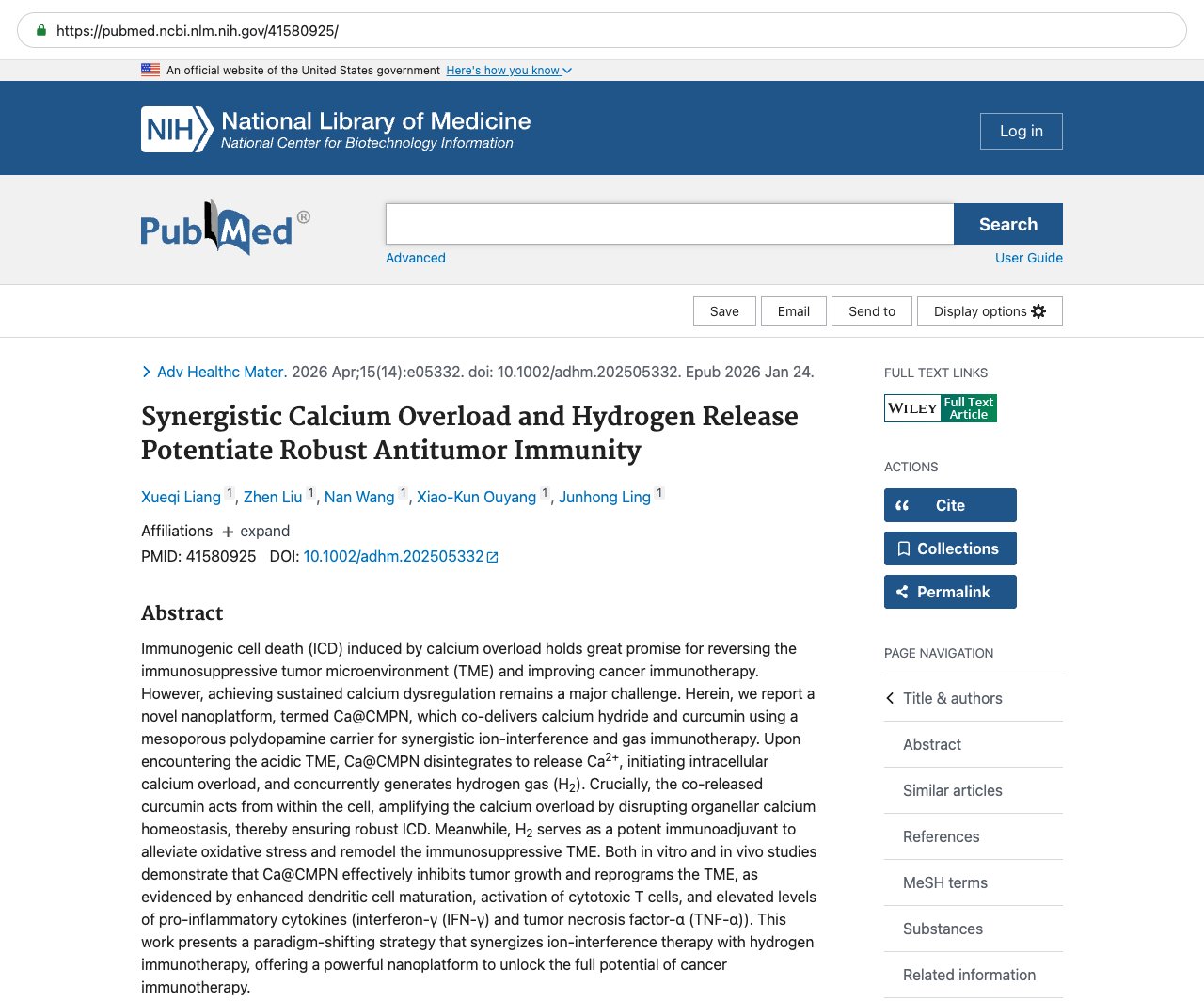
This page mirrors the published abstract (© the authors / publisher) for reference and citation. The canonical source is the PubMed record linked above. This is not medical advice.