2026 Journal of controlled release : official journal of the Controlled Release Society Mechanism / Preclinical InhalationDrinking (HRW)
2026 · Cao — A Hydrogen Generator Enhances Immunogenic Transarterial Chemoembolization in Hepatocellular Carcinoma
Super-Abstract
Adding a hydrogen-releasing material (nano-CaH₂) to the standard TACE (transarterial chemoembolization) procedure for liver cancer enabled local H₂ release that reduced tumor hypoxia, enhanced drug effectiveness, and activated anti-tumor immune responses — all demonstrated in animal models. The hydrogen neutralized the acidic tumor microenvironment and boosted immunogenic cell death triggered by the chemotherapy drug epirubicin. (Journal of Controlled Release, 2026.)
Commentary
TACE is a standard minimally invasive treatment for hepatocellular carcinoma (HCC): a chemotherapy drug is injected directly into the tumor blood supply while the artery is blocked, starving the tumor of blood and delivering concentrated local chemotherapy. Its effectiveness is often limited by tumor hypoxia (low oxygen) and acidosis, which protect cancer cells and suppress immune responses. This study integrates calcium hydride (CaH₂) nanoparticles — which release H₂ and calcium ions upon contact with water — into the TACE emulsion. The released H₂ reduces oxygen consumption in mitochondria (alleviating hypoxia), while calcium ions and hydroxide ions from hydrolysis neutralize acidosis and trigger immunogenic cell death. The evidence comes from rat/mouse animal models — there are no human clinical trial data.
Key quotes
- „Nano-CaH₂ particles, co-delivered locally via TACE, undergo hydrolysis to continuously release hydrogen gas (H₂) and calcium ions (Ca2+). This reaction disrupts mitochondrial function in cancer cells, reduces oxygen consumption, alleviates tumor hypoxia, and consequently counteracts chemoresistance.“ — the core mechanism: CaH₂ hydrolysis → H₂ + Ca²⁺ → hypoxia relief + chemosensitization
- „EPI induces immunogenic cell death (ICD) in moribund tumor cells, activating the host's antitumor immune response.“ — synergistic mechanism: epirubicin triggers ICD that recruits immune attack
- „This strategy presents a novel method to improve TACE efficacy and facilitate its integration with immunotherapy, demonstrating considerable potential for clinical translation.“ — authors' outlook — potential, not yet proven clinically
Our assessment
A preclinical (animal model) study that makes a mechanistically coherent case for adding H₂ release to TACE. The multi-pronged rationale — hypoxia relief, acid neutralization, immunogenic cell death amplification — is well-supported conceptually. However, all efficacy data are from animal models; human pharmacokinetics, immune responses, and safety profile would differ. TACE itself is a highly specialized interventional procedure, and incorporating a novel nanomaterial carries additional regulatory and safety hurdles. This is not clinical evidence and should not be extrapolated to human therapy.
Study design
- Type: preclinical animal study · Model: hepatocellular carcinoma in rodents · H₂ delivery: calcium hydride (CaH₂) nanoparticles co-delivered via transarterial chemoembolization (TACE) with epirubicin
- Result: reduced tumor hypoxia, acid neutralization, enhanced immunogenic cell death, activated anti-tumor immune response, improved tumor suppression vs. standard TACE in animal models
Abstract
Conventional transarterial chemoembolization (TACE) regimens for hepatocellular carcinoma (HCC) are often compromised in efficacy due to hypoxia and acidosis within the tumor microenvironment (TME), frequently leading to unsatisfactory treatment outcomes and tumor recurrence. To overcome these limitations, this study introduces an innovative approach by incorporating a hydrogen generator (calcium hydride, CaH₂) into an epirubicin (EPI)-iodized oil embolization system. This design enables local hydrogen release to remodel the TME following TACE, thereby enhancing the combined chemo-immunotherapeutic antitumor response. Nano-CaH₂ particles, co-delivered locally via TACE, undergo hydrolysis to continuously release hydrogen gas (H₂) and calcium ions (Ca2+). This reaction disrupts mitochondrial function in cancer cells, reduces oxygen consumption, alleviates tumor hypoxia, and consequently counteracts chemoresistance. Simultaneously, EPI induces immunogenic cell death (ICD) in moribund tumor cells, activating the host's antitumor immune response. Additionally, the hydroxide ions generated from CaH₂ hydrolysis neutralize the acidic TME, alleviating immunosuppression and further amplifying the chemo-immunotherapeutic synergy mediated by TACE. This strategy presents a novel method to improve TACE efficacy and facilitate its integration with immunotherapy, demonstrating considerable potential for clinical translation.
Source & links
Screenshot of the PubMed page
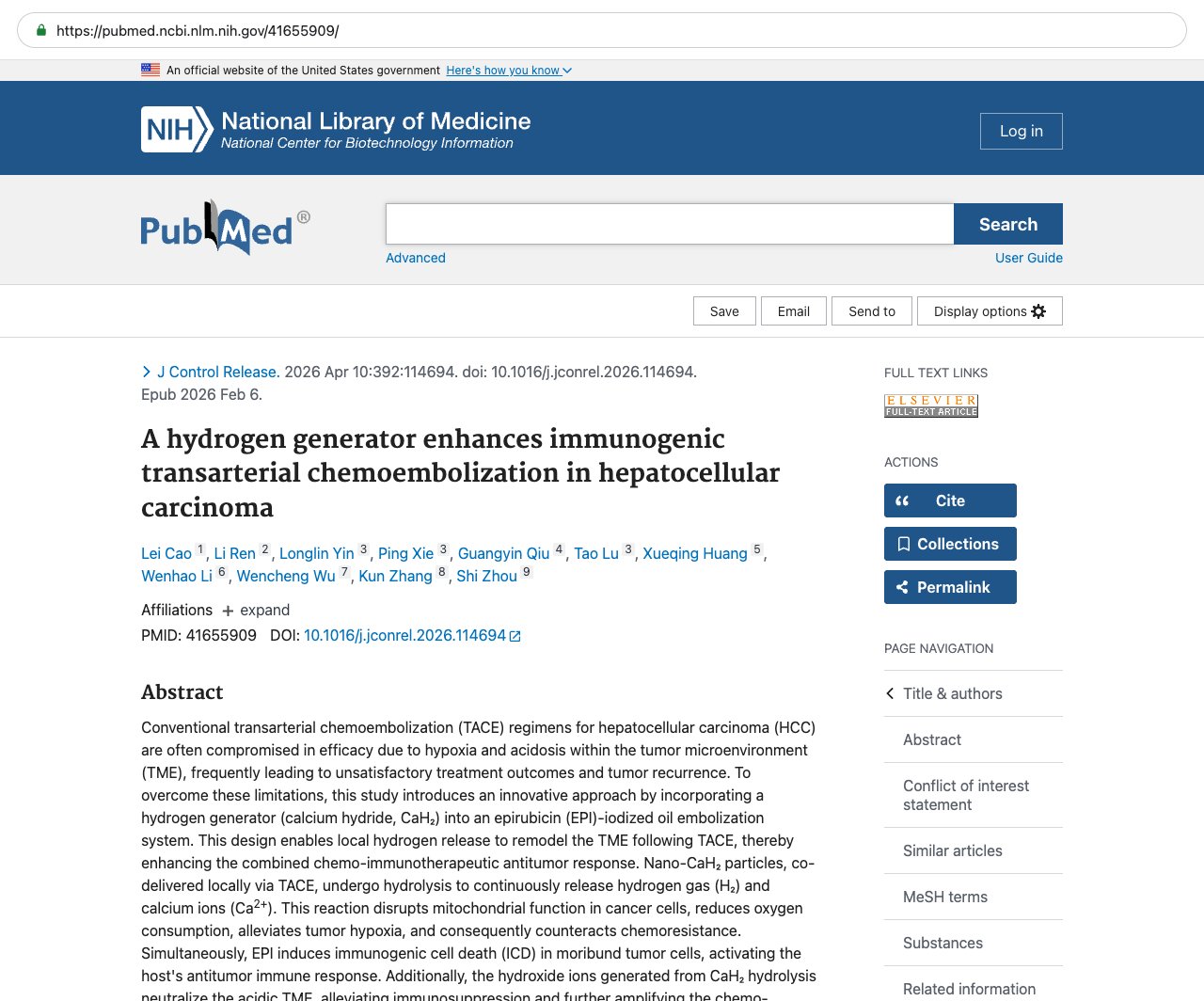
This page mirrors the published abstract (© the authors / publisher) for reference and citation. The canonical source is the PubMed record linked above. This is not medical advice.