2026 · Qin — Tumor Microenvironment-Responsive Hydrogen-Generating Zn-Doped ReZIF-8 Nanoplatform for Enhanced Tumor Suppression
Super-Abstract
A zinc-doped metal-organic framework nanoparticle (ReZIF-8) was designed to generate H₂ inside cancer cells in response to the acidic tumor microenvironment, while simultaneously releasing zinc ions that further disrupt cancer cell redox balance — triggering immunogenic cell death and, in combination with anti-PD-1 checkpoint therapy, suppressing tumor growth in a melanoma mouse model. (Advanced Healthcare Materials, 2026.)
Commentary
Metal-organic frameworks (MOFs) are porous nanostructures used as drug delivery vehicles. This study exploits the fact that zeolitic imidazolate framework-8 (ZIF-8) degrades in slightly acidic environments — making it a pH-responsive H₂ generator inside tumors. The „Re“ prefix refers to partial reduction, which enables H₂ generation upon acidic dissolution. Zinc ions released alongside H₂ are cytotoxic to cancer cells via zinc overload. The combined H₂ + Zn²⁺ stress triggers immunogenic cell death (ICD), which then stimulates dendritic cells and T-cell responses. When combined with anti-PD-1 checkpoint blockade (an established immunotherapy), the effect was amplified in a B16F10 melanoma mouse model. The study presents in-vitro data and animal data — but no human data.
Key quotes
- „The accumulated H2 and Zn2+ overload act synergistically to disrupt redox homeostasis in tumor cells, inducing reactive oxygen species (ROS)-dependent immunogenic cell death (ICD).“ — the mechanism: H₂ + Zn²⁺ co-stress → ROS imbalance → immunogenic cell death
- „Intratumoral administration of ReZIF-8 in a B16F10 melanoma mouse model elicits potent antitumor efficacy via intracellular H2-triggered terminal differentiation and cell cycle arrest.“ — the animal model finding: H₂-triggered cancer cell cycle arrest in melanoma mice
- „The therapeutic effect is further enhanced in combination with αPD-1 immune checkpoint blockade, resulting in extended survival and significant suppression of metastatic progression.“ — synergy with immunotherapy: anti-PD-1 combination improves outcomes in animal model
Our assessment
A preclinical study (in-vitro + melanoma mouse model) with a well-designed multi-mechanism rationale. The combination of intracellular H₂ generation, Zn²⁺ overload, immunogenic cell death, and anti-PD-1 synergy is conceptually layered. The animal survival and metastasis data add weight beyond cell culture. However, no human clinical data exist. The intratumoral administration route limits applicability to accessible tumors, and incorporating this nanoplatform into clinical practice would require extensive regulatory and manufacturing development. This is not human therapeutic evidence.
Study design
- Type: in-vitro + preclinical animal study · Model: cancer cell lines + B16F10 melanoma mouse model · H₂ delivery: acid-responsive H₂ generation from Zn-doped ReZIF-8 nanoparticles (intratumoral injection)
- Result: ROS-dependent immunogenic cell death; tumor growth inhibition; extended survival and metastasis suppression in combination with anti-PD-1 checkpoint blockade in melanoma mice
Abstract
Hydrogen-based tumor therapy demonstrates therapeutic potential, while the efficacy remains limited by insufficient intracellular hydrogen generation, poorly controlled release kinetics, and inadequate immune response potentiation. To address these limitations, a partially reduced zinc-doped zeolitic imidazolate framework-8 (ReZIF-8) is developed, functioning as a dual-functional nanoplatform for both intracellular hydrogen generation and controlled Zn(II) ions (Zn2+) overload. The cationic surface charge of ReZIF-8 enhances cellular internalization, while its pH-responsive properties facilitate controlled intracellular hydrogen gas (H2) release. The accumulated H2 and Zn2+ overload act synergistically to disrupt redox homeostasis in tumor cells, inducing reactive oxygen species (ROS)-dependent immunogenic cell death (ICD). This ICD activation robustly stimulates innate immune responses and enhances antigen cross-presentation. Intratumoral administration of ReZIF-8 in a B16F10 melanoma mouse model elicits potent antitumor efficacy via intracellular H2-triggered terminal differentiation and cell cycle arrest. The therapeutic effect is further enhanced in combination with αPD-1 immune checkpoint blockade, resulting in extended survival and significant suppression of metastatic progression, highlighting its translational potential. The ReZIF-8-mediated H2-generating nanoplatform reprograms intratumoral redox balance to simultaneously induce ICD, amplify antitumor immunity, and drive terminal differentiation. This triple-pronged mechanism leverages synergistic modulation to achieve comprehensive tumor control.
Source & links
Screenshot of the PubMed page
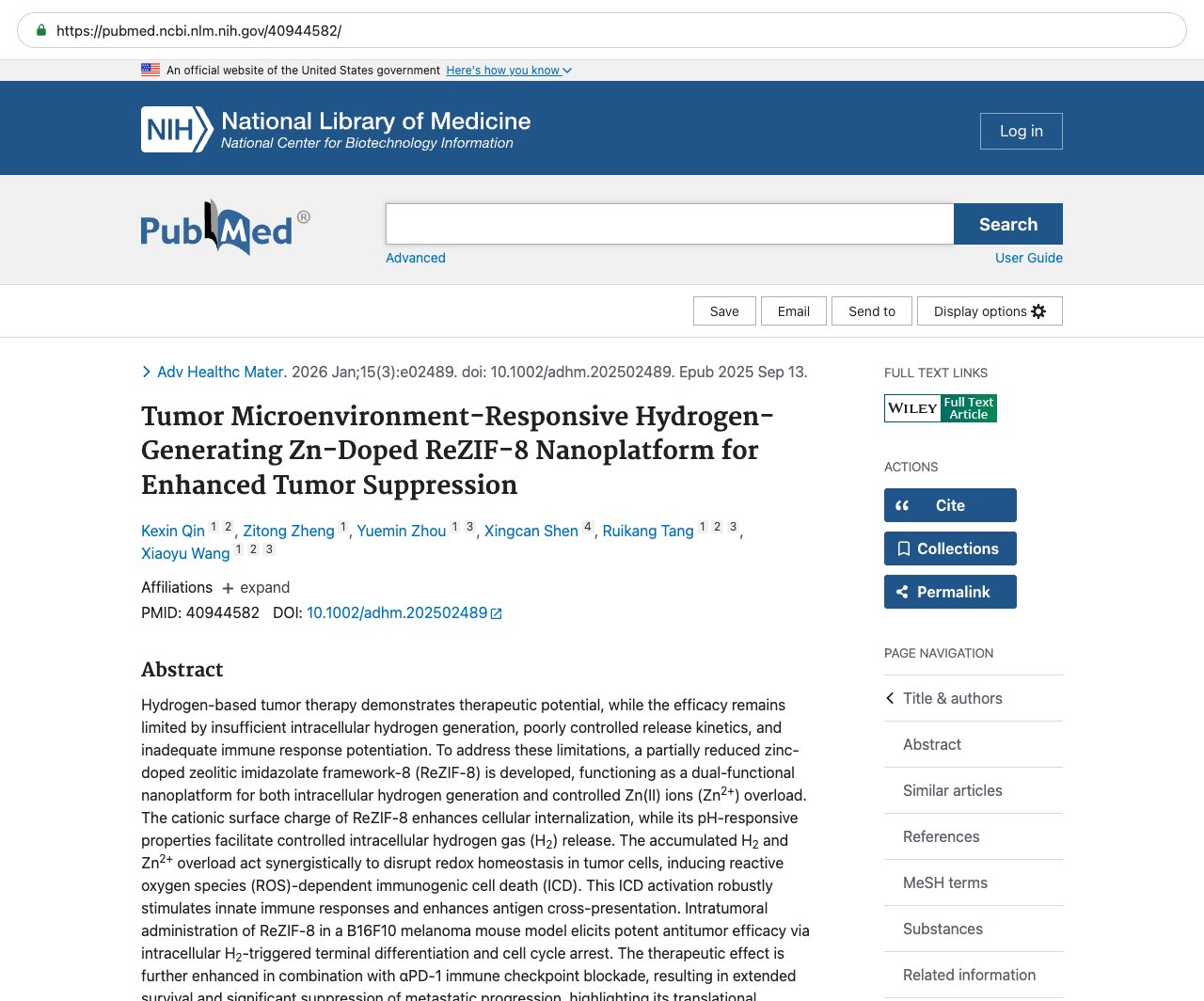
This page mirrors the published abstract (© the authors / publisher) for reference and citation. The canonical source is the PubMed record linked above. This is not medical advice.