2021 · Chen — High-flow hydrogen inhalation might suppress the immune function of middle-aged participants: a self-controlled study
Super-Abstract
Twenty healthy adults who inhaled hydrogen at high flow rates for 2–4 hours daily over two weeks showed significant decreases in several immune cell populations, including T helper cells, NK cells, and gamma delta T cells. This finding raises an important caution: while standard-dose H₂ inhalation is generally considered safe, high-flow delivery may temporarily suppress immune function. (Medical Gas Research, 2021.)
Commentary
This study is unusual and important: it is one of the few that reports a potentially adverse immune effect of H₂ inhalation. The rationale was to explore whether high <em>flow rate</em> (not high concentration) H₂ affects the immune system, as different clinical studies use widely varying flow rates. Twenty adults aged 31–60 inhaled hydrogen for 2 or 4 hours per day for 2 weeks. Immune cell subsets in peripheral blood were measured before and after the protocol. Statistically significant reductions were found in follicular helper T cells, helper (CD4+) and cytotoxic (CD8+) T cells, NK cells, NKT cells, and gamma delta T cells — generally pointing toward immune suppression. The authors interpret this cautiously: in the context of oncology, immune modulation might be desirable; but in healthy adults, suppressing frontline immune cells is a concern. Critically, this study used healthy volunteers and a high-flow protocol; it does not test clinical outcomes or long-term effects. Whether these changes are transient and reversible is not reported.
Key quotes
- „After 2 weeks of hydrogen inhalation, statistically significant changes were observed in follicular helper T cells, helper and cytotoxic T cells, natural killer and natural killer T cells, and gamma delta T cells, generally suggesting a decrease in their proportions.“ — the key finding: broad immune cell suppression across multiple lymphocyte populations
- „Since there is no upper limit for the safe concentration of hydrogen, this study tested the effects of high-flow (not high concentration) hydrogen inhalation on immune function.“ — important framing: the concern is flow rate, not concentration — a parameter often overlooked
- „These results show that high-flow hydrogen inhalation has an inhibitory effect on the immune function of healthy participants.“ — the authors' honest conclusion — cautiously framed as a potential safety signal
Our assessment
A critical safety-signal study that the H₂ field should take seriously. It adds an important caveat to the common assumption that H₂ inhalation is universally safe at any flow rate. Limitations: n=20, self-controlled design (no concurrent control group), no washout period described, reversibility of immune changes not assessed, clinical outcomes not measured, population is middle-aged healthy adults (results may not generalise). The immune changes may be transient — but we do not know. This finding warrants follow-up studies specifically designed to test dose-response, reversibility, and clinical significance of high-flow H₂ on immunity.
Study design
- Type: self-controlled before-after study · n: 20 healthy adults aged 31–60 · H₂ delivery: high-flow hydrogen inhalation, 2 or 4 hours/day, 14 days (concentration not stated as high — flow rate is the variable)
- Outcome: peripheral blood lymphocyte subsets (flow cytometry) — before vs. after 2 weeks
- Result: significant ↓ in follicular helper T cells, CD4+ and CD8+ T cells, NK cells, NKT cells, gamma delta T cells; no clinical adverse events reported; reversibility not assessed
Abstract
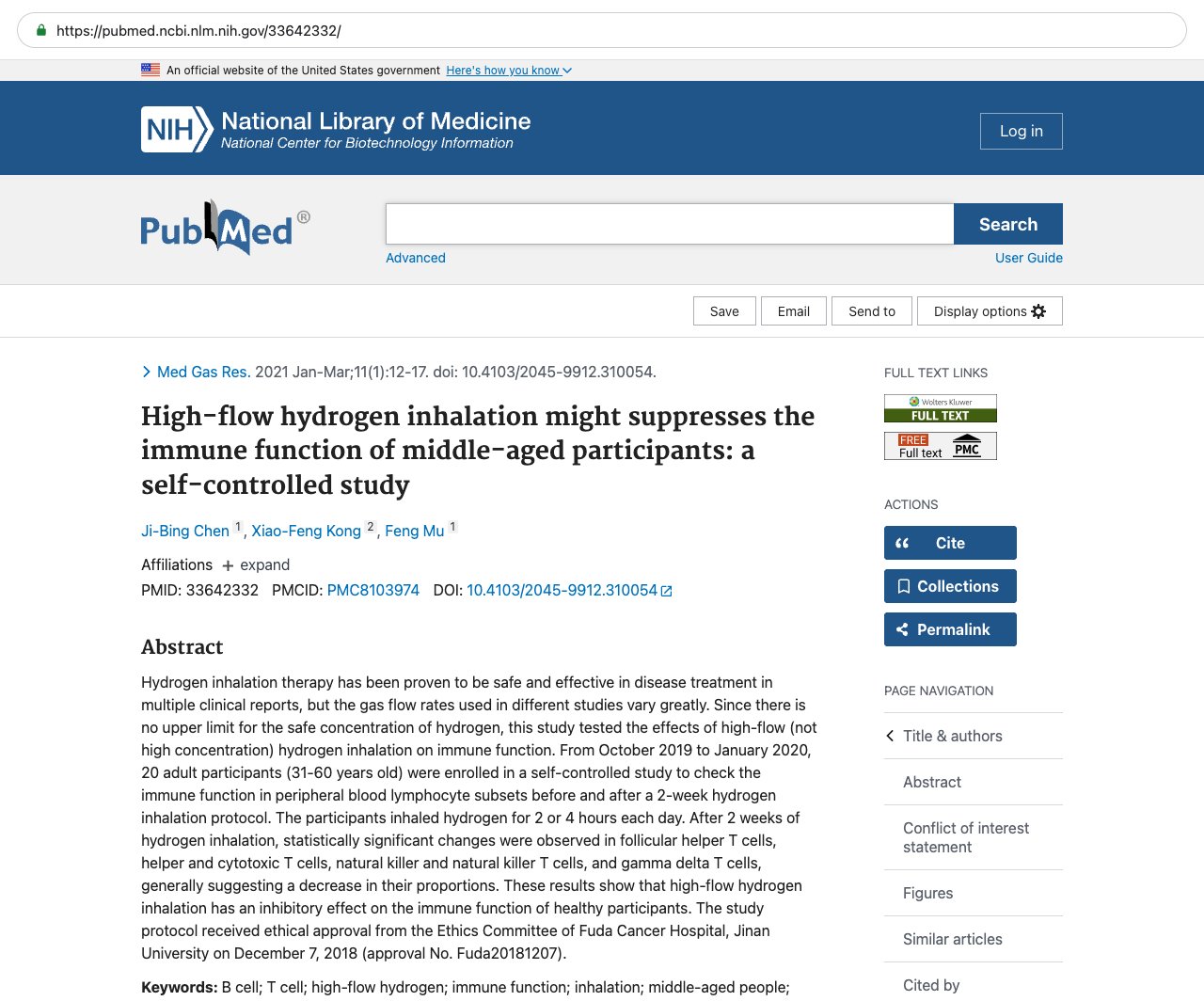
Hydrogen inhalation therapy has been proven to be safe and effective in disease treatment in multiple clinical reports, but the gas flow rates used in different studies vary greatly. Since there is no upper limit for the safe concentration of hydrogen, this study tested the effects of high-flow (not high concentration) hydrogen inhalation on immune function. From October 2019 to January 2020, 20 adult participants (31-60 years old) were enrolled in a self-controlled study to check the immune function in peripheral blood lymphocyte subsets before and after a 2-week hydrogen inhalation protocol. The participants inhaled hydrogen for 2 or 4 hours each day. After 2 weeks of hydrogen inhalation, statistically significant changes were observed in follicular helper T cells, helper and cytotoxic T cells, natural killer and natural killer T cells, and gamma delta T cells, generally suggesting a decrease in their proportions. These results show that high-flow hydrogen inhalation has an inhibitory effect on the immune function of healthy participants. The study protocol received ethical approval from the Ethics Committee of Fuda Cancer Hospital, Jinan University on December 7, 2018 (approval No. Fuda20181207).
Source & links
Screenshot of the PubMed page
This page mirrors the published abstract (© the authors / publisher) for reference and citation. The canonical source is the PubMed record linked above. This is not medical advice.