2014 · Ostojic et al. — Effectiveness of oral and topical hydrogen for sports-related soft tissue injuries.
Super-Abstract
In male professional athletes with acute soft tissue injuries, adding oral hydrogen tablets (2 g/day) plus topical hydrogen-rich packs accelerated joint range-of-motion recovery and reduced plasma viscosity compared to standard treatment alone. This single-blind pilot RCT (n=36) suggests H₂ may be a useful adjunct in sports injury management. (Postgraduate Medicine, 2014.)
Commentary
Soft tissue injuries — sprains, strains, contusions — are the most frequent injuries in professional sport. Standard management (RICE protocol + physiotherapy) works, but recovery time matters enormously in competitive sport. This pilot by Ostojic tests whether adding H₂ — either orally via tablets or topically via hydrogen-rich packs — can accelerate recovery. The three-arm design (control / oral H₂ / oral + topical H₂) is a strength, allowing dose-response reasoning. The headline results — faster return to normal range of motion for both flexion and extension, and a significant reduction in plasma viscosity — are clinically meaningful for sports medicine. That said, single-blind design (athletes knew their allocation), a small cohort of only 36 athletes across three arms, and the use of plasma viscosity as a primary biomarker (not a standard clinical endpoint) are notable limitations. Still, the registered trial status (ClinicalTrials.gov NCT01759498) and the professional athlete population lend credibility.
Key quotes
- „Oral and topical hydrogen intervention was found to augment plasma viscosity decrease as compared with the control group (P = 0.04).“ — H₂ improved a key blood-flow marker
- „oral and topical hydrogen intervention resulted in a faster return to normal joint range of motion for both flexion and extension of the injured limb as compared with the control intervention (P < 0.05).“ — the clinically most relevant finding: faster functional recovery
- „These preliminary results support the hypothesis that the addition of hydrogen to traditional treatment protocols is potentially effective in the treatment of soft tissue injuries in male professional athletes.“ — authors' cautious conclusion — pilot, not definitive
Our assessment
A promising pilot study with a registered protocol and a clinically relevant population. The positive results for range-of-motion recovery are notable, but must be interpreted cautiously: single-blind design (patients knew their group), only n=12 per arm, exclusively male professional athletes (limiting generalisability to recreational athletes or women), and no long-term follow-up beyond 14 days. Plasma viscosity, while significant, is not a standard rehabilitation endpoint. The study is best viewed as hypothesis-generating, warranting a properly powered double-blind RCT.
Study design
- Type: randomized, single-blind, 3-arm pilot RCT · n: 36 male professional athletes (acute soft tissue injury) · H₂ delivery: oral hydrogen-rich tablets 2 g/day ± topical hydrogen-rich packs 6×/day for 20 min, over 14 days
- Comparator: standard treatment protocol alone (control group)
- Result: oral + topical H₂ group showed significantly faster return to normal range of motion (flexion + extension, P<0.05) and greater plasma viscosity reduction (P=0.04) vs. control
Abstract
BACKGROUND: Because hydrogen therapy has been found beneficial for the treatment of inflammation, ischemia-reperfusion injury, and oxidative stress in humans, it seems useful to evaluate the effects of exogenously administered hydrogen as an element in the immediate management of sports-related soft tissue injuries. The main aim of this pilot study was to examine the effects of 2-week administration of hydrogen on the biochemical markers of inflammation and functional recovery in male professional athletes after acute soft tissue injury. METHOD: During the 2013 season (from March to May), 36 professional athletes were recruited as participants and examined by a certified sports medicine specialist in the first 24 hours after an injury was sustained. Subjects were allocated to 3 randomly assigned trials in a single-blind design. Those in the control group received a traditional treatment protocol for soft tissue injury. Subjects in the first experimental group followed the same procedures as the control group but with additional administration throughout the study of oral hydrogen-rich tablets (2 g per day). Subjects in the second experimental group also followed the procedures of the control group, with additional administration throughout the study of both oral hydrogen-rich tablets (2 g per day) and topical hydrogen-rich packs (6 times per day for 20 minutes). Participants were evaluated at the time of the injury report and at 7 and 14 days after baseline testing. RESULTS: Oral and topical hydrogen intervention was found to augment plasma viscosity decrease as compared with the control group (P = 0.04). Differences were found for range-of-motion recovery between the 3 groups; oral and topical hydrogen intervention resulted in a faster return to normal joint range of motion for both flexion and extension of the injured limb as compared with the control intervention (P < 0.05). CONCLUSION: These preliminary results support the hypothesis that the addition of hydrogen to traditional treatment protocols is potentially effective in the treatment of soft tissue injuries in male professional athletes. Trial identification: Clinicaltrials.gov number NCT01759498.
Source & links
Screenshot of the PubMed page
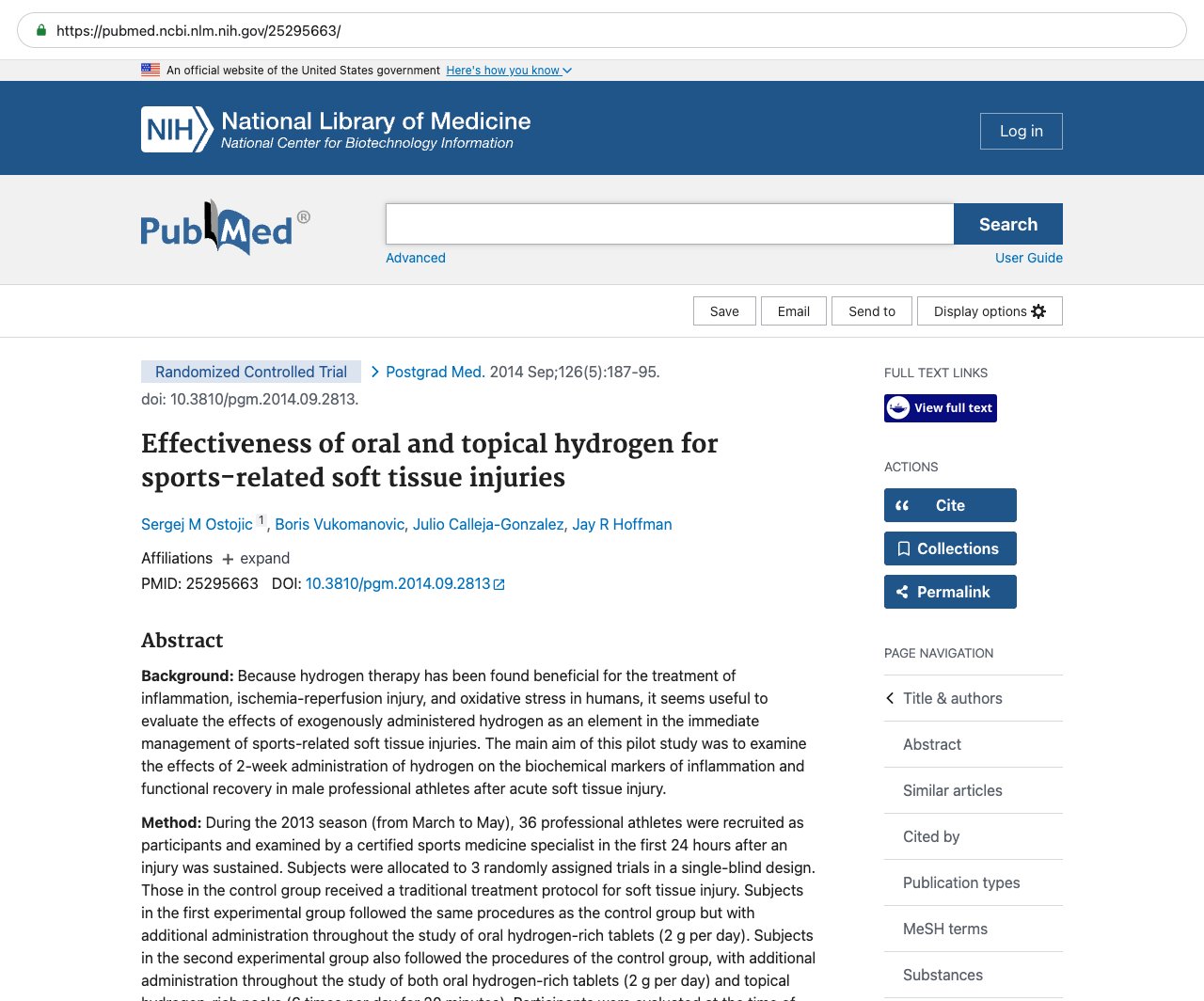
This page mirrors the published abstract (© the authors / publisher) for reference and citation. The canonical source is the PubMed record linked above. This is not medical advice.