2021 · Danilova — Application of Molecular Hydrogen in Heart Surgery under Cardiopulmonary Bypass
Super-Abstract
During open-heart surgery on cardiopulmonary bypass, inhaling 1.5–2% hydrogen gas during anaesthesia reduced markers of lipid peroxidation (oxidative stress) compared to patients who did not receive H₂. The effect was most pronounced one day after surgery, suggesting a protective role against ischaemia-reperfusion injury. (Sovremennye Tekhnologii v Meditsine, 2021.)
Commentary
Cardiopulmonary bypass (CPB) — the heart-lung machine used in open-heart surgery — creates a period of whole-body ischaemia and reperfusion that generates a surge of reactive oxygen species, contributing to organ damage post-operatively. This small pilot study (n=20) tested whether adding 1.5–2% H₂ to the ventilator circuit throughout surgery could attenuate this oxidative response. Blood was sampled at four time points: after anaesthesia induction, before CPB, after CPB, and one day post-operation. In the H₂ group, triene conjugates (TC) and Schiff bases (SB) — markers of advanced lipid peroxidation — were lower than at baseline before CPB and one day after surgery. In the control group (no H₂), SB rose progressively. The data are consistent with H₂ providing antioxidant protection during and immediately after the extreme oxidative stress of CPB. However, with only 11 patients in the H₂ group and 9 in the control, this is firmly a pilot study. No clinical outcomes (mortality, organ function, ICU stay) are reported.
Key quotes
- „Intraoperative inhalation of molecular hydrogen leads to a decrease in the oxidative stress manifestation, it being most pronounced one day after the operation.“ — the central conclusion: H₂ reduces lipid peroxidation markers, peaking in effect on post-operative day 1
- „In the patients of group 2, an increase in the concentration of SB in the arterial blood samples was recorded during the study as compared to the first stage.“ — the control group's trajectory: without H₂, oxidative stress markers rose progressively
- „This suggests that molecular hydrogen can be used in cardiac surgery as an effective and safe antioxidant.“ — the authors' conclusion — cautiously phrased, which is appropriate for n=20
Our assessment
A small but mechanistically coherent pilot study in a high-stakes clinical setting. The four-timepoint sampling design provides useful kinetic data on oxidative stress evolution during and after CPB. Limitations: n=11/9 per group is too small for clinical conclusions; no clinical outcomes (mortality, ICU stay, organ function) were measured — only biochemical oxidative stress markers; the journal (Russian specialty journal) has limited indexing and peer-review transparency; no blinding of patients or laboratory personnel is described. As a safety-and-signal study, it supports proceeding to a larger RCT with hard clinical endpoints.
Study design
- Type: pilot controlled study · n: 20 patients with acquired heart valve disease (H₂ group n=11, control n=9) · H₂ delivery: inhalation at 1.5–2.0% concentration added to ventilator breathing circuit, from intubation throughout surgery
- Blood sampling: 4 time points (post-induction, pre-CPB, post-CPB, post-op day 1) · Outcome: lipid peroxidation markers (diene conjugates DC, triene conjugates TC, Schiff bases SB)
- Result: H₂ group: ↓ TC and SB pre-CPB and on post-op day 1 vs. baseline; control group: ↑ SB progressively. No clinical outcome data reported.
Abstract
UNLABELLED: The aim of this work was to study the effect of molecular hydrogen on oxidative processes in cardiac surgery patients with acquired valve heart disease applied during surgery under cardiopulmonary bypass (CPB). MATERIALS AND METHODS: The study involved 20 patients (16 men and 4 women) with acquired heart valve disease who were operated on under CPB. Two groups of patients were formed. In group 1 (n=11), anesthesia included inhalations of molecular hydrogen, which was supplied to the breathing circuit of the ventilator at a concentration of 1.5-2.0% immediately after tracheal intubation and throughout the operation. In group 2 (n=9), inhalation of molecular hydrogen was not performed. Blood sampling was taken at 4 stages: immediately after anesthesia induction, before CPB and after its termination, and also one day after the operation. The intensity of the processes of lipid peroxidation was evaluated by the level of diene (DC) and triene (TC) conjugates, Schiff bases (SB). RESULTS: In the patients of group 1, the arterial blood samples showed a decrease in the level of TC and SB, as compared to the first stage of the study, before the initiation of CPB and one day after the operation. An increase in the level of DC and TC was detected after the termination of CPB (p<0.05). In the venous blood samples, an increase in the level of DC was noted before the initiation of CPB, which was restored by the third stage of the study (p<0.05). At the same time, after the termination of CPB, a tendency towards a decrease in TC and SB was observed, which persisted one day after the operation.In the patients of group 2, an increase in the concentration of SB in the arterial blood samples was recorded during the study as compared to the first stage. The level of TC and SB in the venous blood samples increased one day after the operation. CONCLUSION: Intraoperative inhalation of molecular hydrogen leads to a decrease in the oxidative stress manifestation, it being most pronounced one day after the operation. This suggests that molecular hydrogen can be used in cardiac surgery as an effective and safe antioxidant.
Source & links
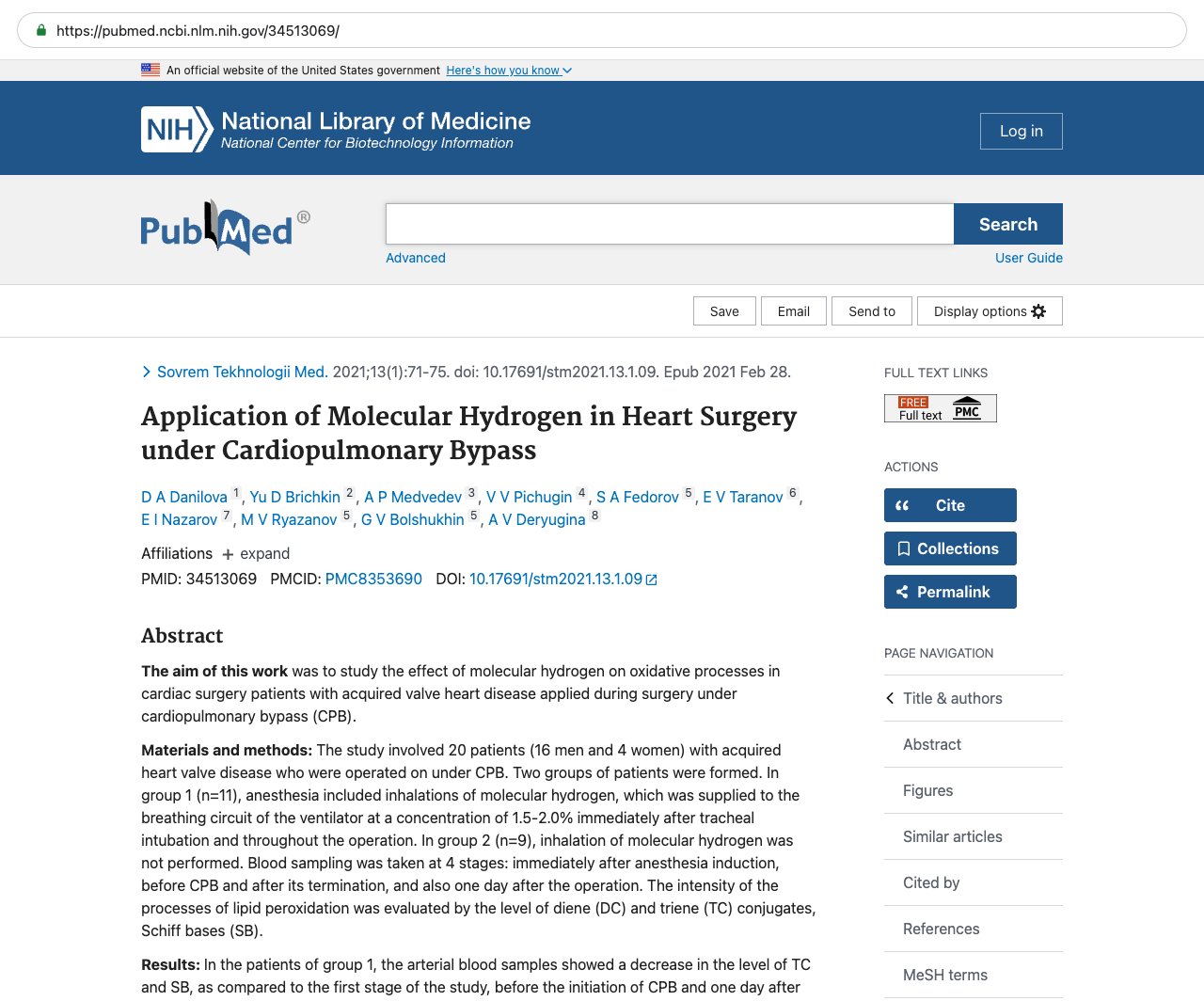
Screenshot of the PubMed page
This page mirrors the published abstract (© the authors / publisher) for reference and citation. The canonical source is the PubMed record linked above. This is not medical advice.