2024 · Pozdnyakova — Rehabilitation program of post-COVID-19 syndrome with the use of nitric oxide and molecular hydrogen
Super-Abstract
The combined inhalation of nitric oxide and hydrogen improved complaints in post-COVID syndrome. In an open controlled study (n = 34), shortness of breath, cough, fatigue and palpitations decreased, quality of life rose, and oxidative stress fell (p < 0.005). (Terapevticheskii Arkhiv, 2024.)
Commentary
Post-COVID syndrome affects, according to the WHO, 10–20% of those who had COVID and is persistent — many suffer for months from shortness of breath, cough and exhaustion. This Russian study combined two medical gases: inhaled nitric oxide (NO) and molecular hydrogen (H₂). 34 patients, on average around 60 years old and a mean of almost two years after infection, were divided into two parallel groups: 17 received 90 minutes of NO/H₂ daily over 10 days, 17 received no inhalation as control. The results in the treatment group: shortness of breath, cough, fatigue and palpitations improved significantly (p < 0.005), the quality-of-life score SF-36 rose (p = 0.006), the fatigue score FAS fell (p = 0.001), and the anxiety component improved too. In the 6-minute walk test, distance walked and oxygen saturation rose, and the markers for oxidative damage and antioxidant activity improved. Quite honestly for the assessment: it is a small, open study — and crucially, two gases were given simultaneously. The effect therefore cannot be cleanly attributed to hydrogen alone; NO is an established vascular and respiratory agent. In addition, the control group received no sham treatment at all, which favors placebo and attention effects.
Key quotes
- „The decrease the symptoms severity, such as dyspnea, cough, fatigue and palpitations (p<0.005), the increase in SF-36 questionnaire scores (p=0.006) and a reducing of FAS score (p=0.001) ... were revealed at the end of treatment in the main group compared to the control group.“ — significant symptom and quality-of-life improvement in the treatment group
- „We observed an improvement in distance walked (p=0.01) and the values SpO2 (p=0.04) in 6-minute walk test.“ — better walking distance and oxygen saturation in the exertion test
- „The results of the study demonstrate clinical efficacy iNO/iH2 on clinical indicators, parameters of oxidative stress and microcirculation in patients with PS.“ — conclusion: clinical efficacy of the NO/H₂ combination
Our assessment
Relevant because post-COVID is a large, still-current affected group and H₂ is tested here as part of a respiratory-gas therapy; the findings on oxidative stress and microcirculation fit the H₂ profile mechanistically. Most important limitation, stated honestly: the intervention was a combination of NO and H₂ — the contribution of hydrogen alone cannot be isolated from this design (confounding by NO). Added to this are a small sample (n = 34), an open design without sham treatment in the control group (placebo/attention effects possible) and subjective questionnaire endpoints. A supportive signal, not isolated proof of H₂ efficacy.
Study design
- Type: prospective, open, controlled parallel-group study · n: 34 (17 NO/H₂ / 17 control without inhalation) · Duration: 10 days, 90 min daily · H₂ delivery: inhalation combining NO (60 ppm) + H₂ (< 4% in the gas mixture)
- Result metrics: dyspnea/cough/fatigue/palpitations ↓ (p < 0.005); SF-36 ↑ (p = 0.006); FAS ↓ (p = 0.001); HADS anxiety ↓ (p = 0.02); 6-minute walk distance ↑ (p = 0.01), SpO₂ ↑ (p = 0.04); oxidative damage ↓ (p < 0.001), antioxidant activity ↑ (p = 0.03)
Abstract
UNLABELLED: Рost-COVID-19 syndrome (PS) is one of the medical and social problem. According to WHO, 10-20% of COVID-19 patients suffer from PS. The use of medical gases - inhaled nitric oxide (iNO) and molecular hydrogen (iH2) - may influence on the mechanisms of development PC. AIM: To evaluate the safety and efficacy of the combined inhalation of NO and H2 (iNO/iH2) in patients with respiratory manifestations of PS. MATERIALS AND METHODS: 34 patients with PS (11 men/23 women, 60.0±11.7 years) were included in the prospective open-label controlled study in parallel groups: the main group (n=17) received iNO/iH2 for 90 minutes once a day for 10 days (concentration of NO 60 ppm, H2<4% in the gas mixture), the control group (n=17) didn't receive inhalations. The period from the confirmation of COVID-19 to the start of the study was 641.8±230.5 days. The groups did not differ in the baseline parameters. The clinical symptoms (from the self-observation diary and mMRC questionnaires, "dyspnea language"), FAS, HADS, SF-36 scores, 6-minute walk test, the blood serum parameters of oxidative stress, the dynamics of the microcirculation in the eye bulbar conjunctiva were evaluated. The individual dose of iNO has chosen during a 15-minute test (the positive dynamics of the microcirculation have indicated that the dose was selected correctly). RESULTS: The decrease the symptoms severity, such as dyspnea, cough, fatigue and palpitations (p<0.005), the increase in SF-36 questionnaire scores (p=0.006) and a reducing of FAS score (p=0.001), as well as the anxiety component of HADS (p=0.02) were revealed at the end of treatment in the main group compared to the control group. We observed an improvement in distance walked (p=0.01) and the values SpO2 (p=0.04) in 6-minute walk test, the increase in the volumetric blood flow velocity in venules (p<0.001), and the date in oxidative damage (p<0.001) and antioxidant activity (p=0.03) parameters in the blood serum. CONCLUSION: The results of the study demonstrate clinical efficacy iNO/iH2 on clinical indicators, parameters of oxidative stress and microcirculation in patients with PS.
Source & links
Screenshot of the PubMed page
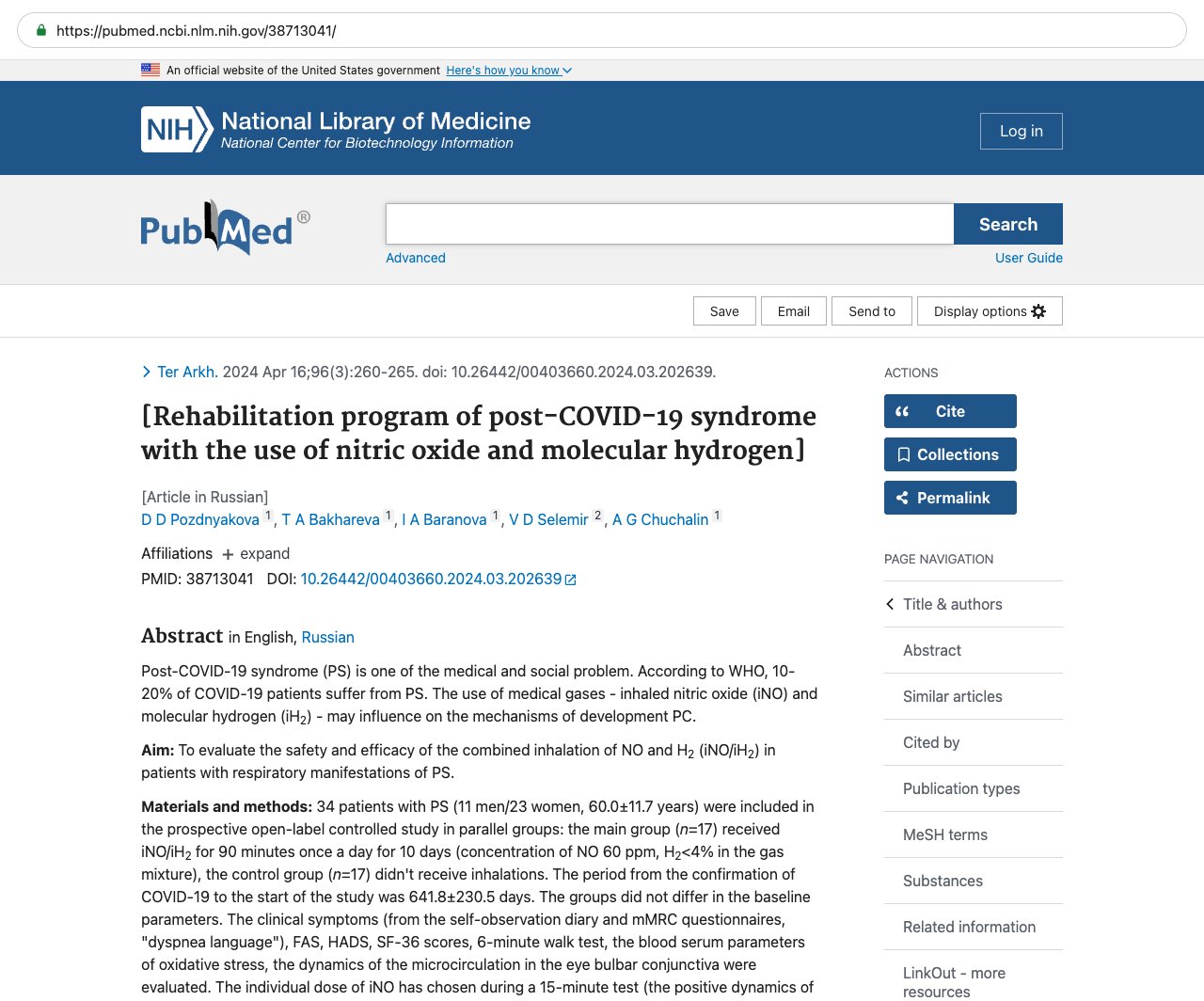
This page mirrors the published abstract (© the authors / publisher) for reference and citation. The canonical source is the PubMed record linked above. This is not medical advice.