2023 · Iketani — H₂-induced transient upregulation of phospholipids with suppression of energy metabolism
Super-Abstract
Short exposure to molecular hydrogen transiently shifts the lipid composition of neuroblastoma cells and temporarily suppresses their energy metabolism — a complex cellular response that hints at how H₂ may interact with cell membranes. This in-vitro cell study reveals that H₂ is not simply a passive antioxidant but actively changes lipid membranes and endosomal transport in human-derived neuroblastoma cells. Results cannot be directly transferred to living organisms.
Commentary
This in-vitro study attempts to fill a key knowledge gap: the molecular mechanism of H₂'s biological effects remains poorly understood despite growing therapeutic interest. The authors chose SH-SY5Y neuroblastoma cells — a widely used neuronal cell model — and applied liquid-chromatography/mass-spectrometry lipidomics plus metabolomics after one hour of H₂ exposure. Their finding that glycerophospholipids (phosphatidylethanolamine, phosphatidylinositol, cardiolipin) transiently increase while overall energy metabolism and glutathione decrease is unexpected: it suggests H₂ initially creates a mild oxidative stress signal that then stimulates protective stress-response pathways. The endosomal transport delay (cholera toxin B trafficking) adds a further mechanistic layer. These are intriguing mechanistic observations, but they are transient, cell-line-specific, and entirely in vitro — translating them to whole-organism or human physiology requires considerable caution.
Key quotes
- „Lipid class analysis of cells exposed to H2 for 1 hour revealed transient increases in glycerophospholipids including phosphatidylethanolamine, phosphatidylinositol, and cardiolipin.“ — the main lipidomics finding: H₂ shifts membrane phospholipid composition
- „H2 exposure for 1 hour transiently suppressed overall energy metabolism accompanied by a decrease in glutathione.“ — surprising counterintuitive finding: H₂ temporarily reduces the antioxidant glutathione
- „We speculate that H2-induced modification of lipid composition depresses energy production and endosomal transport concomitant with enhancement of oxidative stress, which transiently stimulates stress response pathways to protect cells.“ — the authors' proposed mechanism: mild H₂-induced stress triggers protective pathways
Our assessment
This is an in-vitro mechanistic study on a single cancer-derived cell line. Its findings are scientifically interesting — they challenge the simple „H₂ as passive antioxidant” model and suggest a more nuanced stress-response mechanism. However, no therapeutic conclusions for humans can be drawn: the effects are transient, observed in neuroblastoma cells only, and the metabolic suppression and glutathione decrease would require careful interpretation in a living organism. The study is most valuable as a hypothesis-generator pointing to membrane lipid biology as a possible mechanism of H₂ action.
Study design
- Type: in-vitro cell study · Model: SH-SY5Y human neuroblastoma cells · H₂ delivery: H₂ gas inhalation exposure of cells for 1 hour
- Methods: liquid chromatography–high-resolution mass spectrometry (lipidomics + metabolomics), immunofluorescence, endosomal tracking
- Result: transient increase in glycerophospholipids; transient suppression of energy metabolism and glutathione; delayed endosomal cholera toxin B transport — interpreted as mild H₂-induced stress activating protective pathways
Abstract
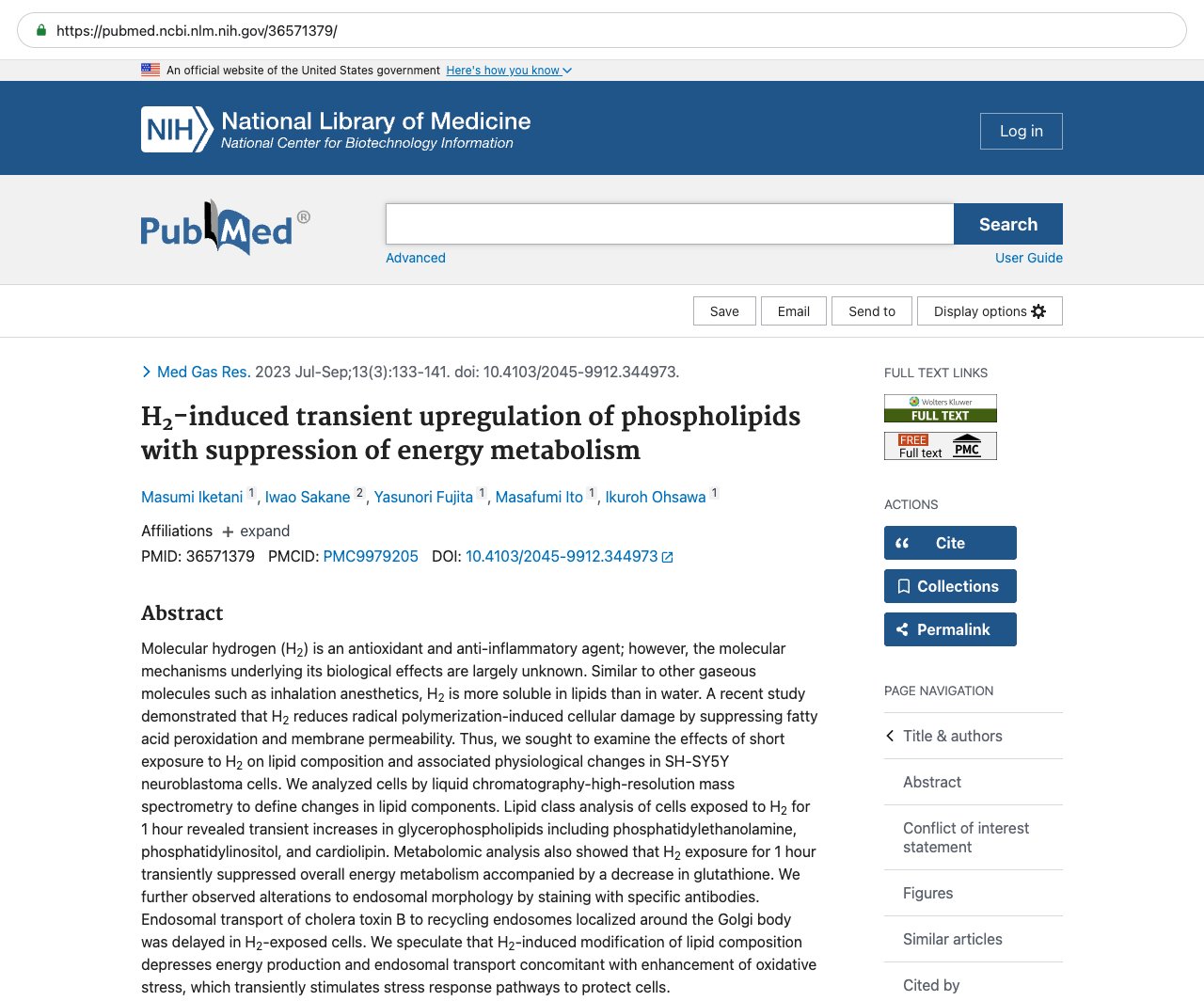
Molecular hydrogen (H2) is an antioxidant and anti-inflammatory agent; however, the molecular mechanisms underlying its biological effects are largely unknown. Similar to other gaseous molecules such as inhalation anesthetics, H2 is more soluble in lipids than in water. A recent study demonstrated that H2 reduces radical polymerization-induced cellular damage by suppressing fatty acid peroxidation and membrane permeability. Thus, we sought to examine the effects of short exposure to H2 on lipid composition and associated physiological changes in SH-SY5Y neuroblastoma cells. We analyzed cells by liquid chromatography-high-resolution mass spectrometry to define changes in lipid components. Lipid class analysis of cells exposed to H2 for 1 hour revealed transient increases in glycerophospholipids including phosphatidylethanolamine, phosphatidylinositol, and cardiolipin. Metabolomic analysis also showed that H2 exposure for 1 hour transiently suppressed overall energy metabolism accompanied by a decrease in glutathione. We further observed alterations to endosomal morphology by staining with specific antibodies. Endosomal transport of cholera toxin B to recycling endosomes localized around the Golgi body was delayed in H2-exposed cells. We speculate that H2-induced modification of lipid composition depresses energy production and endosomal transport concomitant with enhancement of oxidative stress, which transiently stimulates stress response pathways to protect cells.
Source & links
Screenshot of the PubMed page
This page mirrors the published abstract (© the authors / publisher) for reference and citation. The canonical source is the PubMed record linked above. This is not medical advice.