2019 · Yan — Hydrogen gas inhalation attenuates sepsis-induced liver injury in a FUNDC1-dependent manner.
Super-Abstract
In septic mice (cecal ligation and puncture model), 2 % hydrogen (H₂) gas inhalation for 3 hours improved the 7-day survival rate and reduced markers of liver damage. The protective mechanism appears to depend on the mitophagy receptor FUNDC1: when FUNDC1 was pharmacologically blocked, H₂ lost its protective effect. This identifies a specific molecular pathway through which H₂ may protect liver cells during sepsis. (International Immunopharmacology, 2019.)
Commentary
Sepsis-induced liver failure is a major driver of mortality in intensive-care patients, and FUNDC1-mediated mitophagy — the selective removal of damaged mitochondria — has emerged as a key regulatory mechanism in organ protection during sepsis. This study adds mechanistic precision to previous demonstrations of H₂ efficacy in septic animal models by pinpointing FUNDC1-dependent mitophagy as the pathway. The use of a cell-penetrating peptide inhibitor to specifically block FUNDC1 and then show that H₂ protection disappears is a methodologically sound approach to establishing pathway dependency. Limitations: all experiments were conducted in male mice only, the CLP model of sepsis is a single, highly artificial severity, the 2 % H₂ dose and 3-hour window may not translate to clinical intensive-care settings, and no functional liver-outcome endpoints (e.g., coagulopathy, encephalopathy) were measured — only biochemical markers.
Key quotes
- „2% H2 gas inhalation resulted in an increase in the 7-day survival rate, ALT and AST levels, RCR, and P62 and LC3B-II expression but decreased the histological score and FUDNC1, P-18-FUDNC1, Tim23, and caspase-1 levels after sepsis.“ — key survival and liver-protection result in H₂-treated septic mice
- „No significant differences were reported between the CLP + peptide P and CLP + H2 + peptide P groups.“ — critical mechanistic finding: H₂ protection is abolished when FUNDC1 is blocked
- „2% H2 gas inhalation for 3 h may serve as an effective therapeutic strategy for sepsis-induced liver injury through the regulation of FUNDC1-dependent mitophagy.“ — authors' conclusion: mechanism-specific protective effect in mice
Our assessment
This is a well-designed preclinical mechanistic study in mice — not clinical evidence for humans. It advances the mechanistic understanding of how H₂ might protect against septic liver injury via FUNDC1-dependent mitophagy, which is a meaningful scientific contribution. However, all findings are in male mice using a specific surgical sepsis model; no human patients were studied. The clinical gap — including dosing, delivery in ICU settings, and patient heterogeneity — is substantial. Results should not be extrapolated to human sepsis management.
Study design
- Type: preclinical animal study · Model: male C57BL/6J mice, cecal ligation and puncture (CLP) sepsis model · H₂ delivery: 2 % H₂ gas inhalation for 3 h starting 1 h post-CLP; FUNDC1 inhibitor peptide P (i.p., 1 mg/kg, 24 h pre-CLP)
- Result: H₂ improved 7-day survival; reduced ALT/AST (liver enzyme markers); reduced histopathological liver injury score; reduced FUNDC1, Tim23, caspase-1 levels; increased P62 and LC3B-II (mitophagy markers); effect abolished by FUNDC1 inhibition — confirming pathway dependency
Abstract
Sepsis-induced hepatic dysfunction is considered as an independent risk factor of multiple organ dysfunction syndrome (MODS) and death. Mitophagy, a selective form of autophagy, plays a major role in sepsis-induced organ damage. We have demonstrated that hydrogen gas (H2), a selective antioxidant, exerts protective effects in septic mice. Here, we hypothesize that the therapeutic effects of H2 on septic animals with liver damages may be exerted through regulation of the Fun14 domain-containing protein 1 (FUDNC1)-induced mitophagy pathway. Male C57BL/6J mice were subjected to sham or cecal ligation and puncture (CLP) operation and treated with 2% H2 gas inhalation for 3 h starting at 1 h after sham or CLP surgery. To verify the role of FUNDC1, the cell-penetrating peptide P (NH2-GRKKRRQRRRPQDYESDDESYEVLDLTEY-COOH) (1 mg/kg) that functions as a FUNDC1 inhibitor was intraperitoneally injected into mice 24 h before the sham or CLP operation. To evaluate the severity of septic liver injury, the 7-day survival rate, liver histopathologic score, alanine aminotransferase (ALT) and aspartate aminotransferase (AST) levels, respiration control ratio (RCR), and FUDNC1, P-18-FUDNC1, P62, LC3B-II, Tim23, and caspase-1 levels were evaluated after the sham or CLP operation. The results demonstrated that 2% H2 gas inhalation resulted in an increase in the 7-day survival rate, ALT and AST levels, RCR, and P62 and LC3B-II expression but decreased the histological score and FUDNC1, P-18-FUDNC1, Tim23, and caspase-1 levels after sepsis. However, no significant differences were reported between the CLP + peptide P and CLP + H2 + peptide P groups. These observations indicate that 2% H2 gas inhalation for 3 h may serve as an effective therapeutic strategy for sepsis-induced liver injury through the regulation of FUNDC1-dependent mitophagy.
Source & links
Screenshot of the PubMed page
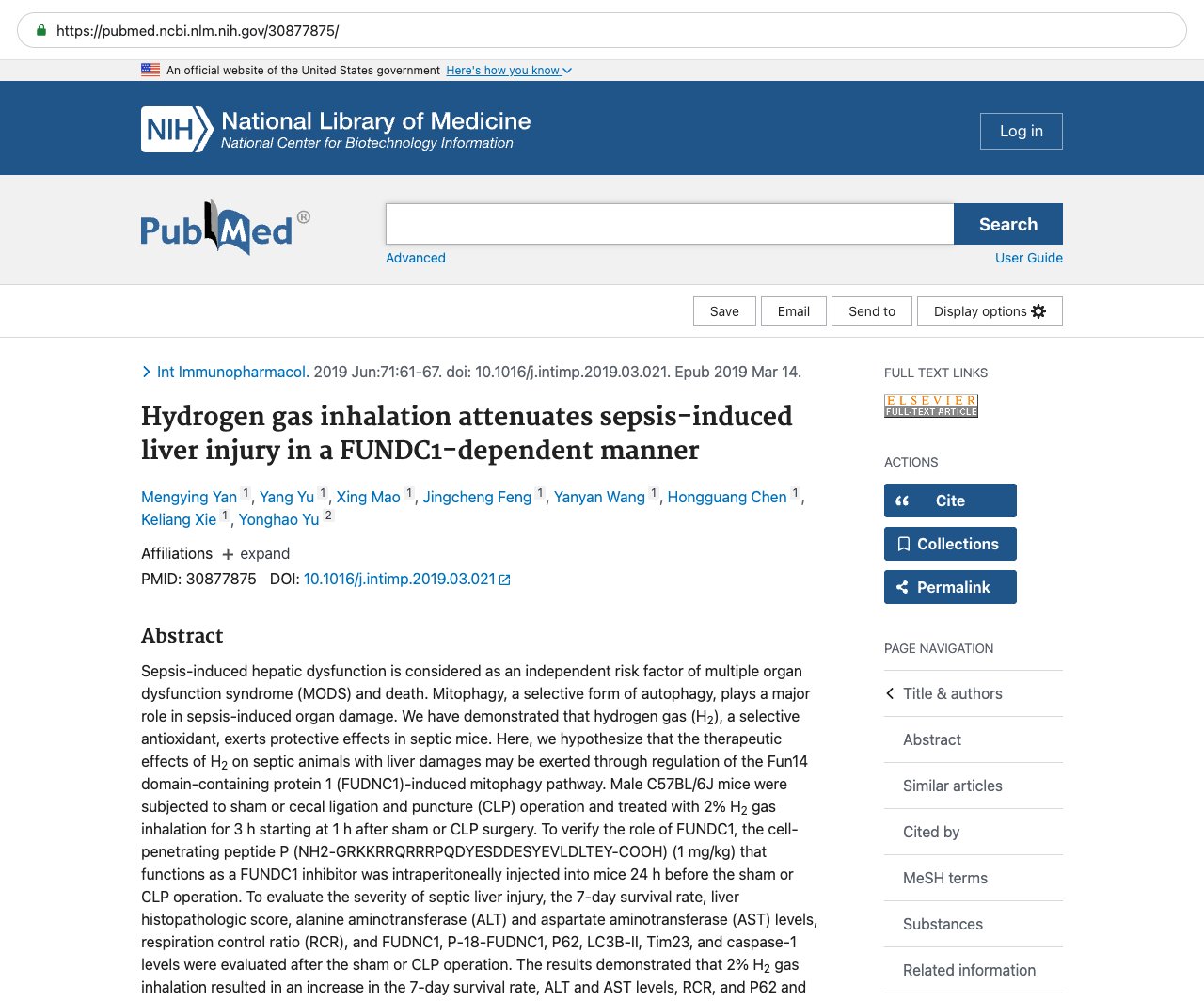
This page mirrors the published abstract (© the authors / publisher) for reference and citation. The canonical source is the PubMed record linked above. This is not medical advice.