2020 · Echeverry-Rendon — Interaction of Different Cell Types with Magnesium Modified by Plasma Electrolytic Oxidation
Super-Abstract
This in-vitro study examined how surface coatings applied to biodegradable magnesium via plasma electrolytic oxidation (PEO) affect vascular cells, immune cells, and adipose-derived stromal cells — finding that the coatings support stromal cell adhesion but that vascular cells remain vulnerable to compounds released during Mg degradation. Hydrogen gas appears here as a cytotoxic byproduct of magnesium corrosion, not as a therapeutic agent. (Colloids and Surfaces B: Biointerfaces, 2020.)
Commentary
The context of this study is biodegradable implant material development. Magnesium degrades in physiological environments and, as a chemical consequence, releases hydrogen gas — which this paper explicitly identifies as „cytotoxic“ in the context of implant degradation. The researchers used PEO surface coatings with different electrolytes to modulate the degradation behaviour and assess biocompatibility across multiple cell types. The study identifies a meaningful hierarchy of vulnerability: adipose-derived stromal cells (ASC) tolerate released compounds better than endothelial cells, with pre-formed endothelial tubes being most sensitive. This has implications for vascular implant applications of Mg alloys. Hydrogen gas here is clearly a hazard to be minimised, not a benefit — the framing is the opposite of therapeutic H₂ medicine.
Key quotes
- „Mg is chemically reactive, and cytotoxic hydrogen gas is released as part of the degradation.“ — key context: H₂ gas from Mg degradation is explicitly described as cytotoxic in this study
- „Preformed endothelial tubes were vulnerable for released compounds, while their supporting ASC was not.“ — cell-type-specific vulnerability: endothelial tubes most sensitive to degradation products
- „PEO-based surface-coating of Mg supports adhesion and future delivery of therapeutic vascular repair cells such as ASC, but that the observed vulnerability of vascular cells for coated Mg components warrants investigations in vivo.“ — conclusion: coatings promising for ASC delivery, but in-vivo safety still open
Our assessment
This is an in-vitro cell biology study in the field of biodegradable implant materials. H₂ gas is explicitly framed as a cytotoxic byproduct of Mg degradation — this is the opposite of therapeutic hydrogen. The study provides useful cell-biology data for implant material scientists, but has no direct relevance to H₂ supplementation or therapeutic hydrogen medicine. No conclusions about H₂ health benefits can be drawn from this work. Results are in-vitro only and require in-vivo validation.
Study design
- Type: in-vitro cell culture study · Model: commercial pure Mg surfaces with PEO coatings (different electrolytes); vascular cells, immune cells, adipose-derived stromal cells (ASC) · H₂ context: H₂ gas as cytotoxic byproduct of Mg degradation (not therapeutic)
- Result: PEO coatings modulate degradation; ASC proliferation supported on all coated surfaces; wound closure of fibroblast monolayers delayed (not blocked); pre-formed endothelial tubes most vulnerable to degradation compounds; PEO-coated Mg proposed as ASC-delivery scaffold pending in-vivo data
Abstract
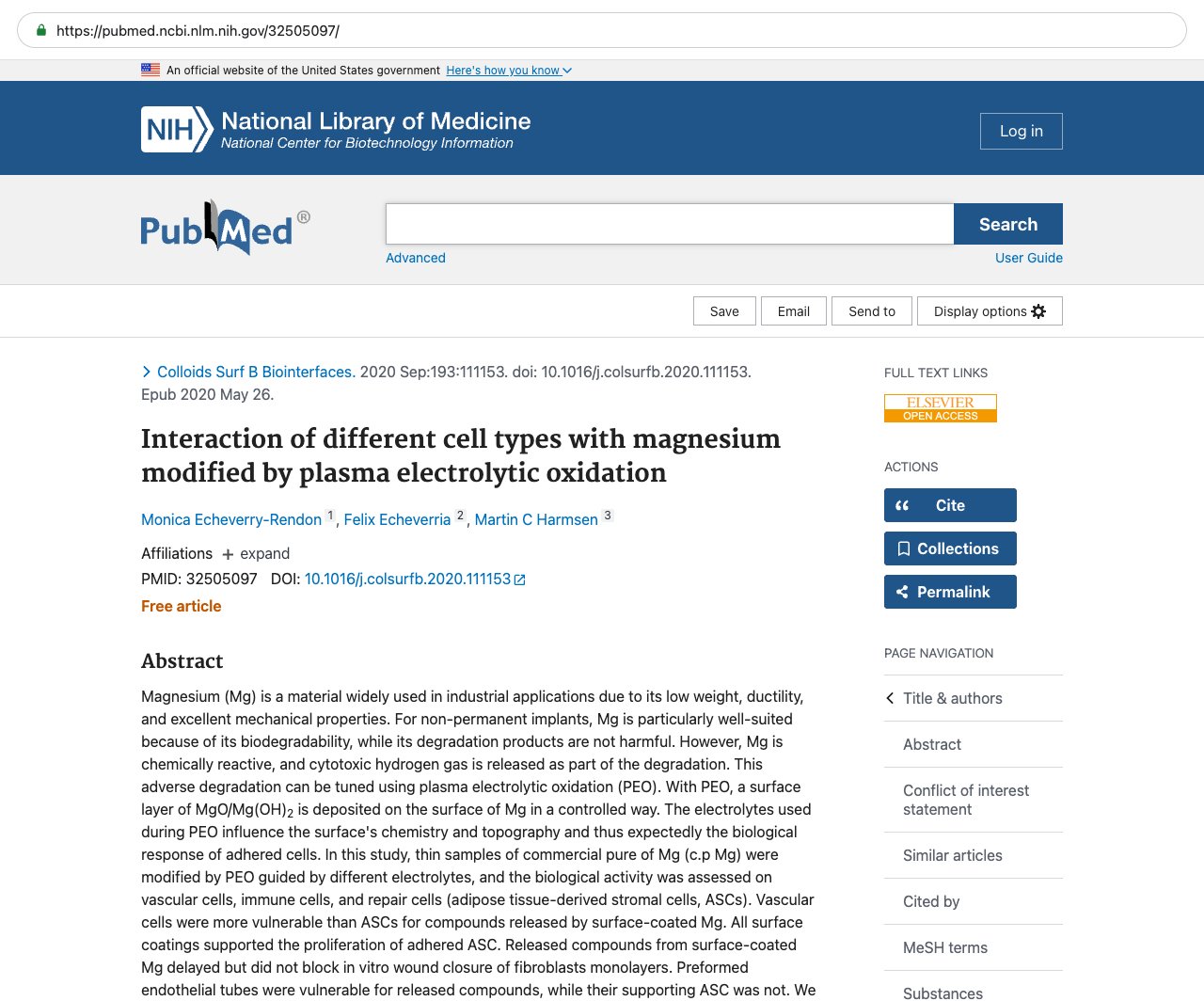
Magnesium (Mg) is a material widely used in industrial applications due to its low weight, ductility, and excellent mechanical properties. For non-permanent implants, Mg is particularly well-suited because of its biodegradability, while its degradation products are not harmful. However, Mg is chemically reactive, and cytotoxic hydrogen gas is released as part of the degradation. This adverse degradation can be tuned using plasma electrolytic oxidation (PEO). With PEO, a surface layer of MgO/Mg(OH)2 is deposited on the surface of Mg in a controlled way. The electrolytes used during PEO influence the surface's chemistry and topography and thus expectedly the biological response of adhered cells. In this study, thin samples of commercial pure of Mg (c.p Mg) were modified by PEO guided by different electrolytes, and the biological activity was assessed on vascular cells, immune cells, and repair cells (adipose tissue-derived stromal cells, ASCs). Vascular cells were more vulnerable than ASCs for compounds released by surface-coated Mg. All surface coatings supported the proliferation of adhered ASC. Released compounds from surface-coated Mg delayed but did not block in vitro wound closure of fibroblasts monolayers. Preformed endothelial tubes were vulnerable for released compounds, while their supporting ASC was not. We conclude that PEO-based surface-coating of Mg supports adhesion and future delivery of therapeutic vascular repair cells such as ASC, but that the observed vulnerability of vascular cells for coated Mg components warrants investigations in vivo.
Source & links
Screenshot of the PubMed page
This page mirrors the published abstract (© the authors / publisher) for reference and citation. The canonical source is the PubMed record linked above. This is not medical advice.