2026 · Pan — Stimuli-Responsive Hydrogen Production from Nanomaterials: Design, Regulation and Biomedical Applications
Super-Abstract
H₂ gas has broad therapeutic potential, but its low solubility and lack of targeted delivery limit clinical use — nanotechnology offers a solution through stimuli-responsive nanomaterials that produce H₂ on demand at disease sites. This review systematically covers nanomaterials that generate H₂ under external triggers such as light, ultrasound, magnetic fields or local tissue microenvironments, and explores their applications in cancer therapy, inflammatory diseases, neurovascular protection and antimicrobial treatment. (Advanced Healthcare Materials, 2026.)
Commentary
This review sits at the intersection of materials science, nanotechnology and H₂ medicine. The central innovation being described — externally triggered nanoscale H₂ generators — addresses the longstanding problem that dissolved H₂ is volatile, difficult to concentrate at specific sites, and rapidly cleared. The mechanisms reviewed span semiconductor photocatalysis to coordination chemistry. Applications are broad (oncology, neurology, infection, inflammation) but almost entirely preclinical; the review explicitly acknowledges that material biocompatibility, hydrogen concentration thresholds, and regulatory pathways remain unsolved challenges. This is a forward-looking technical synthesis, not a clinical efficacy review.
Key quotes
- „low solubility and the lack of targeted delivery limit its clinical application.“ — the fundamental delivery problem that nanomaterials aim to solve
- „Nanotechnology offers a solution with externally stimulated responsive nanomaterials capable of controlled hydrogen production under stimuli such as light, ultrasound, magnetic fields, and microenvironments, overcoming traditional delivery limitations.“ — the core proposition of the review
- „this review analyzes key challenges, including material biocompatibility and regulation of hydrogen concentration thresholds, and looks ahead to the optimization of material design through multidisciplinary collaboration.“ — honest acknowledgement of what remains unsolved
Our assessment
This is a technical review of preclinical nanomaterial research — the described systems are not approved for human use and are largely at proof-of-concept or animal-study stage. The review is valuable for researchers in the field of nano-H₂ medicine but does not constitute clinical evidence for H₂ therapy. No human efficacy data are reviewed. The challenges identified — biocompatibility, dosing thresholds, safety standards — underscore that significant development work remains before any of these systems could reach patients.
Study design
- Type: systematic technical review · n: n/a (literature synthesis) · H₂ delivery: stimuli-responsive nanomaterials (photo-, sono-, magneto-, microenvironment-triggered)
- Applications covered: cancer therapy, inflammatory disease, neurovascular protection, antimicrobial therapy, imaging-guided synergistic treatment
- Conclusion: preclinical promise demonstrated; biocompatibility and dosing standardisation are open challenges; multidisciplinary collaboration and safety evaluation standards needed for clinical translation
Abstract
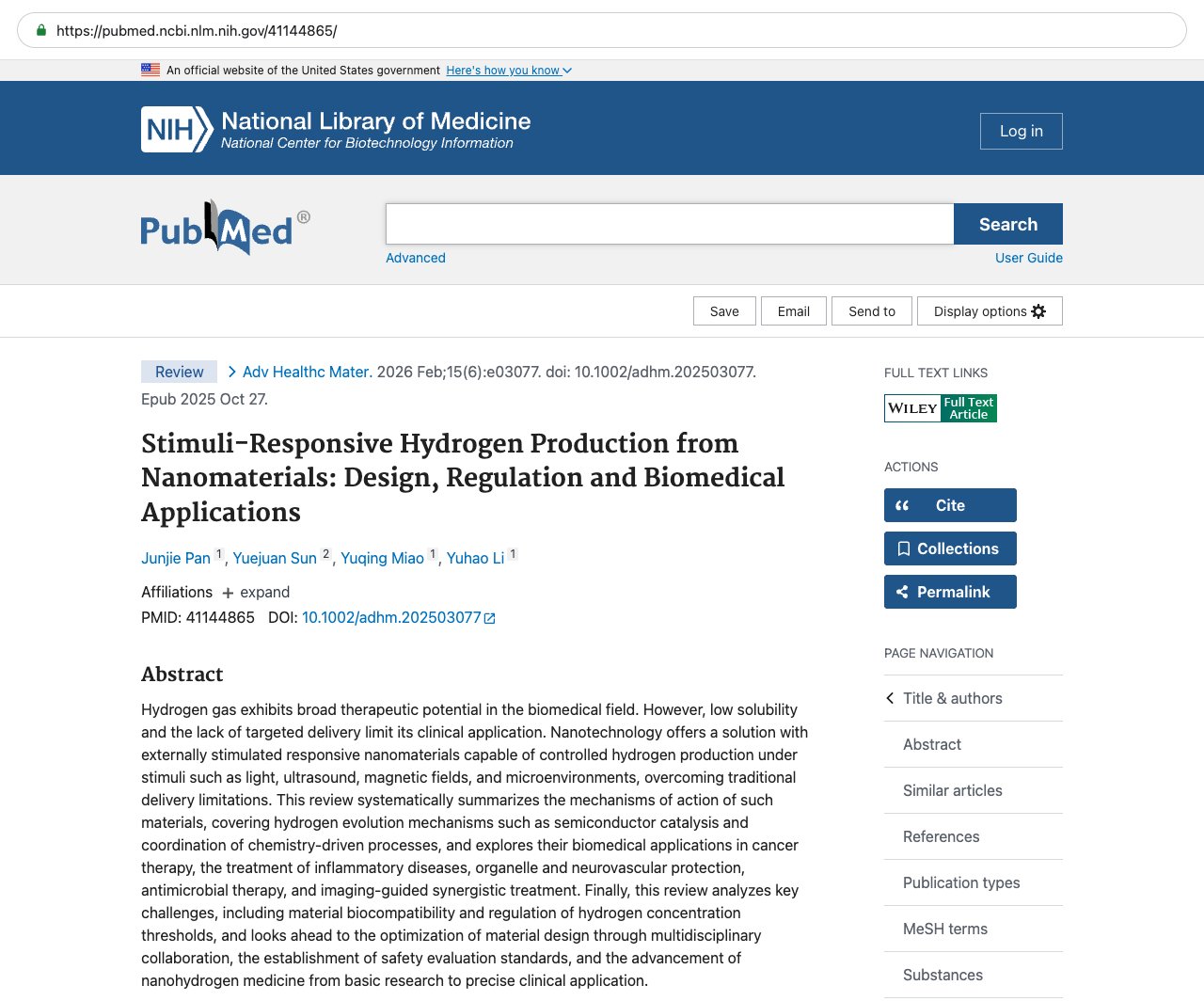
Hydrogen gas exhibits broad therapeutic potential in the biomedical field. However, low solubility and the lack of targeted delivery limit its clinical application. Nanotechnology offers a solution with externally stimulated responsive nanomaterials capable of controlled hydrogen production under stimuli such as light, ultrasound, magnetic fields, and microenvironments, overcoming traditional delivery limitations. This review systematically summarizes the mechanisms of action of such materials, covering hydrogen evolution mechanisms such as semiconductor catalysis and coordination of chemistry-driven processes, and explores their biomedical applications in cancer therapy, the treatment of inflammatory diseases, organelle and neurovascular protection, antimicrobial therapy, and imaging-guided synergistic treatment. Finally, this review analyzes key challenges, including material biocompatibility and regulation of hydrogen concentration thresholds, and looks ahead to the optimization of material design through multidisciplinary collaboration, the establishment of safety evaluation standards, and the advancement of nanohydrogen medicine from basic research to precise clinical application.
Source & links
Screenshot of the PubMed page
This page mirrors the published abstract (© the authors / publisher) for reference and citation. The canonical source is the PubMed record linked above. This is not medical advice.