2025 · Li — Application Trends of Hydrogen-generating Nanomaterials for the Treatment of ROS-related Diseases
Super-Abstract
Hydrogen-producing nanomaterials allow targeted, sustained delivery of H₂ directly to sites of disease — this review surveys how combining H₂ gas therapy with nanomedicine advances treatment of cancers, neurodegeneration, cardiovascular, liver, kidney, and skin diseases driven by excess reactive oxygen species (ROS). The nanoparticle-based approach overcomes key limitations of conventional inhalation or drinking-water routes. (Biomaterials Science, 2025.)
Commentary
Excess ROS is a shared pathological driver across a surprisingly diverse set of diseases. Li et al. frame H₂'s antioxidant selectivity — it preferentially neutralises the most destructive ROS species (hydroxyl radicals, peroxynitrite) without disrupting signalling-relevant ROS — as the scientific rationale for hydrogen therapy. The novelty of this review lies in its focus on nanomaterial delivery systems: Mg-based nanoparticles, metal-organic frameworks, and other engineered carriers that control where and when H₂ is released. This is almost entirely preclinical territory. The majority of studies cited use mouse or rat models; in-vitro cell work features prominently. No human data are discussed. The practical gap between a nanomaterial tested in a mouse tumour model and a clinically approved therapy is vast, and the authors acknowledge that translation remains a future challenge. Nonetheless, the mechanistic insight and engineering creativity on display here represent a genuinely emerging research frontier.
Key quotes
- „Hydrogen gas effectively removes ROS from the body due to its good antioxidant properties, and hydrogen therapy has become a promising gas therapy strategy due to its inherent safety and stability.“ — rationale for H₂ as a gas therapy platform
- „The combination of nanomaterials can achieve targeted delivery and effective accumulation of hydrogen, and has some ameliorating effects on diseases.“ — the core added value of nano-based H₂ delivery
- „Herein, we summarize the use of hydrogen-producing nanomaterials for the treatment of ROS-related diseases and talk about the prospects for the treatment of other ROS-induced disease models, such as acute kidney injury.“ — scope and forward-looking intent of the review
Our assessment
This is a preclinical review — all discussed disease models are animal or cellular; no human data are presented or claimed. The engineering concepts are innovative, but the path from a nanoparticle-delivered H₂ system in a mouse model to a clinical therapy is long and uncertain. The review is valuable as a research-landscape overview for scientists, not as a basis for therapeutic claims. Readers should note the inherent publication bias toward positive animal results.
Study design
- Type: narrative review of preclinical studies · n: n/a (literature analysis) · H₂ delivery: nanomaterial-based H₂ generation (Mg nanoparticles, metal-organic frameworks, and other engineered carriers)
- Result: no pooled effect sizes; survey of hydrogen-generating nanomaterials showing in-vitro and in-vivo efficacy in animal models of cancer, neurodegeneration, cardiovascular, liver, kidney, skin, and joint diseases driven by excess ROS; clinical translation is acknowledged as an open challenge
Abstract
Reactive oxygen species (ROS) play essential roles in both physiological and pathological processes. Under physiological conditions, appropriate amounts of ROS play an important role in signaling and regulation in cells. However, too much ROS can lead to many health problems, including inflammation, cancer, delayed wound healing, neurodegenerative diseases (such as Parkinson's disease and Alzheimer's disease), and autoimmune diseases, and oxidative stress from excess ROS is also one of the most critical factors in the pathogenesis of cardiovascular and metabolic diseases such as atherosclerosis. Hydrogen gas effectively removes ROS from the body due to its good antioxidant properties, and hydrogen therapy has become a promising gas therapy strategy due to its inherent safety and stability. The combination of nanomaterials can achieve targeted delivery and effective accumulation of hydrogen, and has some ameliorating effects on diseases. Herein, we summarize the use of hydrogen-producing nanomaterials for the treatment of ROS-related diseases and talk about the prospects for the treatment of other ROS-induced disease models, such as acute kidney injury.
Source & links
Screenshot of the PubMed page
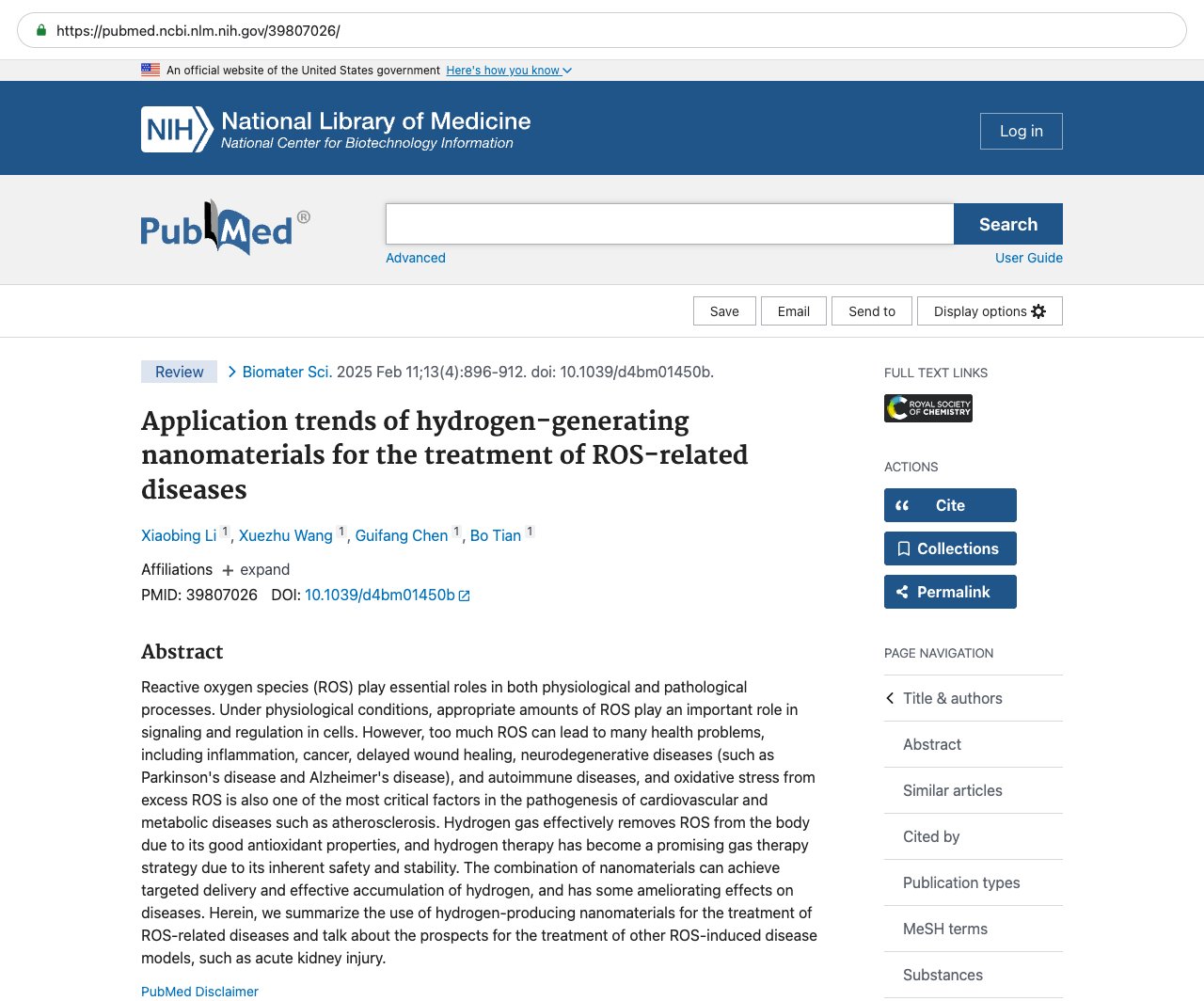
This page mirrors the published abstract (© the authors / publisher) for reference and citation. The canonical source is the PubMed record linked above. This is not medical advice.